
Every successful seller eventually says the same sentence: this needs to become a real brand. Fewer say the second sentence out loud, the one that makes the first necessary: because right now, it is a listing.
There is no shame in that. Amazon is the fastest place on earth to turn a good product into revenue, and it asks for nothing up front except the fees. But it builds everything in its own name. The customer is Amazon's, the traffic is Amazon's, the trust is Amazon's. A brand is the part you build in yours.
This is the pillar guide for that build. It defines what the move actually is, walks the four layers in the order they should go up, and names the mistakes that stall sellers halfway. The layers each get their own deeper guides, linked as you go, and the thinking behind all of it is The Push Concept.
What Building a Brand Beyond Amazon Means
Start with the definition, because the phrase gets used loosely. Building a brand beyond Amazon means creating the assets that exist outside the marketplace and belong to you: a website that is the brand's home, an audience you can reach without renting access, demand that finds you instead of your category, and a reputation that travels with the name.
Notice what the definition does not say: leave Amazon. The marketplace stays exactly where it is, doing what it does brilliantly. The move adds an owned layer to the business. The full inventory of what stays Amazon's if you never build that layer is on What You Don't Own.
The distinction that carries this whole guide is listing versus brand. A listing is a product page with reviews and a rank, all of it attached to Amazon's domain and Amazon's customer. A brand is a name people search for, a place they can find, and a relationship that persists between purchases. Revenue does not convert one into the other. Assets do.
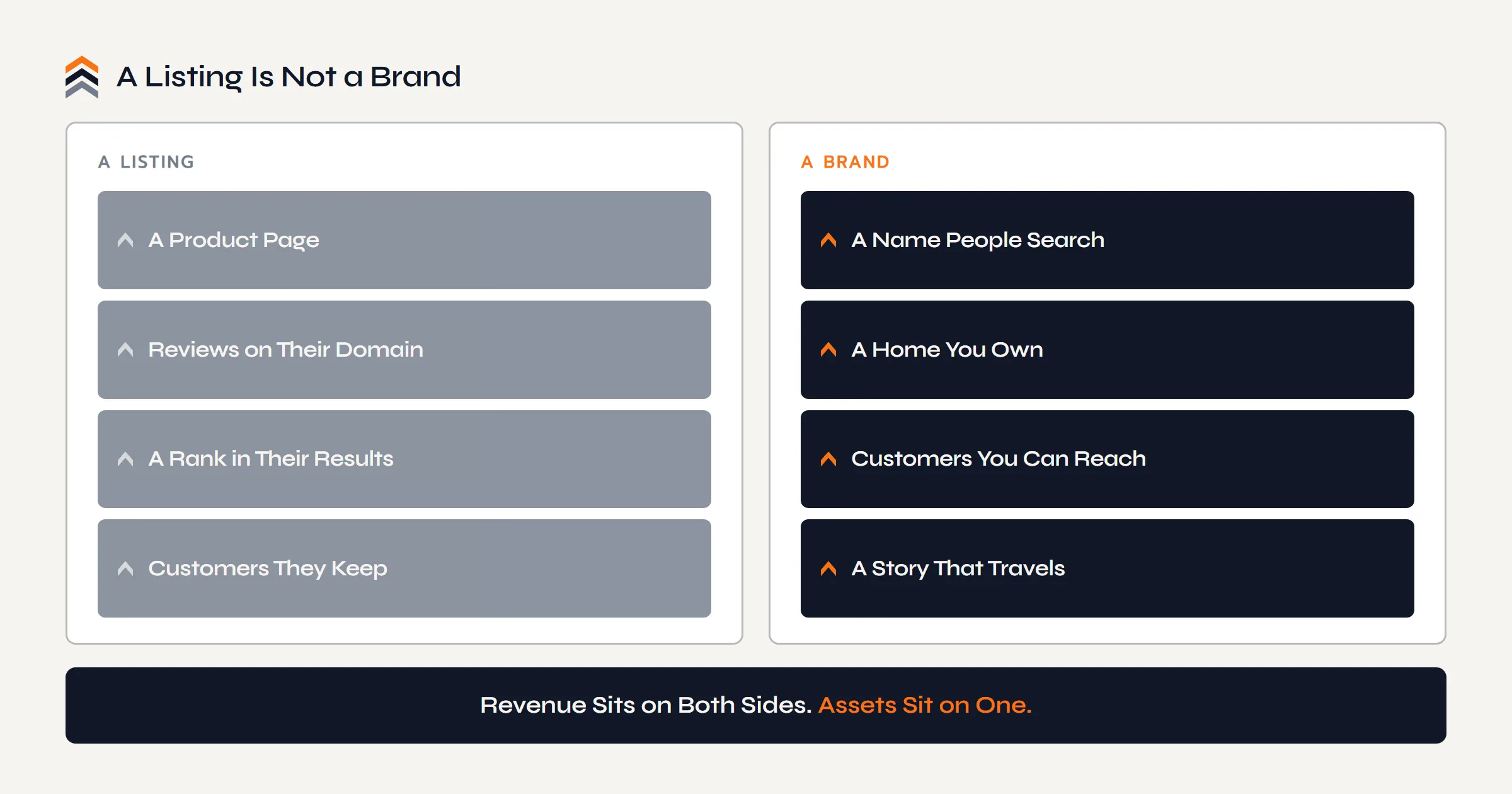
A brand you cannot move is a listing with a logo.
Why Sellers Make the Move
Sellers rarely make this move for romantic reasons. They make it because four outcomes turn out to be impossible to buy on the marketplace at any ad spend:
- Owning the customer. Amazon has sold your product to thousands of people and kept every name. A brand collects its own, and can reach them for the price of pressing send.
- Keeping the margin. Referral fees, fulfillment, and climbing ad costs take their share of every marketplace order. Direct orders answer to no fee schedule but your own.
- Demand from Google. Searches for your brand and your product category happen off Amazon every day. A brand owns the answer to them; a listing watches them land elsewhere.
- Equity that transfers. When a business sells, buyers pay for assets that move: the site, the list, the rankings, the story. Marketplace history transfers thin.
If you are still weighing whether those four justify a second channel, the honest comparison is Selling on Amazon vs Selling on Your Own Website. If the exposure worries you more than the upside, start from the risk end with Reducing Amazon Dependence. Both roads arrive at the same build.
Amazon can build you a revenue stream. It will never build you a brand.
The Move, Layer by Layer
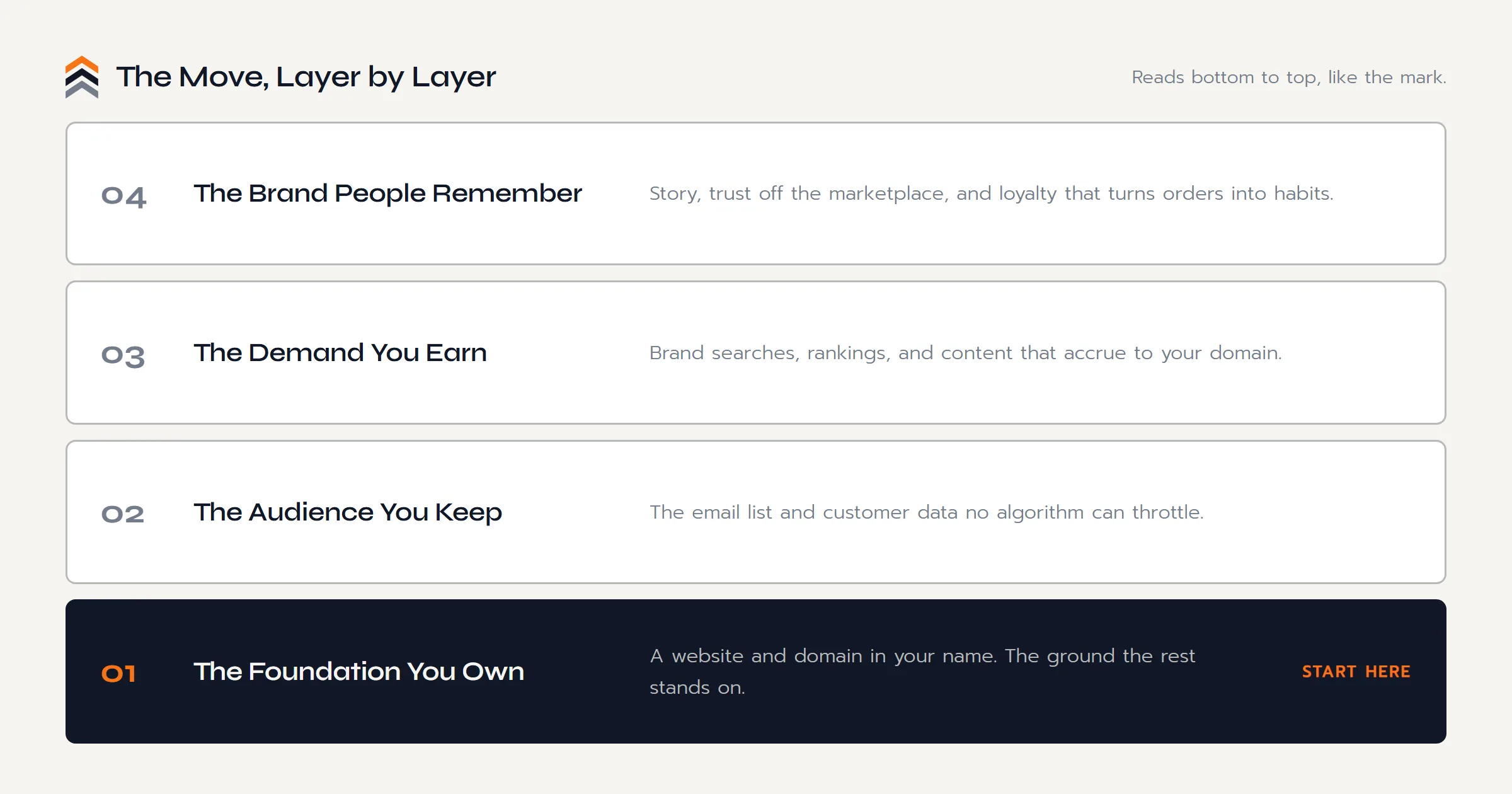
The build has four layers, and the order is not a style preference. Each layer gives the next one somewhere to live: the audience needs a home, the demand needs a destination, the story needs all three underneath it.
Bottom up: the foundation is the website and the domain. The audience is the email list and customer data that live on it. The demand is the search presence and content that pull people toward it. The brand layer is the story, trust, and loyalty that make them stay. The next four sections take them in that order.
An Honest Note
The map is four layers. The build is not four projects at once:
- Year one is mostly the bottom two. Foundation and audience are the build; demand and the brand layer are the compounding that grows on top of them.
- The foundation is a project. The other three are habits. Budget money for the first and attention for the rest.
- If the business is still proving its first product, wait. The marketplace deserves your full focus until there is a brand worth building around.
Build the bottom, grow the top. Nothing on this map requires leaving Amazon.
Layer One: The Foundation You Own
The foundation is a website you own outright, on a domain in your name. Not a link-in-bio page, not a social profile, not a marketplace storefront: a home whose rules nobody else writes and whose rent nobody else can raise.
Its job list is longer than most sellers expect. It is where brand searches land and convert instead of feeding a competitor's ad. It is the container for email capture and, when the numbers justify it, the direct checkout. And it is the proof, to customers and to any future buyer of the business, that the brand exists as more than a seller account.
Two decisions do most of the work at this layer, and each has its own guide. Whether your business is ready for a site at all is answered honestly in Do Amazon Sellers Need Their Own Website? What ground the site stands on is answered in Choosing Your Platform: WordPress vs Shopify vs Wix. The short version of the second: you are leaving rented ground, so do not rebuild on it.
This layer is the one we build for a living. Our packages are tiered exactly this way: brand home first, store when the business calls for it, ownership handed over either way. And if the word migration is what has kept this layer on next year's list, Amazon to Your Own Store retires it: nothing moves, everything extends.
Layer Two: The Audience You Keep
The second layer answers the marketplace's loudest silence: Amazon has never once told you who your customers are. An audience you keep starts as an email list and matures into first-party data, names, preferences, and purchase history, all held by you under your own terms.
The list starts working absurdly early. A few hundred subscribers is already a launch audience for your next product, a repeat-order channel with no acquisition fee attached, and a relationship no algorithm can throttle. It is also the asset a future buyer of the business trusts most, because it is the one that provably transfers. The full mechanics of turning Amazon shoppers into loyal brand fans get their own guide.
Capture starts the day the foundation goes live: every visitor, every direct order, every touchpoint the rules let you speak through, all feeding the same list. Waiting a year to add the form is the quietest expensive mistake on this map.
How Much of Your Business Do You Actually Own?
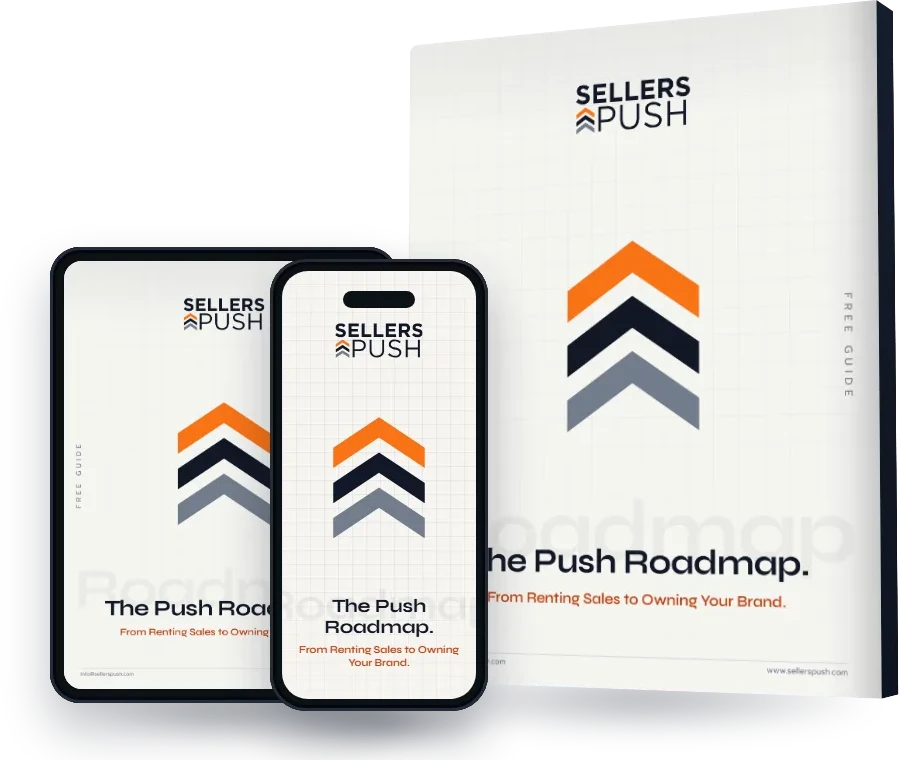
The four layers are the map. The Push Roadmap is the free 12 page PDF that scores your starting point: run the Ownership Scorecard, see which layers already exist, and get the move mapped in order.
Sent straight to your inbox.
Layer Three: The Demand You Earn
The third layer turns the foundation from a brochure into a destination. Off-Amazon demand arrives three ways: people searching your brand by name, people searching the problem your product solves, and shopping surfaces like Google Shopping listing your products beside the marketplace's.
Brand-name search is the first win and the cheapest. That demand already exists, earned by every order you have ever shipped, and right now it resolves to a listing surrounded by competitors' ads. The foundation claims it the week it goes live.
Category and problem search is the compounding win. Content and product pages that rank accrue to your domain quarter after quarter, the closest thing ecommerce has to owned real estate. It moves slower than PPC, and it never sends a bill per click. The whole discipline, translated for a seller who already optimizes listings, is Ecommerce SEO Basics for Your Brand Website; what those pages should actually say is Content Marketing for Amazon Sellers.
Each of those routes has its own guide on this shelf, and even the traffic you send back to Amazon routes better through ground you own. At map level, the principle they share is the only thing that matters: demand earned on your own domain cannot be repriced by anyone.
Layer Four: The Brand People Remember
The top layer is the one that makes customers stay: the story of why the brand exists, the trust that lives off the marketplace, reviews on your own pages, press, community, and the loyalty loops that turn a first order into a habit.
It is also the layer sellers most often mistake for the whole job. A logo refresh and a brand story page, floating on rented ground, change nothing. Built on top of a foundation, an audience, and demand, they change what the business is worth, because they are what people are buying when they pay a premium for a brand.
A Quick Test
The brand test. Four questions that measure the top layer:
- Do buyers search your brand by name, or only your category?
- Could a customer say why your brand exists in one sentence?
- Does any of your reputation live on ground you control?
- Do repeat buyers come back to you, or just to the marketplace?
A listing can fail all four and keep selling. A brand answers all four, and is worth more because of it.
The Mistakes That Stall the Move
Most stalled moves are not defeated by competition. They stall from the inside, usually in one of three ways.
- Building all four layers at once. A store, a content plan, an ad budget, and a rebrand in the same quarter usually ends with everything half-built and nothing compounding. The map has an order because the order works.
- Treating the website as only a checkout. A checkout with no audience and no demand is a store on a street nobody walks. The foundation's first job is the brand home; direct selling grows into it.
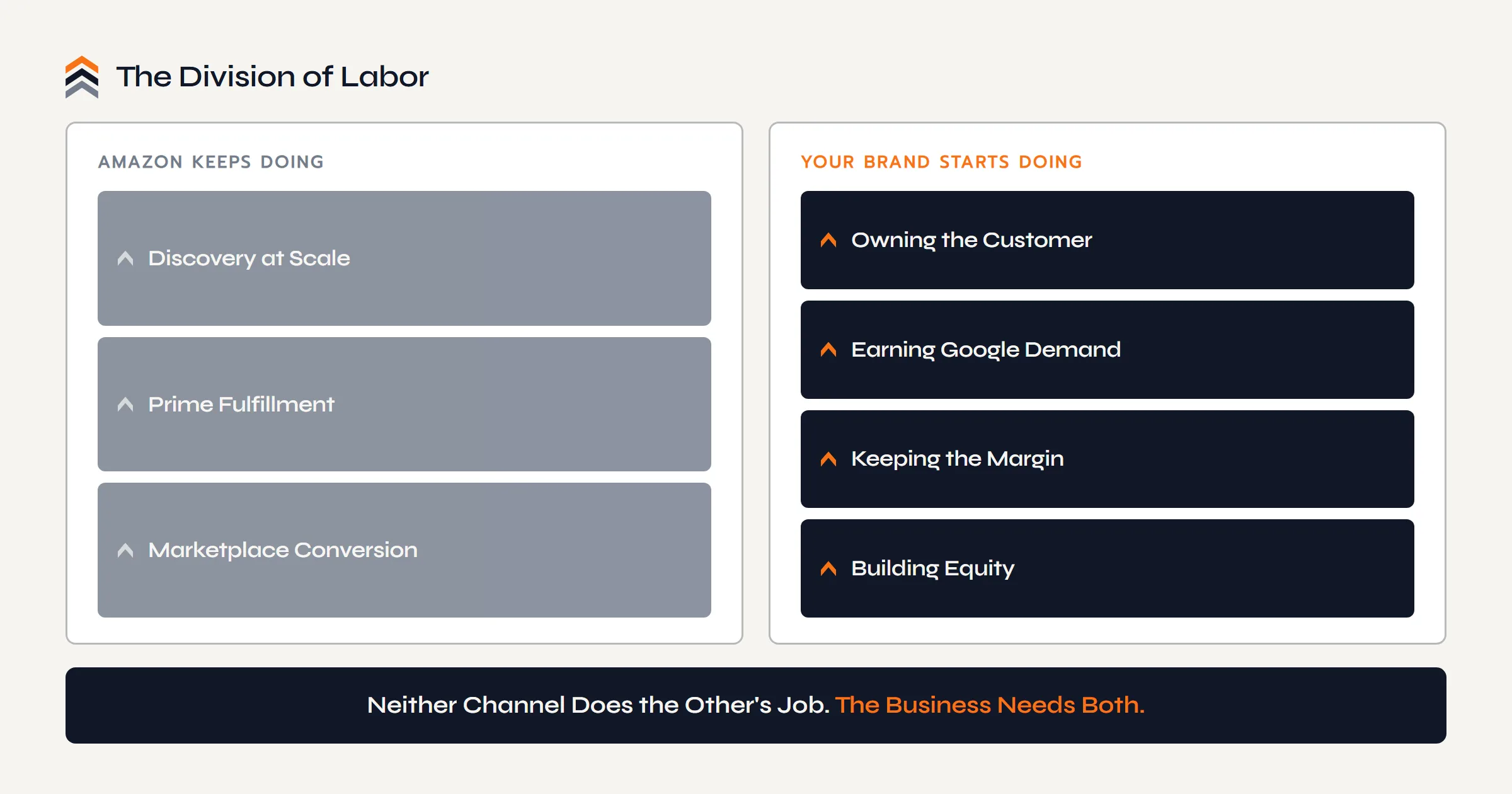
- Pausing Amazon to focus. The marketplace is the funding for the entire build. Cutting it starves the move and reintroduces the exact risk it exists to retire. The two channels have different jobs, and they are better at them together.
The common thread is impatience with the sequence. Our own process exists mostly to protect the build from these three.
Questions Sellers Ask
Can You Build a Real Brand While Still Selling on Amazon?
Yes, and it is the standard route, not the workaround. The marketplace funds the build and keeps doing what it does best while the owned layers go up beside it. The channels feed each other: a brand people find on Google earns the branded searches Amazon's algorithm rewards, and marketplace customers who love the product go looking for the brand behind it.
What Is the Difference Between a Private Label and a Brand?
A private label is a product wearing your name on someone else's shelf. A brand is a name that carries its own demand: people search it, a home answers them, an audience hears from it, and a story travels with it. The label becomes a brand the day its assets start existing off the marketplace, which is exactly what the four layers in this guide build.
What Does It Cost to Build a Brand Beyond Amazon?
Think in shapes rather than one number. The foundation is a one-time build plus commodity hosting; our prices are public on the Services page. The audience and demand layers cost more attention than money: capture running from day one, content published consistently. The expensive version of this move is the one done twice because the first attempt skipped the order.
Does Brand Registry Mean I Already Own My Brand?
Brand Registry is worth having and worth being precise about. It protects your listings on Amazon: your content, your storefront, your defense against hijackers, backed by your trademark. What it does not create is anything off the marketplace. It guards your presence on Amazon's property; this guide is about building property of your own. A registered brand with no owned layer is still a listing.
What Should I Build First?
The foundation, with email capture live from its first day. Those two move together: the site gives the brand a home and the list starts filling the moment it exists. Demand work begins once there is a destination worth ranking, and the brand layer grows across all of it. One layer at a time, in order, beats four layers at once in every version we have seen.
How Long Does the Whole Move Take?
There is no honest finish date, because the top layers never really finish: demand and brand keep compounding for as long as they are fed. What can be said is that each layer starts paying the day it exists. The site answers brand searches immediately, the list is useful from its first hundred names, and rankings build from whenever the content starts. Start of the sequence matters far more than speed.
Is It Worth It for a Brand With Only a Few Products?
Often more so. Small catalogs make the cleanest moves: one clear story, one hero product for the site to showcase, one audience to build. Some of the strongest consumer brands run on a handful of products and a deep relationship with the people who buy them. Equity is not a function of SKU count; it is a function of what you own around the products you have.
The Conclusion
Building a brand beyond Amazon is not a departure. It is a promotion. The listing keeps its job, the revenue keeps flowing, and the business gains an identity that exists outside anyone's marketplace.
The map is four layers in one order: the foundation you own, the audience you keep, the demand you earn, the brand people remember. Each one starts paying the day it exists. Each one compounds. And not one of them requires touching your Amazon sales, because the move was never about where you sell. It is about what you own while you sell there. If you want that as a number before you start, the free Amazon Ownership Score gives you one in ten questions.
Your sales can live on Amazon. Your brand should not.
The Next Move
You Have Read the Argument.
Pick Your Path.
Ready to Build
A free call, no pitch script. Walk us through your Amazon business and get a straight answer on what your own site would take.
Book a Free CallStill Weighing It
The Push Roadmap is the free PDF version of this decision. Put a number on where your brand stands before you commit to anything.