
Here is the final guide in this series, and it points in a direction the other fourteen might not lead you to expect: back toward Amazon. Driving outside traffic to your listings is a real, legitimate, marketplace-approved play. Amazon wants the demand you bring, rewards it, and in one program actually pays you for it.
But there is a decision hiding inside the play, and most sellers never notice they are making it. Every external click needs a destination, and the destination determines who keeps the customer when the sale is done. Sent straight to the listing, the click buys a sale. Routed through ground you own, the same click buys the sale and the beginning of everything the rest of this library is about.
So this guide does both jobs honestly: how external traffic works and where to find it, and then the routing question that turns a marketing expense into an asset.
Why Amazon Rewards Traffic You Bring
The mechanics are unmysterious. A shopper arriving from outside is demand Amazon did not have to generate: they land already interested, they convert well when the traffic is honest, and every sale they make adds to the velocity the ranking algorithm feeds on. Sellers have watched outside traffic help listings climb for years, and while Amazon has never published the equation, it has said the important part out loud with its wallet.
That statement is the Brand Referral Bonus: Brand Registered sellers earn back a percentage of sales driven from outside the marketplace, tracked through Amazon Attribution links. The details and rates are Amazon's to change, so read the current terms before building around them, but the signal does not move: the marketplace values the traffic you bring enough to pay for it. Very few landlords offer a rebate for bringing your own guests. This one does, and it is worth collecting.
Where External Traffic Actually Comes From
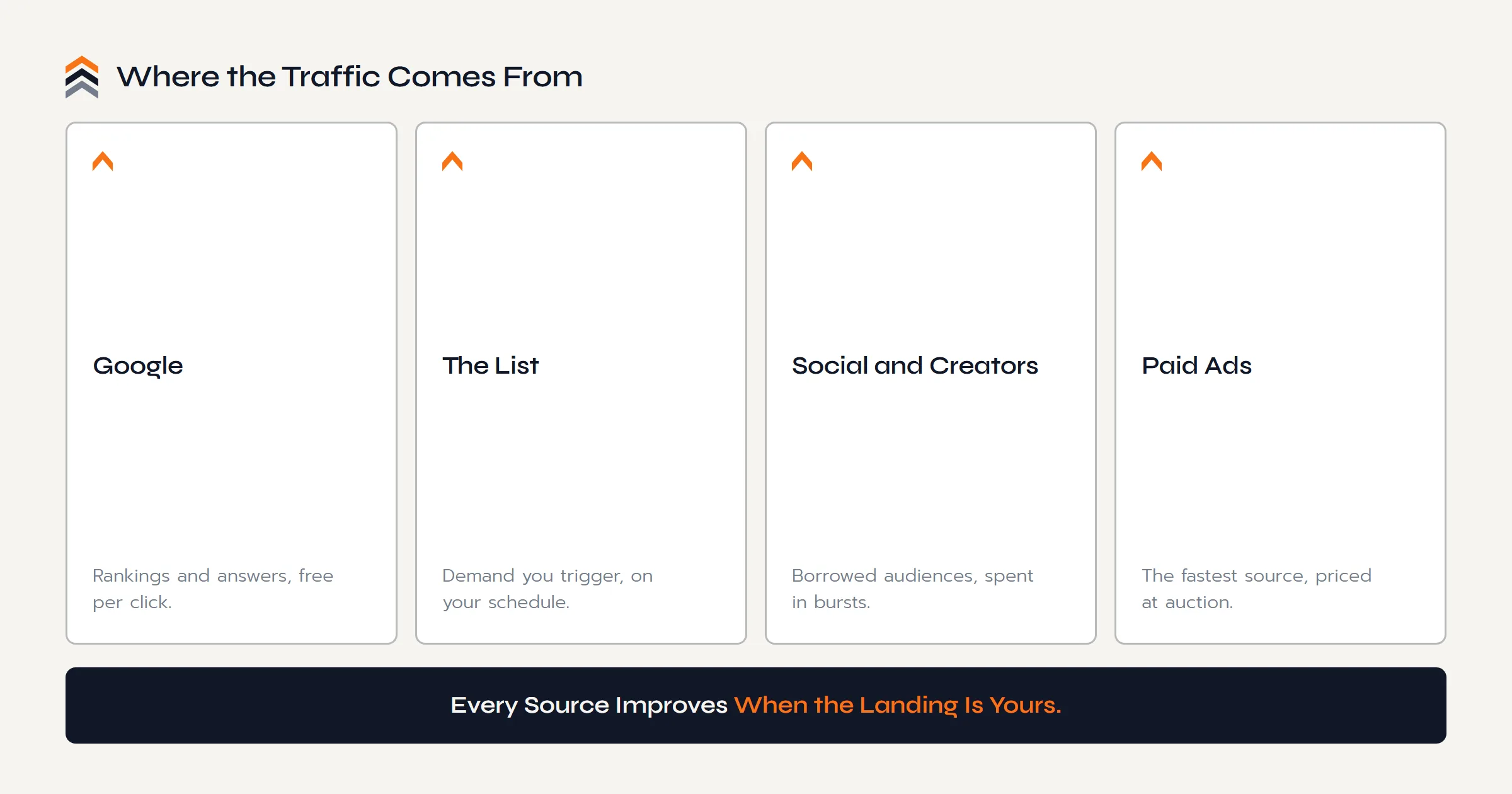
Strip away the growth-hack listicles and a product brand has four honest sources, every one of them covered somewhere in this library:
- Google. The rankings your pages earn and the answers you publish pull searchers in every day, free per click. The demand arrives at your domain, and where it goes next is yours to route.
- The list. Demand you trigger, on your schedule. A send on launch day is external traffic of the highest intent there is, aimed wherever you point it.
- Social and creators. Borrowed audiences, honestly borrowed: a creator's mention or a post that lands sends real buyers. The feed forgets fast, which makes where you send that burst matter more, not less.
- Paid ads. The fastest source and the most expensive, priced at auction and gone when the budget stops. Ads are a skill and a budget, not a hack, and running them is a discipline of its own; this guide's concern is the destination they deserve.
The Destination Decision
Now the part the listicles skip. Point that traffic straight at the listing and look at what happens after the click. The sale completes, which is real. And then: the customer lands as Amazon's, for all the reasons the loyalty guide spelled out. No pixel of yours saw the visit, so there is nothing to retarget and nothing to measure. The email capture never had its chance. The spend bought a transaction on ground where you cannot even say thank you.
Route the same click through a page you own and the arithmetic changes without the sale being lost. The visitor meets the brand at full strength, story and proof instead of a template. Your analytics see everything, so the next campaign is smarter than this one. The email form makes its offer. And the buyer still reaches Amazon in one click if that is their checkout of choice, through an attribution link that keeps the bonus and the ranking credit intact. The toll for that detour is honest: a second page adds a step, and a step costs some clicks. What the step buys is every asset this library spent fourteen guides on.
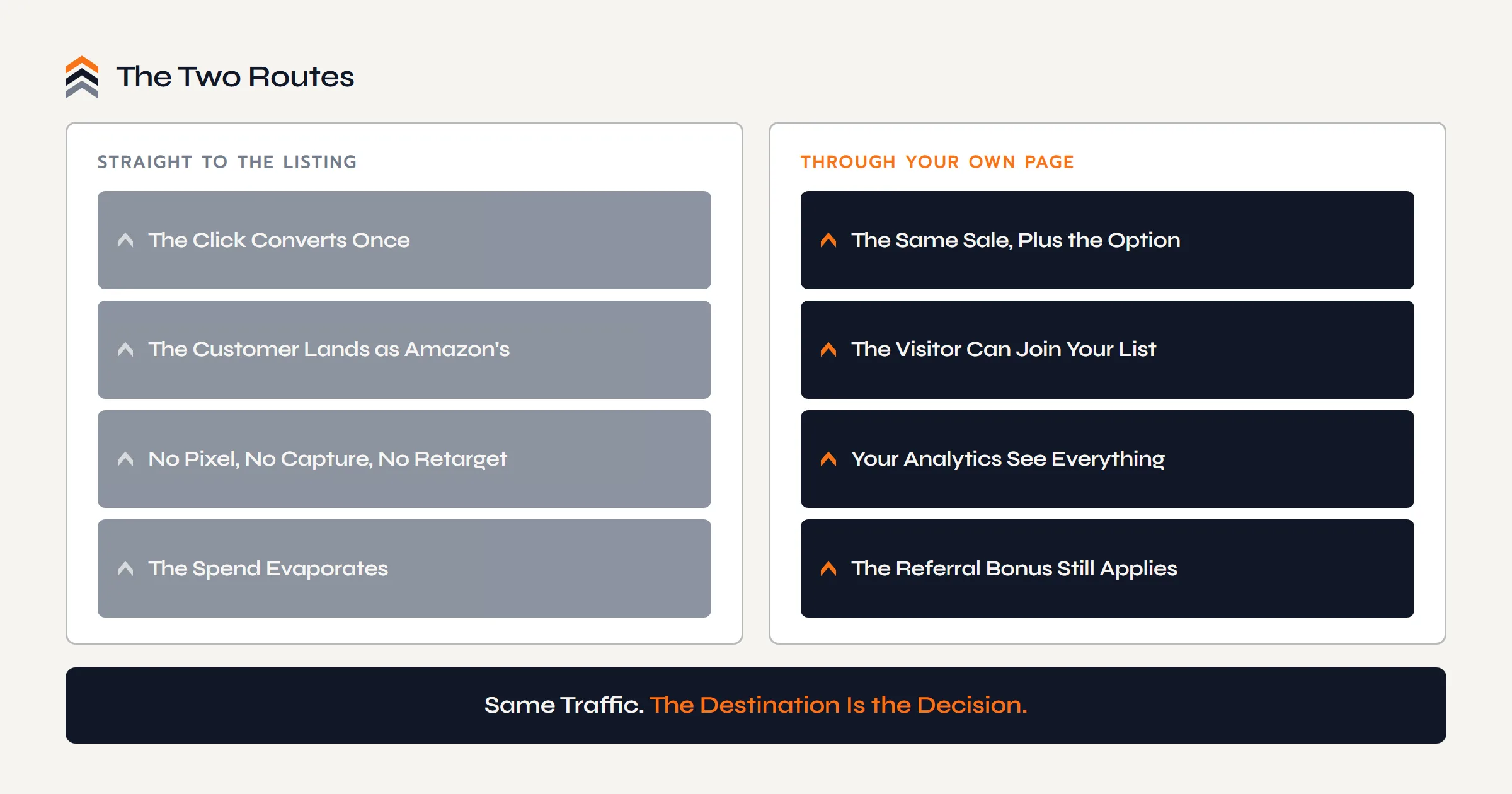
Straight to the listing, the spend buys a sale. Through your page, it buys a sale and a customer.
A Quick Test
The routing test. Three questions about the traffic you already drive:
- Think of your last off-Amazon effort, a post, a send, an ad. Where exactly did the click land?
- If a creator mentions you tomorrow morning, what URL do you hand them?
- Of all the visitors you have ever paid for, how many can you reach again today?
If every answer is the listing: the routing has been deciding for you.
How Much of Your Business Do You Actually Own?
The destination you own is the asset. The Push Roadmap is a free 12 page PDF with the Ownership Scorecard: score where your brand stands today and see the move to owned ground mapped out.
Sent straight to your inbox.
The Bridge Page (What It Is, What It Does)
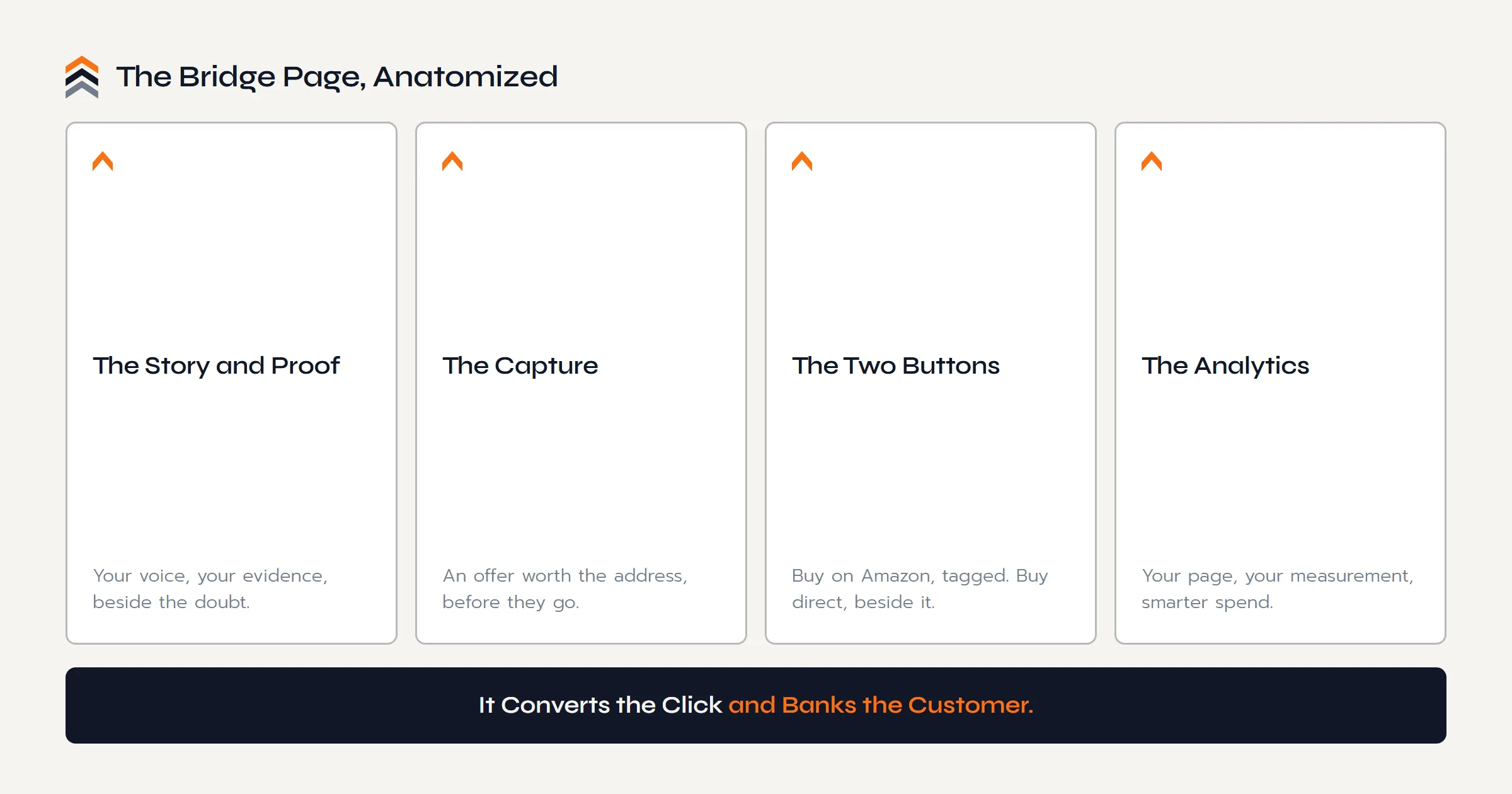
The mechanism has an unglamorous name and a simple anatomy. A bridge page is a page on your domain built to receive outside traffic for one product or one offer, and it carries four things:
- The story and the proof. The product presented in your voice with the evidence beside it: the stand, the specifics, the testimonials placed where the doubt lives. Everything the template forbids, working for the click you paid for.
- The capture. An email offer worth the address, so the visitor who is not ready today is not lost forever. Even a modest capture rate turns ad spend into list growth.
- The two buttons. Buy on Amazon, through an attribution link that keeps the bonus and the credit, and buy direct, for the customer who prefers your checkout. The buyer chooses; either way the brand wins.
- The analytics underneath. Your page, your measurement. Which source converts, which creator sends buyers, which headline holds attention: the questions ads never answer when they point at a listing.
If the anatomy sounds familiar, it should: it is a product page on a proper brand site doing its ordinary work. Building pages that receive traffic this way is what we build, not as a funnel bolted onto a brand, but as the brand's home doing its job.
When Direct to the Listing Is Right
Honesty due, because the answer is not always the bridge. Launch week, when velocity is the entire game, is a fair time to send everything straight at the listing and let the algorithm see the surge. Deal events reward it too: traffic arriving during Prime Day wants the badge, the countdown, and the deal price, and a detour costs more than it banks. And a seller with no site yet has no bridge to route across; if that is you, this guide is simply fifteenth in a series that starts one question earlier.
The principle is deliberateness. Route by default and the default quietly decides your asset sheet. Route by intention, velocity to the listing when velocity is the goal, relationship through the bridge when the brand is the goal, and every click serves the plan instead of the habit.
An Honest Note
Three limits, before traffic gets treated as the answer to everything:
- Traffic multiplies the destination. It cannot fix a listing that does not convert, and low-intent clicks actively hurt, because conversion rate is rank fuel.
- Ads are a budget and a craft, not a hack. Running them well is its own discipline. We build the ground they land on; we do not sell the campaigns.
- Nobody can promise the rank effect. The mechanism is real and the schedule is not yours to set. Anyone quoting a timeline is quoting a guess.
Send better traffic, not just more. And own where it lands.
Questions Sellers Ask
Does External Traffic Really Help Amazon Rankings?
The honest version: sellers have observed it for years, Amazon has never published the math, and the marketplace pays a bonus for referred sales, which is as close to a yes as a platform gets. What is certain is the mechanism: outside traffic that converts adds sales velocity, and velocity is what rankings eat. What nobody honest will give you is a number or a date.
What Is the Brand Referral Bonus?
Amazon's program that returns a percentage of sales you drive from outside the marketplace, for Brand Registered sellers, tracked through Amazon Attribution links. It effectively discounts your referral fees on traffic you brought yourself. The rates and rules are Amazon's and they move, so read the current terms; the principle worth keeping is that routed properly, the bridge does not cost you the bonus.
Should Ads Point at My Listing or My Website?
Decide by goal, not by habit. Chasing launch velocity or a deal event: the listing, directly. Building the brand with every dollar doing double work: the bridge, so the click converts and the customer has a chance of being yours. Most established brands run both deliberately, and the ones that regret their spend are almost always the ones that never chose.
What Is a Bridge Page in Plain Terms?
A page on your own domain that receives outside traffic for one product or offer: the story and proof in your voice, an email capture worth the address, a buy-on-Amazon button carrying an attribution link, and a buy-direct button beside it. In practice it is simply a good product page on a real brand site, pointed at by your campaigns instead of discovered by luck.
Do I Have to Run Paid Ads at All?
No. Ads are the fastest source, not the only one. Rankings and published answers pull traffic free per click, the email list is external traffic you trigger at will, and creator mentions arrive on relationship rather than budget. Plenty of brands build the whole flywheel before spending an ad dollar. Ads accelerate a machine; they are a poor substitute for one.
Will Selling Direct Hurt My Amazon Rank?
A direct sale is one the marketplace never sees, so it adds nothing to listing velocity; that much is arithmetic. It is not harm, it is diversification, and the dependence guide makes the longer case: revenue that arrives through a second door is the point, not a leak. Brands that win run both channels on purpose and let each do what it does best.
Can I Retarget People Who Visited My Listing?
No. The listing runs no pixel of yours and never will; visitors who bounce off it are gone. That is precisely the leak the bridge closes: on your own page, your analytics see the visit and, within privacy rules and honest consent, the campaign can find those people again. It is one of the quietest but largest differences between the two destinations.
Where Should a Creator or Influencer Link?
Your page, almost always. A creator's audience is borrowed for one burst, and the burst is spent the moment it lands; the bridge turns some of it into subscribers and repeat visitors instead of a single spike on someone else's ledger. The exception is a deal-event push built around the badge and the countdown. Otherwise: hand every creator the URL you own.
The Conclusion
Fifteen guides ago, this library opened with what sounded like a choice: selling on Amazon or selling on your own website. Every guide since has answered the same way from a different angle, and the last one, the guide about sending traffic back to the marketplace, lands there too. Keep the sales wherever they convert best. Put the assets, the address, the audience, the memory, the proof, on ground you own.
So drive the external traffic. The marketplace rewards it, the algorithm feeds on it, and the brand needs it. Just route it like an owner: through the page that captures, remembers, and offers a choice, toward whichever checkout serves the customer best that day. The map underneath that page is the complete guide to building your brand beyond Amazon, and the library you have just finished is the whole argument, made honestly, fifteen times.
Your sales can live on Amazon. Your brand should not.
The Next Move
You Have Read the Argument.
Pick Your Path.
Ready to Build
A free call, no pitch script. Walk us through your Amazon business and get a straight answer on what your own site would take.
Book a Free CallStill Weighing It
The Push Roadmap is the free PDF version of this decision. Put a number on where your brand stands before you commit to anything.