

Somewhere between the inventory reorder and the PPC report, someone has told you to start a blog. The advice usually arrives with a straight face and no further instructions, and it deserves the sigh it gets. You sell physical products. You are not a magazine.
Here is the version of content marketing that survives contact with a real Amazon business: it is answering the questions your buyers already ask, in public, on ground you own. Not volume. Not posting for the algorithm's sake. Answers, wearing your brand name, at the address where the asker can find them.
And you are closer to it than you think, because you have been writing those answers for years. You have just been writing them one buyer at a time, in places that keep them.
What Content Marketing Actually Is
Drain the term the way we drained brand storytelling, and this is what is left: content marketing is publishing the most useful answer to a question your customers actually ask, so that being helpful and being found become the same act. For a product seller that means buying guides, honest comparisons, care instructions, and the story behind the product. It does not mean industry news, trend commentary, or a post every Tuesday because a calendar said so.
On the map of the full move, content sits where the demand layer meets the brand layer. It pulls searchers toward your domain, and it is how the brand behaves in public between purchases: useful before the sale, interesting after it. One test covers everything this guide will recommend: would a buyer thank you for it? If the honest answer is no, it is filler, whatever the keyword tool says.
You Already Make Content All Day
Take an inventory of last month. The buyer messages you answered. The reviews you replied to. The questions on the Q&A tab. The bullets and A+ modules you sharpened until they explained the product properly. Every one of those is content: an answer, researched by experience, written by the person who knows the product best.
Now look at where those answers live. Buried in a Q&A tab nobody scrolls. Locked inside a messaging system built for order problems. Attached to one listing, in one store, under someone else's terms. Each answer helped exactly one person, and the next buyer with the same question makes you write it again. The marketplace keeps the surface; the work evaporates.
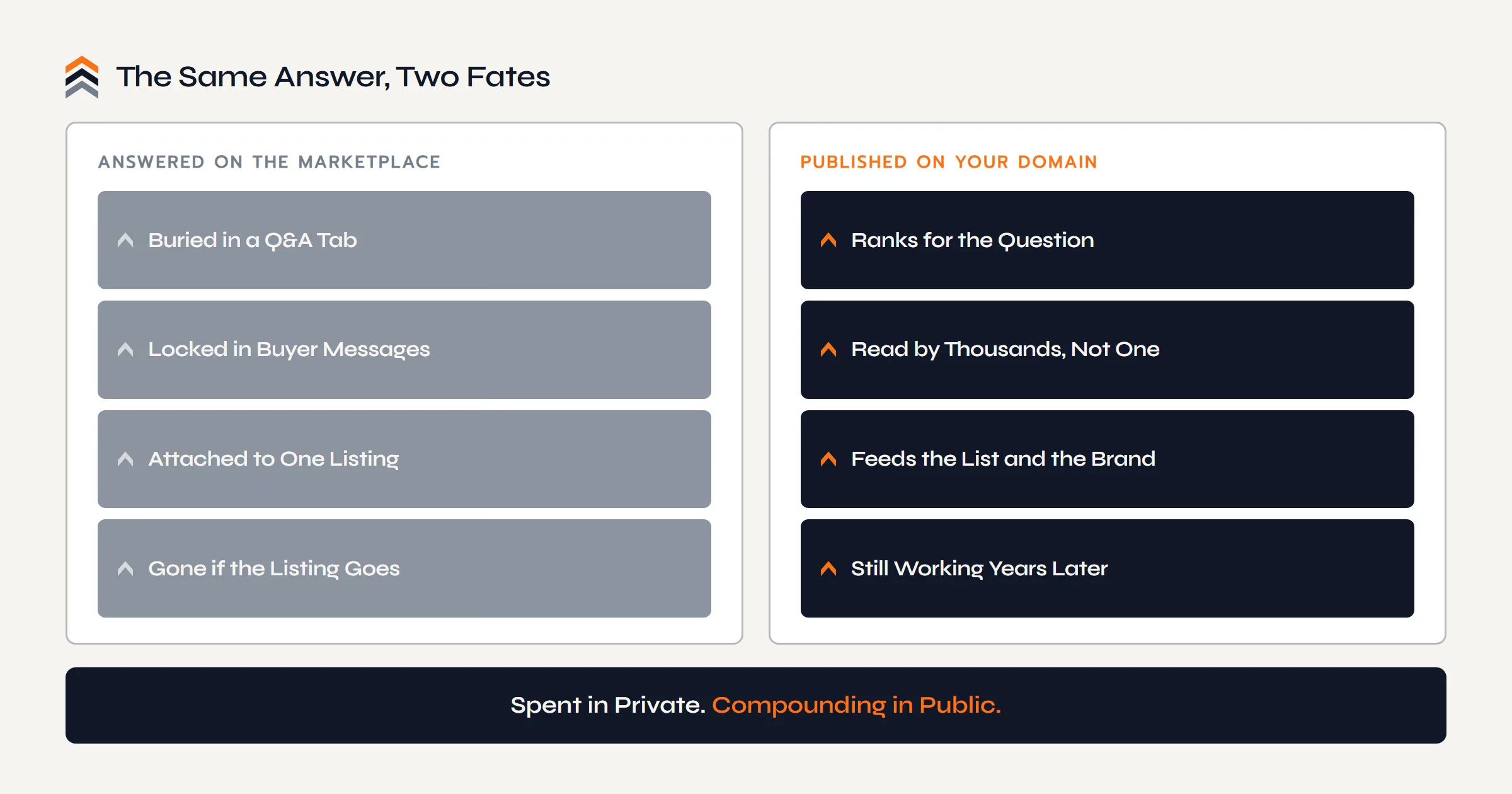
Published once on your domain, the same answer runs the other direction. It ranks for the question and keeps answering it while you sleep. It gets linked, cited, and sent. It feeds the email list and introduces the brand. It is still on duty years later, and it is part of what transfers if you ever sell the business.
A Quick Test
The inbox test. Three questions before you write anything:
- Open your buyer messages and reviews. Which three questions keep coming back?
- Search one of them on Google. Who is answering it today, and is the answer any good?
- When a customer asks it next month, do you have a link that is yours to send?
Your editorial calendar already exists. It is sitting in your inbox.
You have been making content for years. You just answered in private, one buyer at a time.
Why Content Pays Twice
The first payment is demand. The marketplace meets shoppers at the last step, the one that types a product name into a search bar. Content meets them earlier, at the questions that come before a brand is chosen: how to pick one, what actually matters, what goes wrong. The person asking those questions has not decided whose product to buy, which is exactly why being their answer is worth so much. How those published answers climb the rankings is the SEO guide's whole subject; this guide is about what is worth ranking in the first place.
The second payment is trust, and it is the quieter, larger one. People buy from the brand that taught them, because a genuinely useful answer is proof of expertise no ad can fake. Content is also how the brand keeps speaking between purchases: it gives the voice you decided on in the storytelling guide something to say all year, and it is the honest version of the invite step in the loyalty loop, a reason to return that is not a discount.
The marketplace answers buyers who already chose. Content reaches them while they are still choosing.

How Much of Your Business Do You Actually Own?
Published answers become owned assets the same way a domain or a list does. The Push Roadmap is a free 12 page PDF with the Ownership Scorecard: score where your brand stands today and see the move to owned ground mapped out.
Sent straight to your inbox.
The Four Kinds That Fit a Product Seller
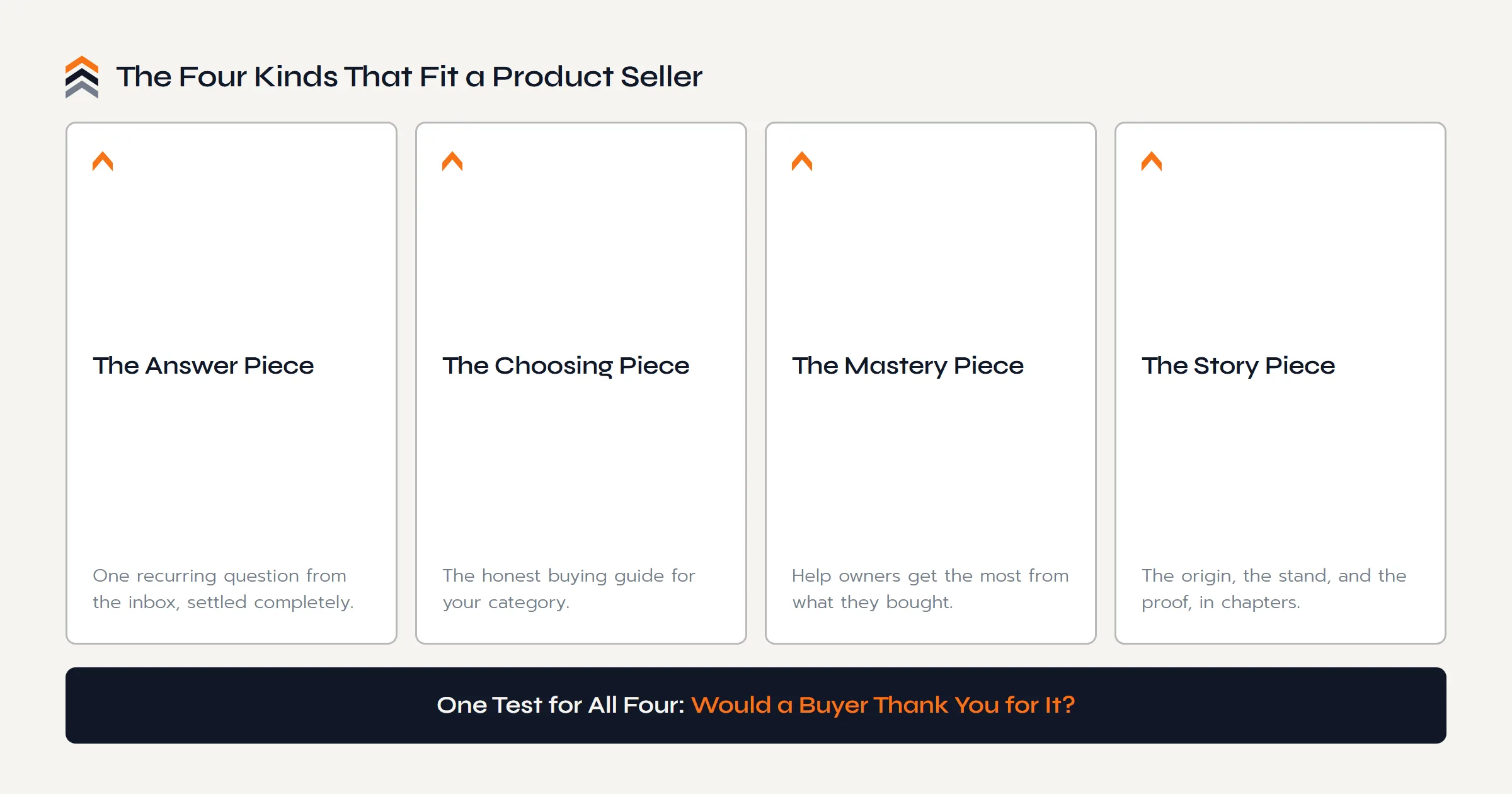
You do not need a content strategy with forty formats. Four kinds cover a product business, and every one of them starts from material you already hold:
- The answer piece. One recurring question from the inbox, settled completely. The sizing question, the compatibility question, the will-it-survive-the-dishwasher question. Boring to you, decisive to the person asking.
- The choosing piece. The honest buying guide for your category: what actually matters, what is marketing noise, and who each option genuinely suits. It only works honest. A guide where your product wins every round convinces nobody, and saying plainly who should not buy from you is the most credible sentence you can publish.
- The mastery piece. Help for people who already bought: setup done right, care that extends the product's life, uses they had not considered. It reads as generosity, and it quietly runs the loyalty loop: fewer returns, better reviews, customers who succeed and come back.
- The story piece. The origin, the stand, the proof, told in chapters. The five decisions behind the brand, serialized into pages people actually read.
What is deliberately not on the list: category news, seasonal trend posts, and anything published because a week went by. Those serve the calendar, not the customer, and the customer can tell.
Where It Lives and What It Costs
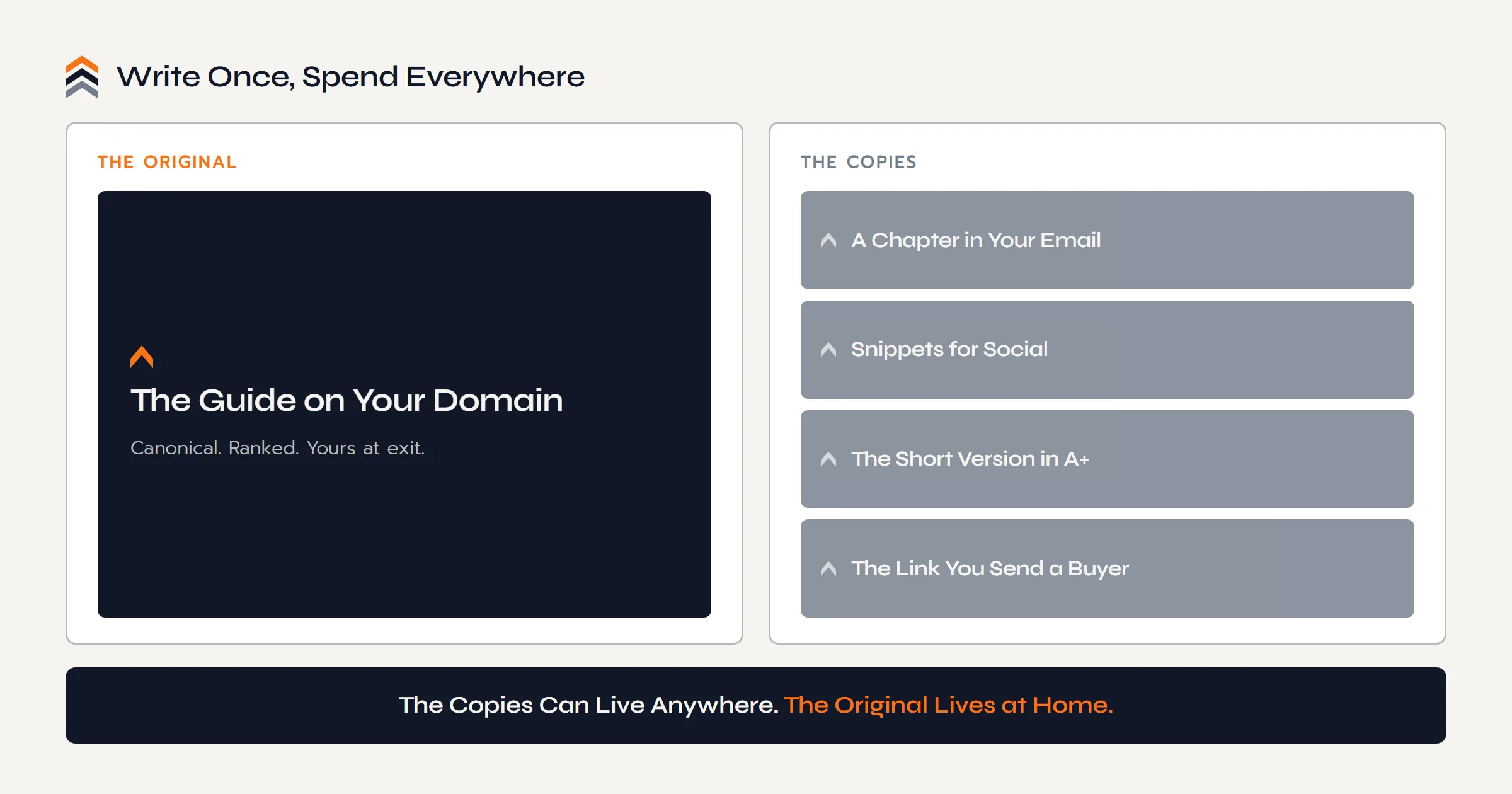
The original lives on your domain. That is the entire placement strategy, and it is the same logic as every other guide in this series: rankings accrue to the address, and the address should be yours. From that one original, copies radiate outward on whatever schedule suits you: a chapter in your email, snippets for social, the short version in an A+ module, and the link you send the next buyer who asks. The copies are distribution. The original is the asset.
The cost is honest but real, and it is measured in attention more than money. One genuinely useful piece a month, written by the person who knows the product, beats thirty thin posts written by nobody in particular. A home for those answers is part of what a brand site is for, which is why our builds ship with one rather than bolting a blog on later.
An Honest Note
Three limits, before content gets oversold the way it usually is:
- Content cannot fix the product or a broken offer. It amplifies whatever is true, which is only pleasant when the truth is good.
- Thin filler is worse than silence. Readers and search engines have both learned to skip it, and it teaches your audience that your name means nothing useful.
- The first year is quiet. Rankings and trust both compound on their own schedule, and nobody honest will promise you the date.
Publish less. Answer more.
Questions Sellers Ask
What Is Content Marketing in Plain Terms?
Publishing the most useful answers to the questions your customers actually ask, on ground you own, so that being helpful and being found become the same act. For a product seller that means buying guides, honest comparisons, mastery content, and the brand's story. It is expertise made public, not a publishing schedule.
I Sell Products, Not Advice. What Would I Even Write About?
Whatever your buyers ask before they purchase and after they unbox. Your messages, your reviews, and the Q&A tab hold months of material, and your competitors' reviews hold more: every recurring complaint in your category is a question waiting for the seller honest enough to answer it in public.
Do I Need a Blog?
You need a place on your domain where answers live at permanent addresses. Call it guides, resources, the journal, anything but nothing. The word blog carries the baggage of obligation, daily posts and running commentary, and none of that is required. Ten genuinely useful pages outwork a hundred dated entries.
How Often Should I Publish?
As often as you have a real answer to give, and no oftener. One thorough piece a month is a serious content operation for a product brand; the compounding comes from years of useful, not weeks of frequent. The moment quantity becomes the goal, quality pays for it, and readers notice before the rankings do.
Can I Just Post on Social Media Instead?
Social is distribution, and good distribution, but it is rented ground with a feed that forgets you in a day. A post cannot rank for a question next year; a page can. Publish the original at home, spend the snippets socially. Building only on social is the same move as building only on Amazon, just with a different landlord; the dependence guide calls that diversified renting.
Should AI Write My Content?
Tools can help you draft and tighten; what they cannot supply is the thing that makes content work, which is what only you know. The dishwasher answer, the warped bamboo, the reason the hinge is brass. If a page could have been generated by anyone about any brand, it is wallpaper. Publish only what you would proudly send to a real customer who asked.
How Do I Know if It Is Working?
Before revenue moves, watch the earlier signals: the piece starts ranking for its question, visitors stay and read, the email list grows from its page, and customers begin arriving already informed. The buyer who has read you converts calmer and returns less. Revenue attribution stays fuzzy forever; the signals do not.
Does Content Help My Amazon Listings Too?
Indirectly and honestly, yes. Informed buyers convert better wherever they end up purchasing, brand searches rise as your answers circulate, and some of that demand lands on your listings. Nobody can promise you the attribution report that proves it, but the pattern is old: the brand that teaches the category tends to sell in it, on every shelf it occupies.
The Conclusion
Content marketing, for a seller, is not a new job. It is the job you already do, answering the people who want your product, moved to an address where the answers stop evaporating. The inbox supplies the questions. Your years in the category supply the answers. The only missing piece is a home where they compound.
Start with the three questions you are most tired of answering. Answer them once, properly, in public, and let every future asker be sent a link that is yours. That is the whole discipline, repeated until the brand becomes what it should be: the name that taught the category.
Your sales can live on Amazon. Your brand should not.
The Next Move
You Have Read the Argument.
Pick Your Path.
Ready to Build
A free call, no pitch script. Walk us through your Amazon business and get a straight answer on what your own site would take.
Book a Free CallStill Weighing It
The Push Roadmap is the free PDF version of this decision. Put a number on where your brand stands before you commit to anything.