The path from Amazon seller to brand owner, mapped in one free guide. Grab Your Push Roadmap

The Reality

What You Don't Own When Amazon Is Your Only Channel.

The sales can be real and the risk real at the same time. Here is what running on Amazon alone leaves in someone else's hands: what each gap is, what it costs you, and how we fix it with a brand website you own. None of this is a reason to leave Amazon. It is the reason to own the ground beside it.

The Customer

Your Customers Aren't Yours.

Amazon hands you the sale and keeps the customer. There is no email address, no phone number, no way to reach the person who just bought from you. The relationship you paid to create, through ranking work, ads, and reviews, lives inside the marketplace, and the marketplace decides what happens to it next.

The cost shows up quietly. Every reorder happens on a search page where competitors bid on your keywords. Every launch starts from zero because there is nobody to announce it to. You win the same customer over and over, and you pay full price for them every time.

How We Fix This.

A brand website puts the relationship in your name: the visitor, the sign-up, and on direct builds the buyer too. Customers can be brought back with an email instead of an ad budget. See the Packages for what every build hands over.



The Rules

One Policy Away From Zero.

Amazon enforces its marketplace at machine scale, and the enforcement is blunt by design. A flagged keyword, a competitor complaint, a category policy update, and a listing or an entire account can be paused while the appeal works through the queue. Honest sellers get caught in it every week.

The problem is not the rule. It is that when Amazon is your only channel, a decision you did not make can freeze the entire income stream, and there is nothing underneath it. You play by rules you do not write, and you carry the downtime alone.

How We Fix This.

Owned ground changes the math. A brand site is a channel no marketplace decision can touch: it keeps selling while an appeal runs, and it turns a shutdown into a bad week instead of a crisis. Read the Push Concept for the model behind it.


The Asset

You're Building Amazon's Asset.

Every order you ship grows Amazon's marketplace: its customer base, its data, its valuation. Your work compounds, but it compounds into an asset you do not hold. At the end of a strong year you have cash flow, and Amazon has everything the cash flow built.

It matters most on the day you think about selling. Buyers of e-commerce businesses pay for what transfers: the brand, the audience, the channels. An account on someone else's platform transfers thin. The same revenue with an owned site, list, and demand behind it is a different company on paper.

How We Fix This.

We build the asset in your name from the first file: domain, hosting, design, data, every login. Nothing rents, everything transfers. See How It Works, including the handover.


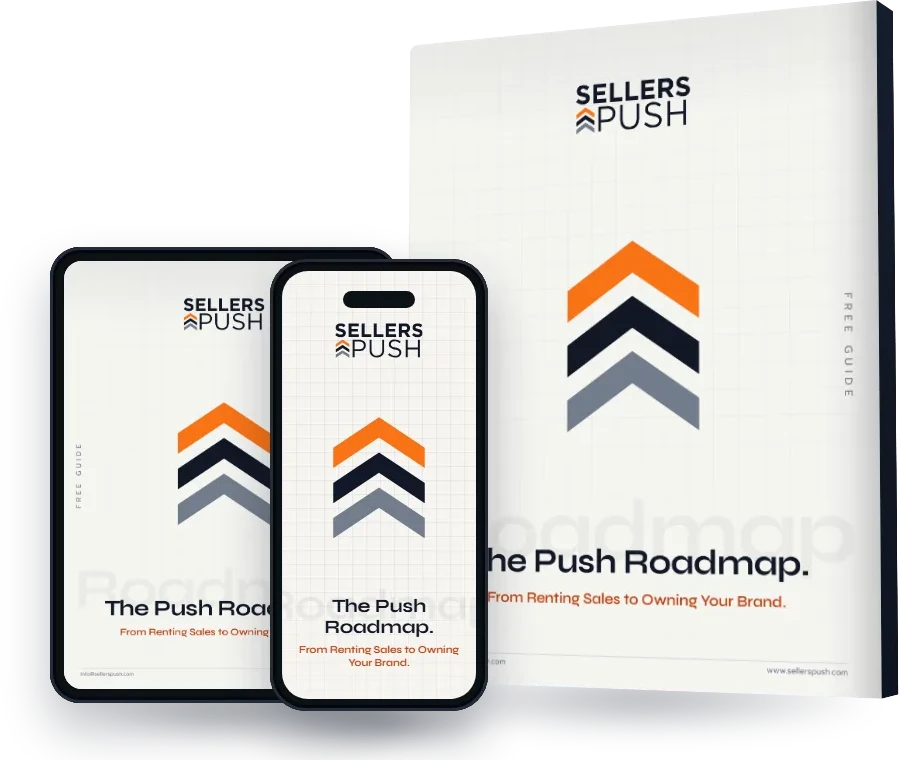
The Push Roadmap guide as a book, on tablet and phone
  • Free 12 Page PDF
  • Yours to Keep

How Many of These Gaps Are Yours?

The Push Roadmap includes the Ownership Scorecard, a free 12 page PDF: score your brand against every gap on this page and see the fix mapped in order.

Sent straight to your inbox.


The List

No List, No Remarketing.

The second sale is the cheapest revenue a brand ever earns, and it usually starts with a list. Amazon-only businesses do not have one. No emails, no remarketing audiences, no way to tell a thousand past buyers that the new product exists.

That is revenue you already earned, left on the table. You paid to acquire every one of those customers. Without a list, each of them has to be acquired again, at whatever the ad market charges this quarter.

How We Fix This.

Your site collects first-party data from day one: sign-ups, buyers, and a growing picture of who wants what. It is the difference between renting attention and owning reach. See the Packages.


The Fees

The Fees Only Go Up.

Referral fees, FBA fees, storage fees: the stack takes its share of every order, and the long-term direction has only been up. None of it is negotiable, because negotiating requires an alternative, and an Amazon-only business does not have one.

So margin shrinks exactly as dependence grows. The better the marketplace performs for you, the more of your economics it quietly owns.

How We Fix This.

Selling direct keeps the fee stack in your pocket on every order your site takes, and even a partial direct channel lifts your blended margin. The Summit build is designed for exactly this. See the Summit Package.


The Brand

A Listing, Not a Brand.

A listing is a shelf position, not a brand. It sits in a grid beside knockoffs and lowest-price competitors, in a template you cannot design, with a story cut down to bullet points. The customer remembers Amazon, not you.

That is why Amazon-only brands end up competing on price instead of preference. Nothing in the environment lets a customer choose you on purpose, so the only lever left is being cheaper.

How We Fix This.

A brand site is where preference is built: design, voice, story, proof, all yours. People who choose on purpose pay for the brand, not just the product. Read the Push Concept for the thinking.


Every risk on this page is one of the five pillars a platform can hold. The free Amazon Ownership Score turns them into a number: ten questions, two minutes, and an honest measure of how much of your brand you own.

The Next Move

Own the Part That Protects You.

One call, your store on screen, and a straight answer on which of these gaps is costing you most, and what the fix looks like.

Free Push Roadmap

Get the Push Roadmap.

Tell us where to send it. The PDF lands in your inbox a few minutes later.

  • Free PDF
  • About a 12 Minute Read

No spam. Just the roadmap, and the occasional note worth reading. Unsubscribe anytime.