
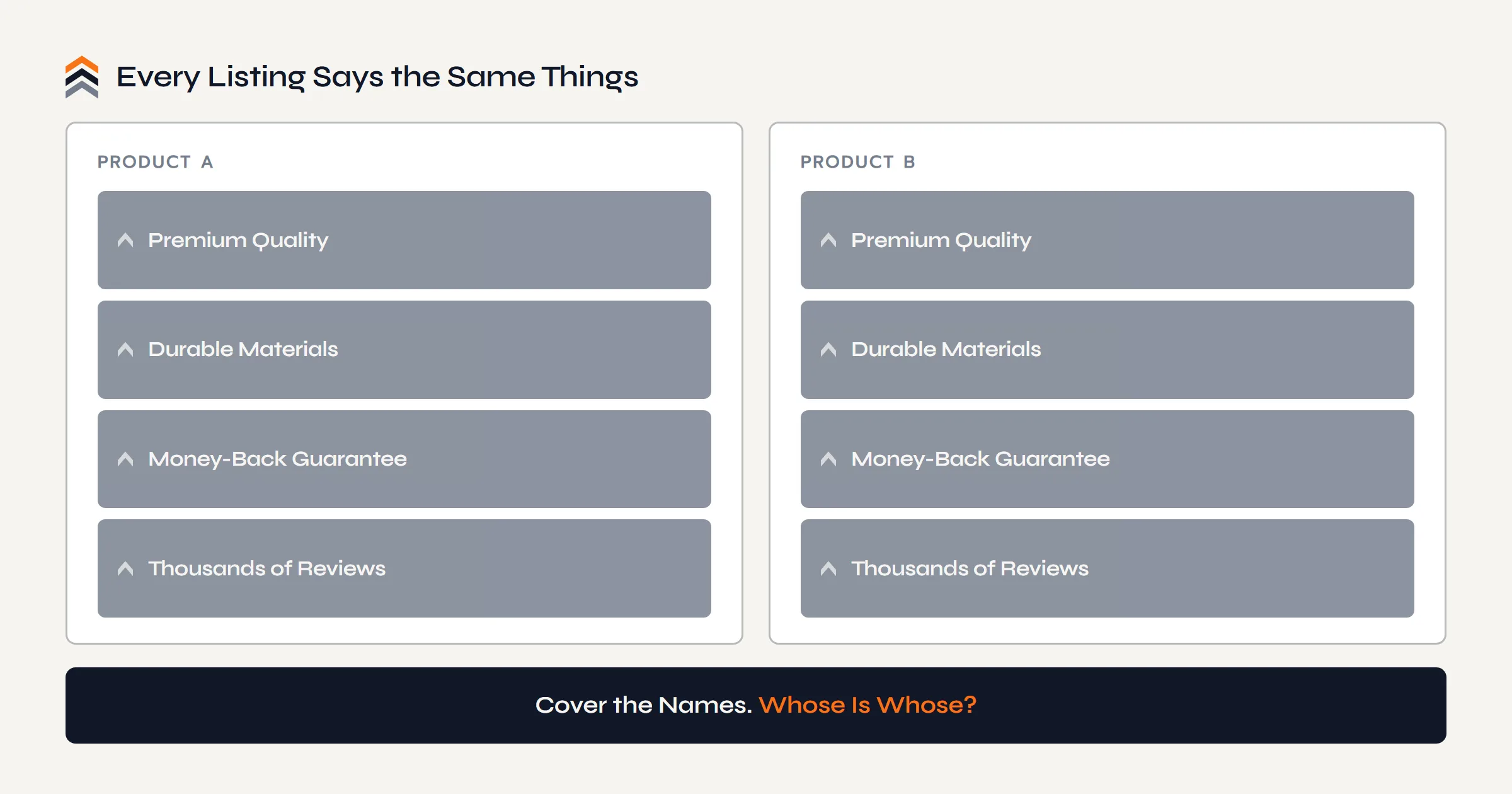
Here is an uncomfortable exercise. Put your listing beside your top three competitors and cover the brand names. Now pick out which one is yours. If it takes you more than a moment, and you made the product, imagine the shopper.
That anonymity is not your fault. It is the template's job. Amazon renders every product in the same bullets, the same modules, the same comparison grid, because standardized products are easier to rank, price, and substitute. The marketplace does not strip your story out of malice. It strips it because story is the one variable it cannot standardize.
This guide is about putting that variable back to work: what a brand story actually is once the fluff is drained out of the term, why it sells physical products, the five decisions it is made of, and where it has to live. It is the top layer of the brand build, and like every layer under it, it needs ground you own.
The Template That Makes Every Product Anonymous
Open any category and read three listings in a row. The same claims in the same order: premium quality, durable materials, satisfaction guaranteed. The same lifestyle photos with different hands. Even strong A+ content is modular sameness: nicer sameness, arranged in the same grid. When every surface is standardized, only two levers remain visible to the shopper, price and rank, and both are races with no finish line.
Sellers respond by optimizing harder inside the template: sharper bullets, better photography, tighter keywords. All necessary, and all copyable within a season. Specs converge. Photography converges. Even review counts converge, given time and volume. The optimization game has a ceiling, and every serious competitor is already pressed against it.
A Quick Test
The anonymity test. Three questions, honestly answered:
- Cover the brand names on your listing and two rivals. Can a stranger tell whose is whose?
- Ask your best customer why they chose you. Do they say anything a competitor could not also claim?
- Read your About page, if one exists. Could it be pasted under another logo without anyone noticing?
If everything true of you is also true of them, you have a product. Not yet a brand.
The template treats every product as a commodity. Story is the one spec nobody can copy.
What a Brand Story Actually Is
Drain the fluff out of the term and a brand story is this: the consistent answer to three questions. Why does this brand exist? Who exactly is it for? And what does it refuse to be? Everything else, the founder anecdote, the tone, the photography, is delivery. Those three answers are the story.
Just as important is what a story is not. It is not a founder biography, unless the biography explains the product. It is not a mission statement assembled from the words empower, elevate, and community. And it is not purpose-washing borrowed from causes the brand never touches. The test is brutal and simple: if your story could sit under a competitor's logo without anyone noticing, it is not a story. It is wallpaper.
The honest version is usually small. A real irritation with the products that existed. A specific person you built for because you were that person. A corner everyone else cuts that you refuse to. Small and true outworks grand and generic every time it is told consistently.
Why Story Sells Products
Not by magic, and not overnight. Story earns its keep through three mechanisms, each one boring and durable:
- It breaks ties. When specs, photos, and review scores converge, the buyer needs a reason to pick one. A brand that stands for something specific is a decision shortcut; an anonymous listing is a coin flip against every rival at once.
- It makes the brand memorable. Humans index the world in stories, not spec sheets. The seller whose why sticks gets searched for by name later, and branded search is the demand every other guide in this series keeps pointing at.
- It gives a premium something to stand on. Nobody pays extra for premium quality; everyone claims it. People pay extra for the version whose reason they believe: the refused corner, the specific who-for, the proof behind it.
Story compounds the way rankings do: slowly, then noticeably, then structurally. It is equity work, not a promotion.
A product answers what. A brand answers why. Why is what earns the premium.
How Much of Your Business Do You Actually Own?
A story is one asset on the ownership list. The Push Roadmap is a free 12 page PDF with the Ownership Scorecard: score where your brand stands today and see the move to owned ground mapped out.
Sent straight to your inbox.
The Five Decisions Behind a Brand Story
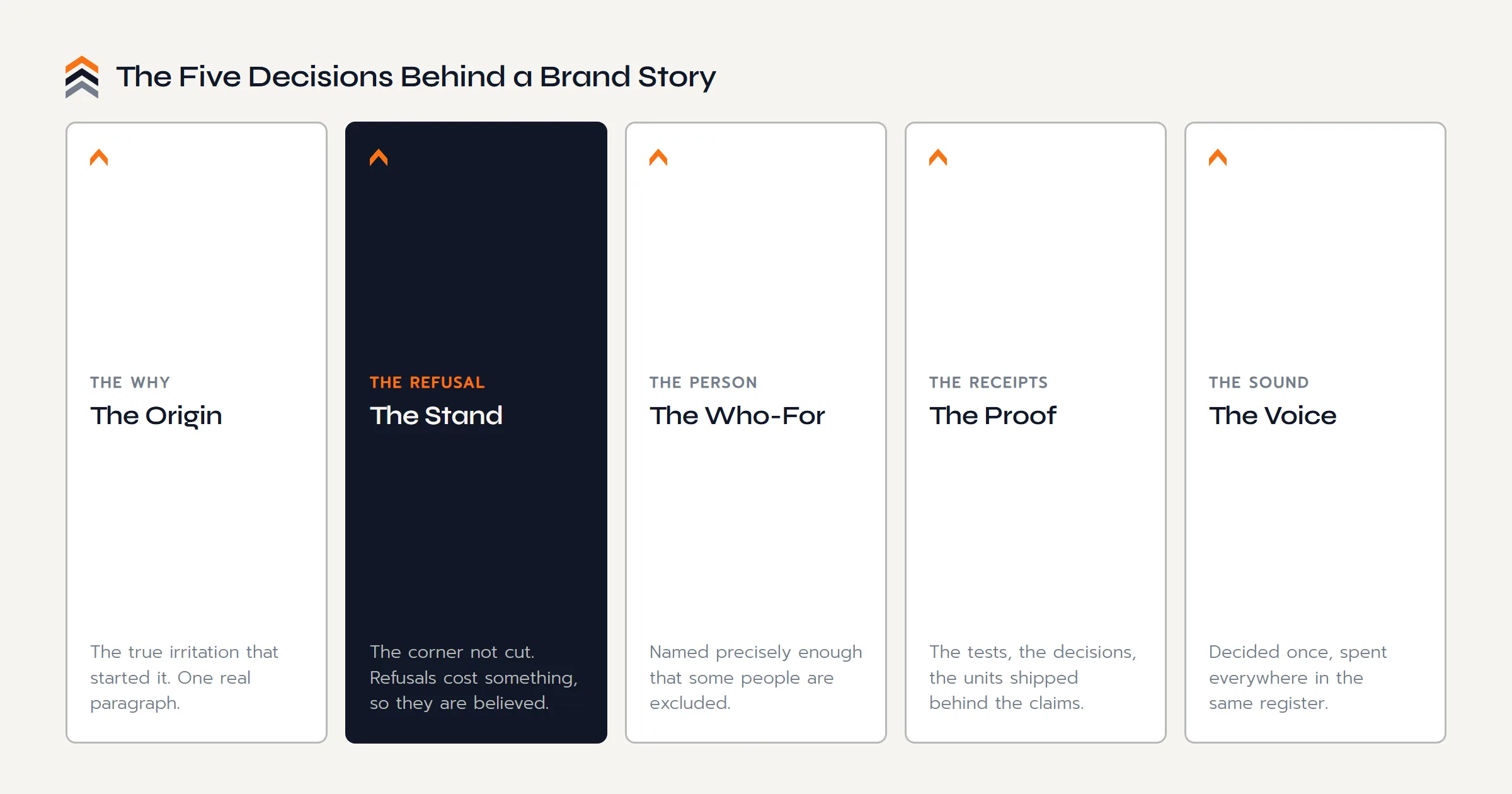
Before a story is any writing at all, it is five decisions. Make them once, honestly, and every page, insert, and email afterward has something to be consistent with:
- The origin. The true irritation that started it: the product that broke, the ingredient list you could not pronounce, the tool that almost worked. One real paragraph, no epic required.
- The stand. What you refuse: the corner not cut, the filler not used, the shortcut not taken. Refusals are more believable than promises, because they cost something.
- The who-for. The exact person you built for, named precisely enough that some people are excluded. Exclusion is the point; a brand for everyone is a brand for the search filter.
- The proof. The receipts behind the claims: the design decision, the test, the units shipped, the guarantee honored. Proof is where your years on the marketplace finally pay narrative rent, and the trust guide shows how it gets rebuilt on your own pages.
- The voice. How the brand sounds, decided once, spent everywhere: page, packaging, and email in the same register, so every touch feels like the same hand.
Notice that none of the five requires a copywriter to exist. They require decisions from the person who knows the product best, which is you. Words can be hired. Truth cannot.
Where the Story Lives (and Where It Cannot)
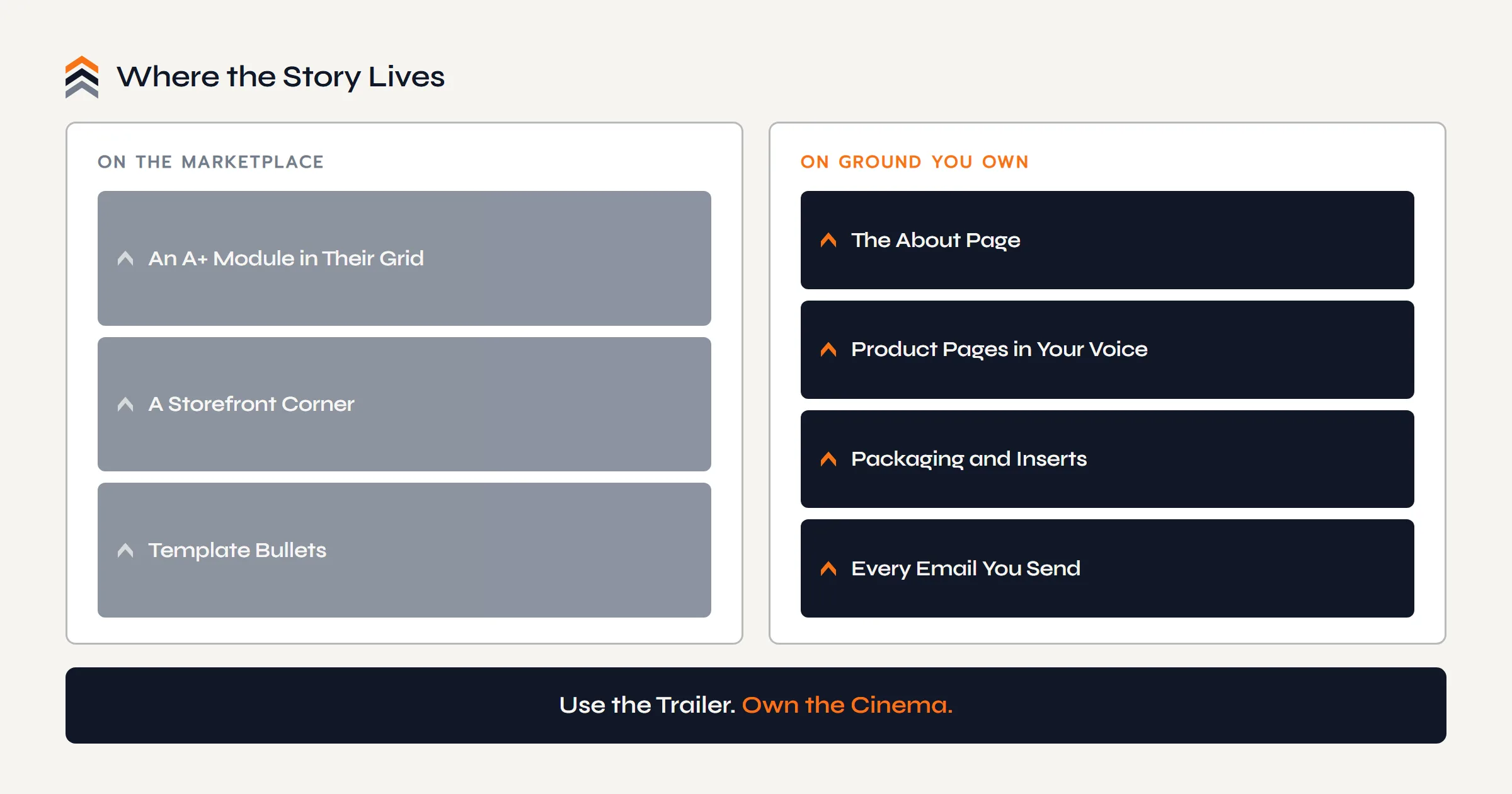
A story is architecture, not an essay. It lives across surfaces, and the repetition is the mechanism: the About page carries the long version, product pages weave the why into the what, packaging and inserts repeat it at the moment of delight, and email tells it in chapters over months. One decision, spent everywhere. That consistency is what turns a paragraph into a brand, and a one-time buyer into a loyal brand fan.
Amazon deserves its honest credit here. The A+ brand story module and the storefront are real surfaces and worth filling properly; they are the best the template offers. They are also modules in someone else's grid: no voice control over the page around them, competitors' ads above them, and no way to follow up with whoever read them. Use them as the trailer. The film needs a cinema you own.
Whether that home is due yet for your business has its own honest answer in Do Amazon Sellers Need Their Own Website? Building it so the story has somewhere to live is, plainly, what we do.
An Honest Note
Three limits, before the word story oversells itself:
- Story amplifies whatever is true. It cannot fix a product that disappoints; it will only make the disappointment more memorable.
- You do not need a Nike myth. A small, true story told consistently outworks a grand, vague one every time.
- If writing is not your craft, fine. The decisions still are. Help with words is easy to find; nobody can outsource the truth of the five decisions.
Write small. Write true. Repeat it everywhere.
Questions Sellers Ask
What Is Brand Storytelling in Plain Terms?
The consistent answer to why your brand exists, who exactly it serves, and what it refuses to be, told the same way on every surface a customer touches. Not poetry, not a mission statement: three decisions, repeated until they are what people remember about you.
Is Storytelling Just Marketing Fluff?
The fluffy version is, and it deserves the eye-roll. The working version is positioning made memorable: when specs, photos, and review scores converge, the buyer needs a tiebreaker, and a brand that stands for something specific is one. Fluff is a story that could belong to anyone. Strategy is a story that could only be yours.
My Product Is Simple. Does It Really Need a Story?
Simple categories need it most, because that is where the template's sameness bites hardest. A cutting board is a commodity; a cutting board built by someone who got tired of warped bamboo and explains exactly why theirs will not is a choice. The story does not need to be big. It needs to be specific and true.
Do I Have to Put Myself in the Story?
Only as much as you want. The origin usually involves the founder because someone had the irritation that started it all, and one honest paragraph of that is worth more than a page of brand poetry. But the brand can carry the story from there in its own voice. A face helps; a reason is required.
Can I Tell My Story on Amazon?
Partially, and do: the A+ brand story module and your storefront are the template's best real estate, and most sellers leave them generic. But they are modules in a grid you do not control, with competitors' ads overhead and no way to follow up with the reader. The full inventory of what the marketplace holds back is on What You Don't Own.
How Is Storytelling Different From Brand Strategy?
Strategy is the set of choices: who you serve, what you charge, where you play, what you refuse. Story is those choices made visible and memorable. You cannot tell a story you have not decided, and a strategy nobody can retell at a dinner table is not finished. The five decisions in this guide are where the two meet.
Where Do I Start?
Not with a writer. With an hour and the five decisions: the origin, the stand, the who-for, the proof, the voice. Write each as one honest sentence. Then give them a home, starting with the About page and product pages of a site you own, and repeat them on every surface after that. The words can be polished forever; the decisions only have to be made once.
The Conclusion
The marketplace template will keep rendering your product as a commodity, because that is what templates are for. The way out is not louder bullets. It is the one variable the grid cannot standardize: a specific, true answer to why you exist, who you serve, and what you refuse, repeated everywhere a customer meets you.
Make the five decisions. Give them a home you own. Spend them consistently for years, not weeks. That is the entire discipline, and if you want to see the exercise done in public, our own answer fits on one page: The Push Concept.
Your sales can live on Amazon. Your brand should not.
The Next Move
You Have Read the Argument.
Pick Your Path.
Ready to Build
A free call, no pitch script. Walk us through your Amazon business and get a straight answer on what your own site would take.
Book a Free CallStill Weighing It
The Push Roadmap is the free PDF version of this decision. Put a number on where your brand stands before you commit to anything.