
Somewhere in your Brand Analytics there is a number that looks like loyalty: the share of customers who came back and bought again. It is a good number to watch, and sellers are right to want it higher. Now try to thank one of them.
You cannot. The email address on the order is masked and stops working once the order closes. The messaging system exists for delivery problems, not gratitude. Writing to a past buyer with anything that resembles marketing is against the rules you agreed to on day one. The customer who has bought from you three times is, as far as you are permitted to know, a row in a report.
In the last guide we looked at how the marketplace template makes every product anonymous to the shopper. This guide is the same anonymity running in the other direction: the checkout makes every shopper anonymous to you. Turning Amazon shoppers into loyal brand fans is the work of closing that gap, and it starts with being honest about what loyalty is, why the marketplace cannot hand it to you, and where it actually gets built.
The Repeat Buyer You Cannot See
Amazon will tell you plenty about your buyers in aggregate. Brand Registry earns you real analytics: repeat purchase rates, demographic bands, how well each product holds its audience. The reports are worth reading and most sellers do not read them enough. What none of them contains is a person. No name you may use, no address you may write to, no permission to start a conversation.
That is not an oversight. It is the deal. Amazon brings you demand you could never summon alone, and in exchange the customer belongs to the store, not the stall inside it. Every seller accepted that trade at signup, most without reading the clause, and it remains a good trade for selling products. It is just a poor foundation for building fans, because fandom is a relationship, and a relationship needs two parties who are allowed to know each other.
Amazon knows your customers by name. You know them as a percentage.
What Loyalty Actually Is (and What the Dashboard Measures)
Loyalty is preference that survives friction. A loyal customer searches your brand by name instead of the category. They wait the extra day when your shipping cannot match Prime. They pay a fair price without hunting for a coupon, and they give you the benefit of the doubt when one order goes wrong. That behavior is a relationship doing its work.
What the dashboard measures is repetition, and repetition has many parents. Prime shipping produces it. Holding the top search slot produces it. A Subscribe and Save discount produces it. From inside a report, convenience and devotion draw exactly the same graph, and the difference only shows when friction arrives: the day your listing slips, a rival undercuts you, or the buy box wobbles. The repeat buyer and the brand fan look identical right up until that day.
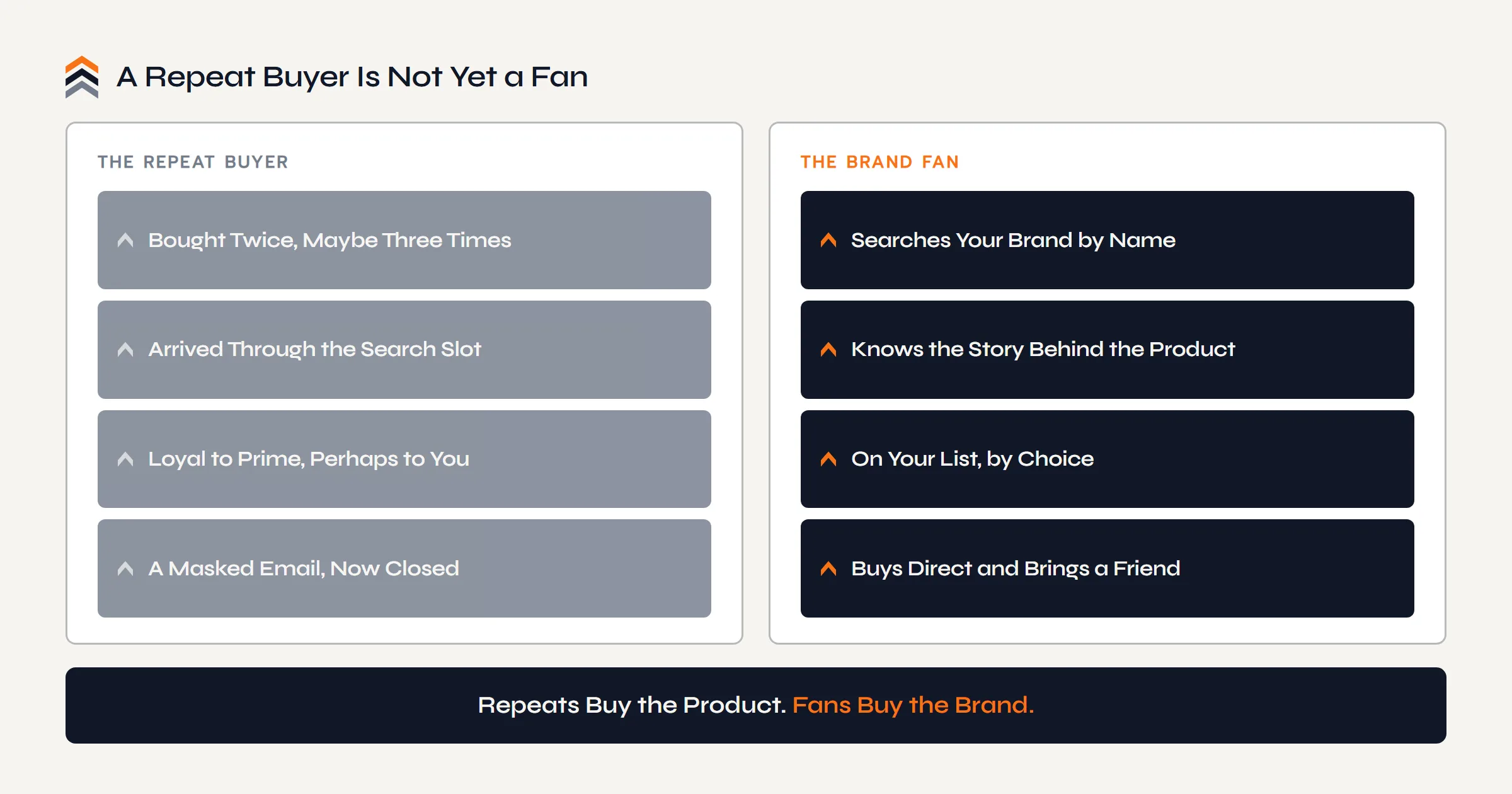
None of this makes repeat buyers worthless. It makes them a beginning: proof the product deserves fans, waiting on a brand that is allowed to make them.
A Quick Test
The page one test. Three questions to separate repeat buyers from fans:
- If your listing slipped to page three tomorrow, how many of your repeat buyers would come looking for you by name?
- Search your brand on Google. Is there anywhere a fan could land that you own?
- Could you send a thank you to your last hundred customers today?
If the answers are few, nowhere, and no: you have repeat buyers, not fans yet.
Why the Marketplace Keeps Your Buyers Anonymous
It helps to see this from Amazon's side, because the logic is sound. Shoppers trust that checkout with their card and their address, and part of what they trust is the silence afterward: buy from a hundred sellers and not one of them follows you home. The anonymity is not a gap the marketplace forgot to close. It is a feature it sells to its shoppers, and it is one of the reasons they convert so readily. Amazon protects its customers from you because they are its customers.
Honest credit for what you do get inside the walls. Brand Analytics turns buyers into useful aggregates. The Follow button lets shoppers raise a hand for your brand, and Amazon will email them about your launches in its own templates, on its own schedule, with its own approval. Subscribe and Save creates genuine repeat revenue, funded by your discount. All of it is worth using. None of it gives you an address, a voice, or anything you keep if the account stumbles. The full inventory of what stays behind those walls is on What You Don't Own.
How Much of Your Business Do You Actually Own?
Customers you can reach again are one asset on the ownership list. The Push Roadmap is a free 12 page PDF with the Ownership Scorecard: score where your brand stands today, relationships included, and see the move to owned ground mapped out.
Sent straight to your inbox.
The Loyalty Loop: How Fans Actually Get Made
Strip any loyalty program down to the frame and the same loop is underneath, five steps long:
- Recognize. Know who just bought, and be allowed to know it. A name, an email, a permission. This is the step the marketplace withholds, and every step after it depends on it.
- Thank. A welcome in your own voice, sent because a person chose you. Gratitude that reads like it was written by someone, not generated for everyone.
- Invite. One honest reason to come back: the guide that helps them get more from the product, the story behind the next one, first word on what is coming.
- Reward. Returning should feel noticed. Early access, a small kindness, remembering what they bought last time. A discount is the least imaginative option on the list.
- Repeat. Each pass raises the odds of the next. Fans are made in laps, not moments.
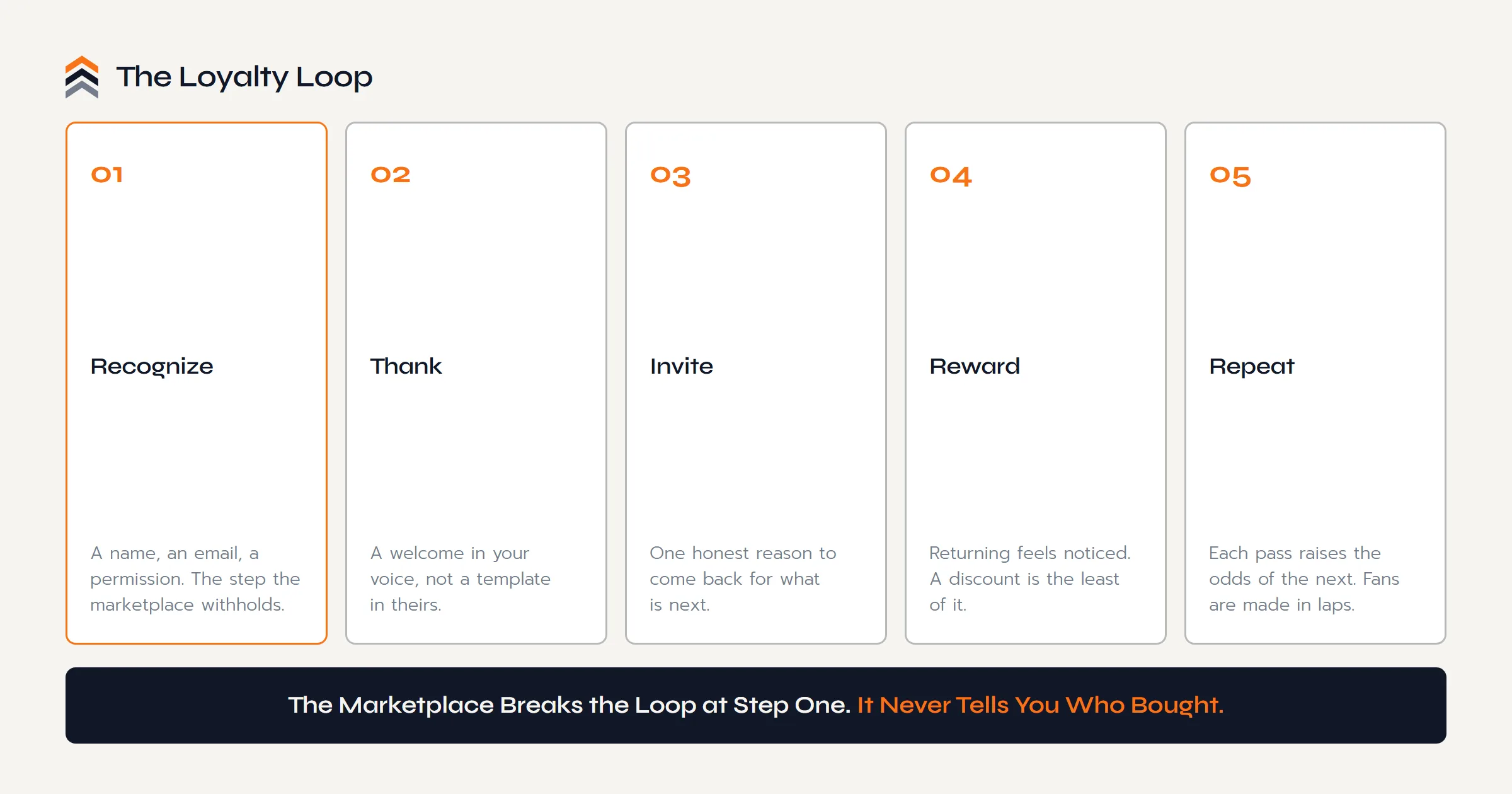
The loop needs three things a listing cannot provide. Identity: the permission to know your customer. A home: pages in your own voice where the brand is more than bullets. A channel: email, the one line to a customer that no algorithm sits between. On the map of the full move this is the audience layer, and the pillar guide places it second for a reason: it is the first asset that compounds.
It compounds outward, too. Fans search your name, and branded search is demand you can watch accrue to your own domain; the SEO guide covers why that matters. Fans also recruit: the friend who was told about you arrives already halfway convinced.
Loyalty is not a number that happens to you. It is a loop you run on ground you own.
Where Loyalty Lives (and What to Build)
The bridge between the marketplace and the loop rides inside the box. Packaging and inserts are the one surface you fully control that reaches every single Amazon customer, and most sellers spend it on a logo and a barcode. A simple card that says who you are, why the product exists, and where home is turns a delivery into an introduction. Play it strictly by the rules: no review bribes, no conditional offers, just a brand saying hello. The box was the handshake all along.
Then home has to be worth arriving at. Product pages written in your voice instead of the template's. An About page that gives a fan something to be loyal to. A welcome email that lands like a person wrote it, and a list that grows because people chose to be on it. Building that home is the work we do, and the loop is the reason every site we build treats email capture as day one plumbing, not a plugin added later.
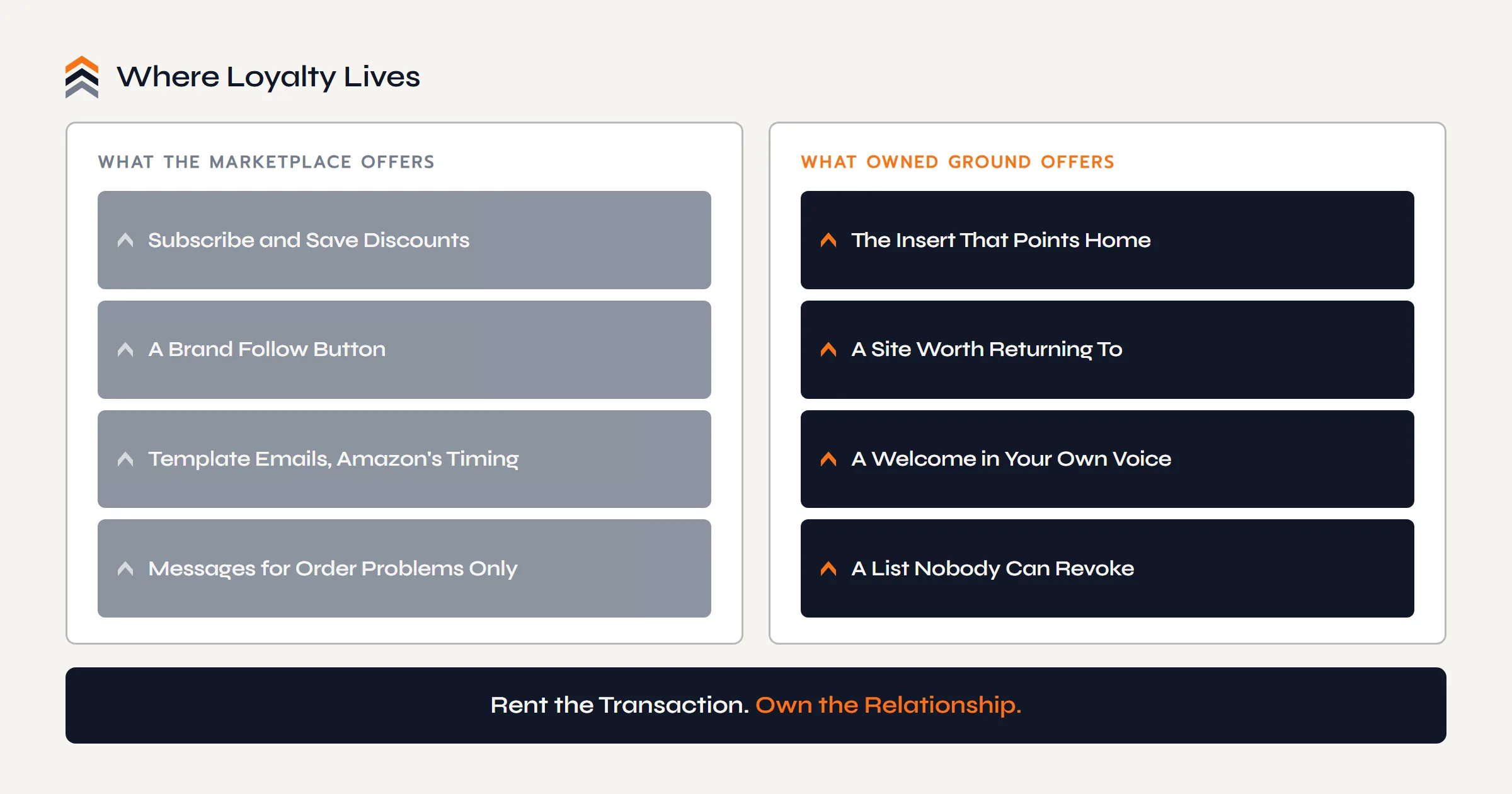
Loyalty also pays down a debt this series keeps returning to: every fan who searches your name or buys direct shrinks the share of your business that would vanish with the account. That arithmetic has its own guide.
An Honest Note
Three limits, so the word loyalty does not oversell itself:
- Loyalty amplifies the product; it cannot replace it. Nobody becomes a fan of something they would not have rebought anyway.
- Discounts buy repetition, not preference. A customer who only returns for the coupon is loyal to the coupon. Reward with recognition first and price last.
- The loop runs in laps, not campaigns. There is no honest schedule for fandom. There is only the compounding of doing it every month.
Fans are not captured. They are kept.
Questions Sellers Ask
Can I Email My Amazon Customers?
No. The addresses are masked, the messaging system is reserved for order problems, and using buyer information for marketing is against Amazon's terms. This is not a loophole waiting to be found; it is the deal itself. The list you can actually write to has to be built on ground you own, one invited customer at a time.
Does Subscribe and Save Count as Loyalty?
It counts as retention, and real retention at that: predictable repeat revenue is nothing to sneer at. But look at who holds each piece. You fund the discount, Amazon holds the relationship, and the subscription lives exactly as long as your listing and account do. It is repetition rented from the marketplace. Use it, and do not confuse it with fans.
What Does the Brand Follow Button Actually Do?
Shoppers can follow your brand, and Amazon will show those followers your posts and deals, in Amazon's templates, on Amazon's schedule, inside Amazon's app. Switch it on; it costs nothing and it is the closest thing to an audience the marketplace offers. Just see it clearly: no addresses, no voice of your own, no export, and it ends at the account's edge.
Are Package Inserts Allowed?
Yes, within clear rules: no asking for positive reviews, no rewards conditional on a review, no bait to intercept the transaction. A plain card that introduces the brand and says where it lives online is standard practice across serious sellers. The policies do get revised, so read the current ones before you print ten thousand of anything.
Do I Need a Points Program to Have Loyal Customers?
No. Points, tiers, and punch cards are mechanics, and mechanics without preference underneath just become a discount with extra steps. Run the loop first: recognize, thank, invite, reward, repeat. If the brand earns fans, a program can organize them later. It cannot create them.
How Fast Does Loyalty Show Up in Revenue?
Slower than a promotion and faster than you fear, and anyone who gives you a precise schedule is selling something. Loyalty compounds the way rankings do: invisibly at first, then noticeably, then structurally. The honest measure in the early months is not revenue; it is list growth, reply rates, and the first customers who arrive by searching your name.
What Should the Website Do That the Listing Cannot?
Three things the template forbids: recognize the customer, speak in your own voice, and remember. A returning visitor can be greeted, a buyer can be thanked, a story can run deeper than bullets, and every relationship built there is yours to keep. What that build looks like in practice is laid out on How It Works.
Is Any of This Worth It if Most Sales Stay on Amazon?
Yes, and most of the sellers we talk to keep the majority of their sales on Amazon for years. Fans help there too: they search your name, click your listing, buy without a coupon, and defend the price. The full weighing of the two channels, side by side, is in Selling on Amazon vs Selling on Your Own Website.
The Conclusion
The marketplace made your product anonymous to the shopper, and it made the shopper anonymous to you. Neither is malice. Both are the same design doing its job, and both have the same answer: a place where the brand has a face and the customer has a name.
Keep the repeat buyers; they are proof the product earns a second purchase. Then build the loop around them: the insert, the home, the welcome, the list. Run it in laps for a year and the difference stops being philosophical. It becomes people who would find you on page three.
Your sales can live on Amazon. Your brand should not.
The Next Move
You Have Read the Argument.
Pick Your Path.
Ready to Build
A free call, no pitch script. Walk us through your Amazon business and get a straight answer on what your own site would take.
Book a Free CallStill Weighing It
The Push Roadmap is the free PDF version of this decision. Put a number on where your brand stands before you commit to anything.