

Every seller who considers a store beyond Amazon hits the same wall, usually inside the first minute: five thousand reviews over there, a blank page over here. The listing has a decade of stars. The new site has nothing but your word. Why would anyone buy?
It is an honest fear, so it deserves an honest guide. The reviews will not transfer, and nobody who tells you otherwise should be trusted with your brand. But the fear rests on a misreading of what those reviews were doing for you, because the trust that actually closes a sale on Amazon was never stored in your review count to begin with.
This guide closes the brand shelf of this series. The story gave the brand a voice, loyalty gave it fans, and content gave it something to say. Trust is what makes a stranger believe all three.
Five Thousand Reviews and a Blank Page
Start with the facts, because the market for comforting lies here is crowded. Review text lives on the platform where it was written. It was licensed to Amazon by the reviewer, it displays on Amazon's terms, and no legitimate mechanism carries it to your domain. The tools that promise otherwise scrape what is not theirs and break without warning. Write the number off now: the badge does not move.
And yes, a new store converts worse than a seasoned listing at first. That is not a design flaw or a pricing problem. It is a trust deficit, and it is normal. The whole point of this guide is that the deficit is a page you have not built yet, not a decade you have to relive.
What Shoppers Actually Trust on Amazon
Look closely at what happens when a stranger buys your product on the marketplace. Two different kinds of trust close that sale, and only one of them involves you. The first is product proof: your reviews, your rating, your photos from real kitchens and garages. That one you earned, even if you hold it on rented terms. The second is transaction trust: the certainty that the card is safe, the parcel will arrive, and returns are painless. That one was never yours at all. It belongs to the guarantee, the logistics, and the two decades of habit wrapped around your listing.
This is why the blank-page fear overstates the loss. You are not replacing five thousand reviews. You are replacing one kind of proof you rented and one kind you never had, and on your own store both get built in your name. The full inventory of what the marketplace keeps is on What You Don't Own; the review badge is just its most visible line.
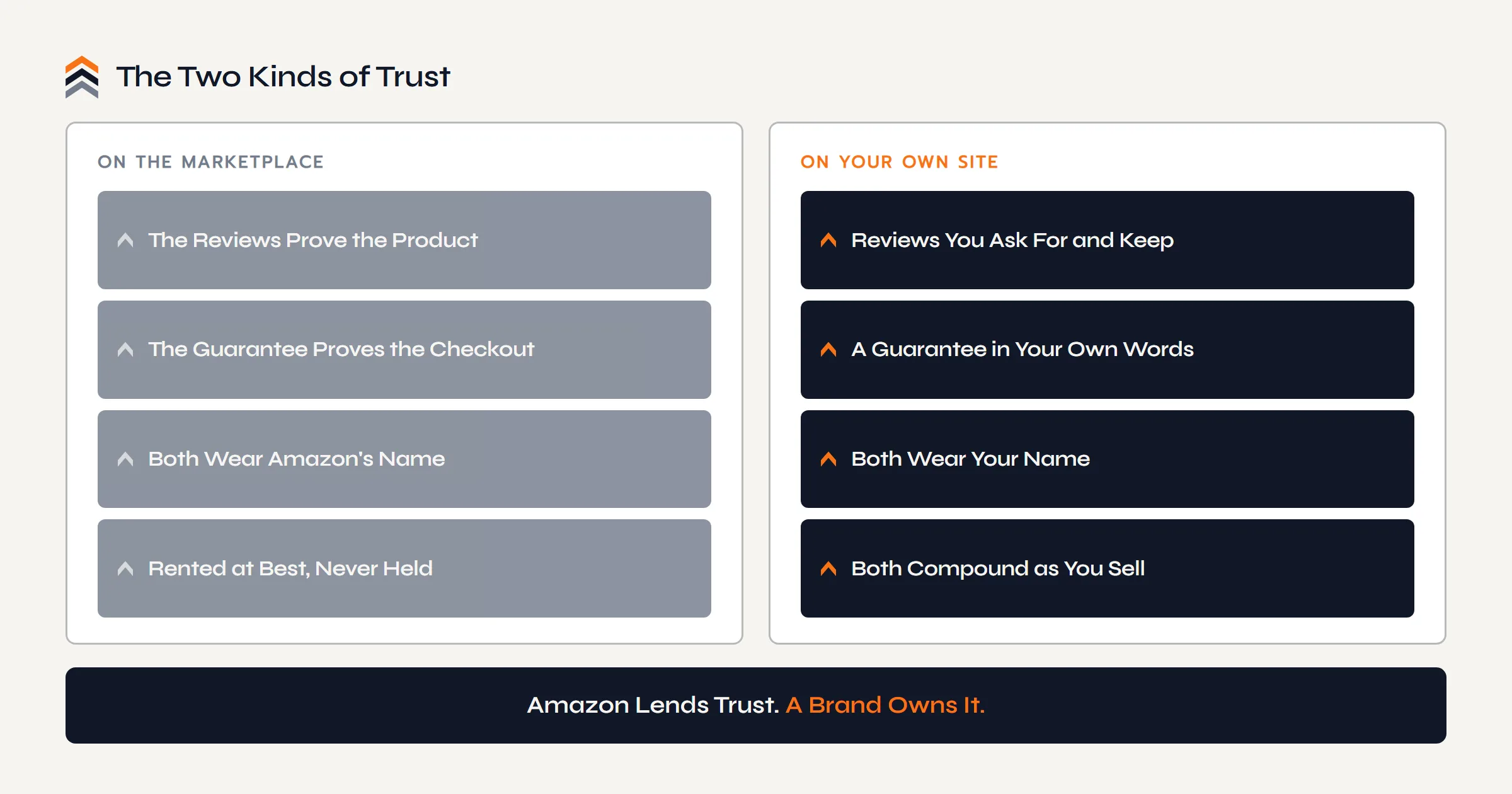
Shoppers never trusted your listing. They trusted the guarantee wrapped around it.
What Actually Travels (More Than You Think)
Now the encouraging half of the ledger, and it is longer than the fear admits. The track record itself is a portable fact: a rating earned across thousands of orders can be stated plainly on your own pages and linked to the listing that proves it. Borrowed proof, honestly cited, and it works while the owned kind grows. What buyers taught you travels too: years of questions, complaints, and praise that let you answer doubt before it forms. Your best customers travel, the fans who would vouch for you by name the moment you ask. And the story only you can tell needs no permission slip at all.
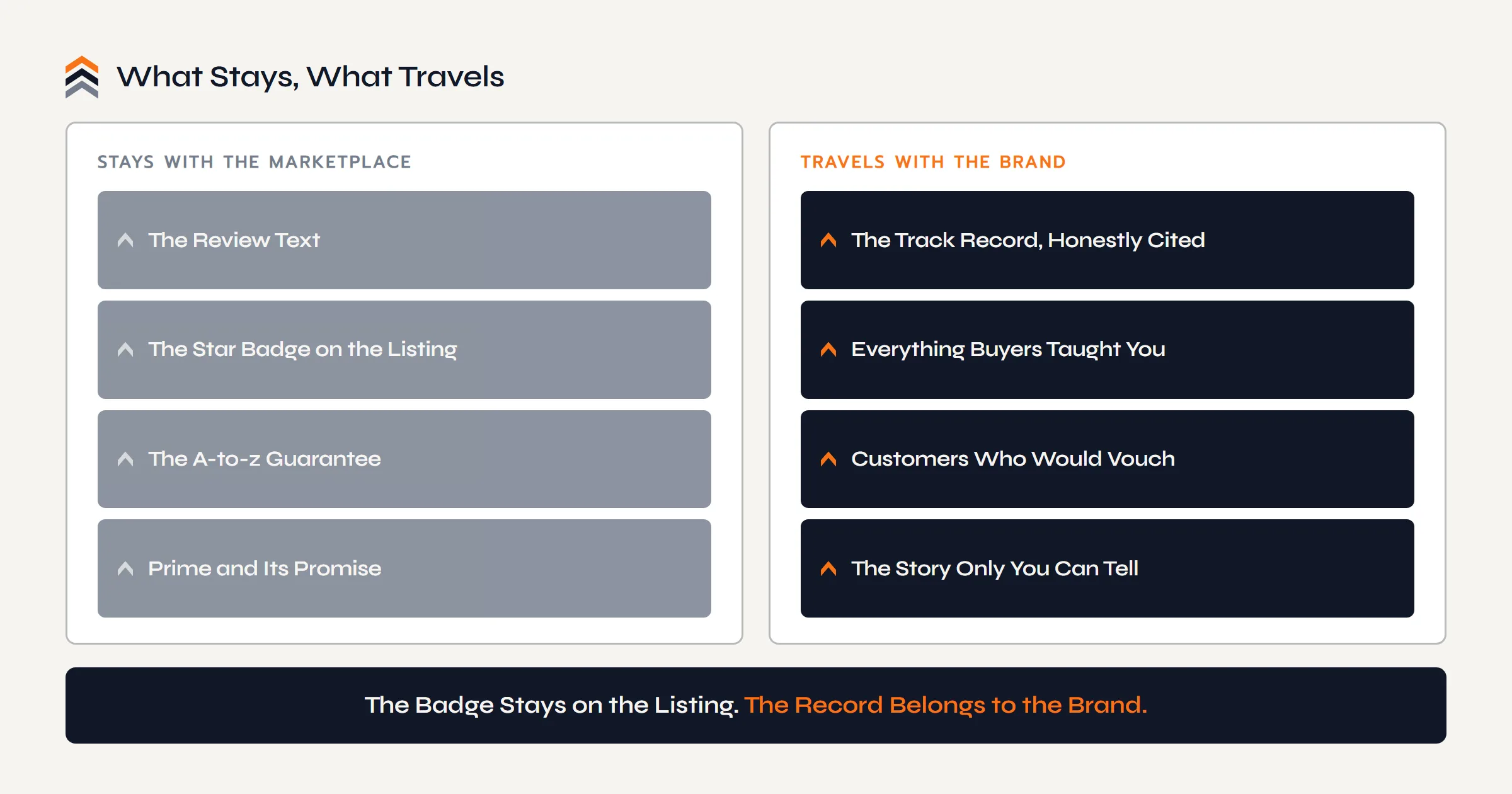
What carries over when the store is built beside the marketplace, stock, content, name, and all, is its own guide. This one is about the column the fear fixates on, and even there the news is better than the blank page suggests.
A Quick Test
The blank page test. Three questions before you write off your own store:
- Take your three best reviews. Could you name real customers who would say the same thing again, in an email, with their name on it?
- Does your returns promise read like a legal document or like something a person would actually say?
- If a stranger landed on your site today, what on the page answers their exact doubt at the moment they feel it?
Trust is not a badge you lost. It is a page you have not written yet.
How Much of Your Business Do You Actually Own?
Owned proof is one asset on the ownership list. The Push Roadmap is a free 12 page PDF with the Ownership Scorecard: score where your brand stands today and see the move to owned ground mapped out.
Sent straight to your inbox.
The Owned Proof Engine
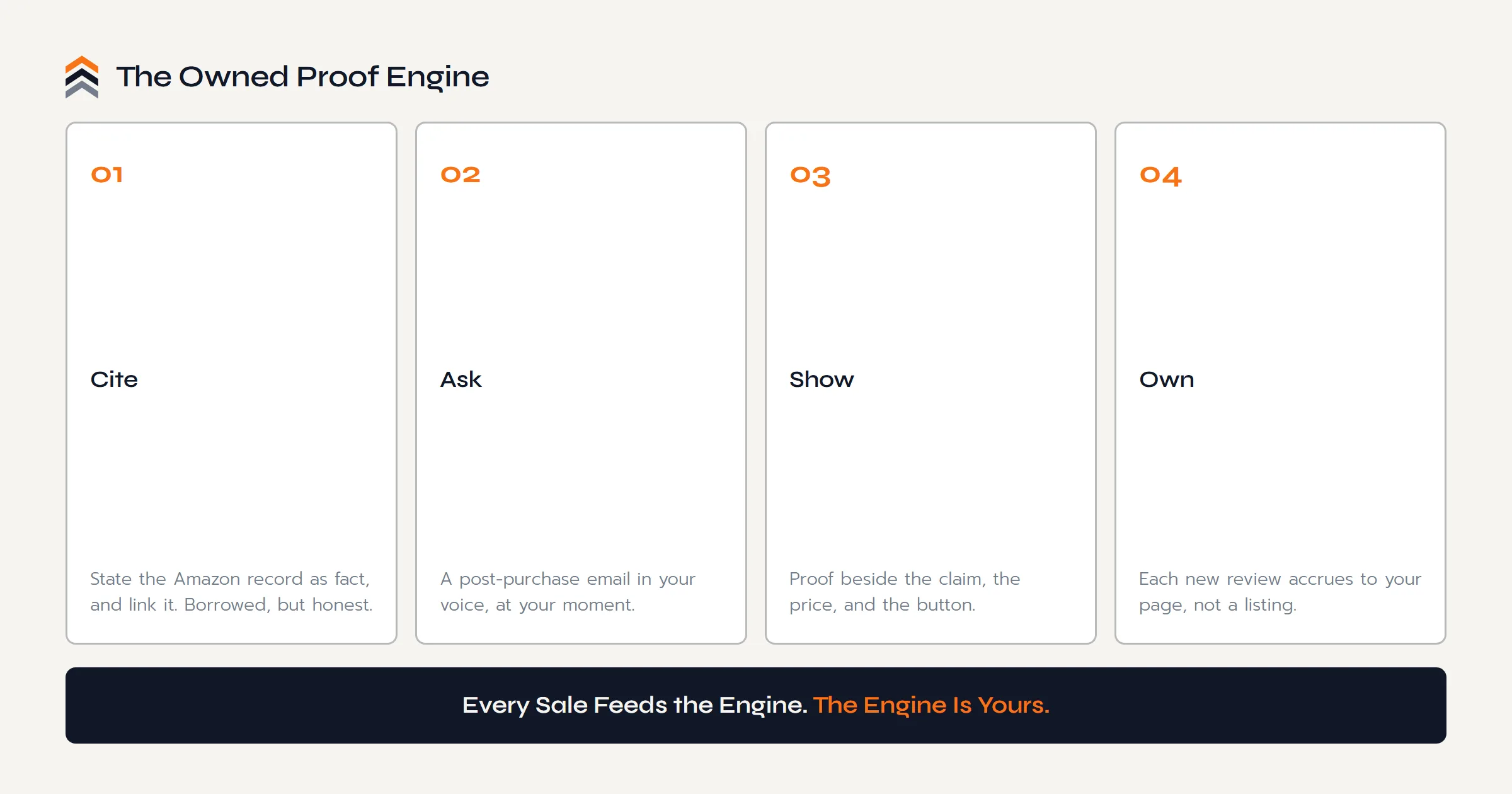
Rebuilding proof is not a scramble. It is a small engine with four moving parts, and every order you ship turns it once:
- Cite. While the owned proof grows, state the borrowed kind honestly: the rating, the order count, the years in the category, linked to the listing that backs it. No inflation needed; the truth is already impressive.
- Ask. Every customer gets a post-purchase email asking for a review, in your voice, at the moment you choose. This is the quiet freedom of owned ground: no policy anxiety around the ask, no template between you and the customer. If you ever sweeten it, say so plainly; disclosure is cheap and credibility is not.
- Show. Proof goes where doubt lives, which the next section maps. A hundred reviews nobody sees do less than ten placed well.
- Own. Every review lands on your page, feeds your rankings, and compounds. This is the step the marketplace never offered: proof as equity instead of proof as rent.
On the map of the full move, this is the top layer earning its keep: trust that lives on your pages, in your name, at your address. It is the slowest asset in the stack and the one buyers of businesses inspect first.
Amazon's trust is a service it can withdraw. Yours is an asset nobody can.
Where Proof Goes on the Page
Social proof fails most often not from scarcity but from placement. The rules are old and unglamorous. Proof belongs beside the claim it supports: the durability testimonial next to the durability promise, not in a carousel three screens away. It belongs near the price, where the doubt is sharpest, and near the button, where the decision happens. And specific beats voluminous everywhere: a named customer explaining exactly which doubt proved unfounded outworks a wall of five-star ratings with no faces.
Transaction trust gets built the same deliberate way, because your store has to supply what Amazon used to: a returns promise written like a sentence a human would say, a contact route that visibly answers, the founder somewhere findable, and a checkout that looks after the card. None of it is decoration. It is the guarantee layer, rebuilt in your name, and building it into the page is part of the work we do.
An Honest Note
Three limits, because trust is the worst possible place to cut corners:
- Never fake it. Invented testimonials and purchased reviews are the one shortcut that poisons everything downstream. Regulators fine it now, and buyers smelled it long before regulators moved.
- You will not match Amazon's counts, and you do not need to. The stranger deciding on your page needs their doubt answered, not a bigger number.
- Proof amplifies the product. A great review engine attached to a disappointing product just documents the disappointment faster.
Fake proof is debt. Real proof is equity.
Questions Sellers Ask
Can I Move My Amazon Reviews to My Website?
No. The text was written by your customers and licensed to the platform it lives on; no legitimate tool carries it to your domain. What you can do is cite the record honestly, a stated rating and review count linked to the listing, and start the owned engine so the next thousand reviews land on pages you keep.
Can I Mention My Amazon Rating on My Own Site?
Yes, as long as it is true and stays true. A plain sentence like a 4.8 star average across thousands of Amazon orders, linked to the listing, is honest borrowed proof, and it carries real weight with a stranger. Treat it as scaffolding: essential while the owned proof grows, and quietly less necessary every month after.
How Do I Get My First Reviews Off Amazon?
Start with the customers who already love you. The repeat buyers and the people who email you unprompted are your first ten testimonials, and a personal request from the founder converts far better than an automated blast. After that, the post-purchase email does the steady work: one polite ask per order, in your voice, forever.
Are Review Apps and Widgets Worth It?
The tool matters far less than the ask, but yes, a proper review system on your store earns its keep. What to insist on: verified-purchase marking, a frictionless flow for the customer, photos supported, and full control over where and how reviews display. What to avoid: anything that imports content you do not have rights to, or nags customers into resentment.
What About Trustpilot and Google Reviews?
Useful satellites, and worth maintaining once the home base runs. Independent platforms add third-party verification your own pages cannot, and Google reviews surface right where your search presence is growing. Just keep the hierarchy straight: they are other people's ground with your reputation on it. Home base first, satellites second.
Do Guarantees Actually Work?
Yes, when they are specific, plainly worded, and honestly costed. A guarantee is transaction trust in sentence form: the willingness to state it is itself the proof. Write it like a promise, not a contract, honor it without friction, and count the occasional abused return as marketing spend. It converts the exact doubt Amazon's wrapper used to cover.
Do Social Media Followers Count as Social Proof?
Weakly. Follower counts are easy to inflate and buyers know it. What works from social is the content, not the number: real customers showing the product in use, tagged posts you can feature with permission, the unpolished photo that no brand would have staged. One genuine kitchen counter photo outworks a follower badge every time.
What if My Brand Is New and Has No Track Record Anywhere?
Then skip the cite step and lead with what you have: a founder with a face and a reason, radical specificity about the product, a guarantee that carries the early risk for the buyer, and fast, visible answers to every question. Every brand you admire started at zero reviews. Trust does not require history; it requires that nothing on the page smells evasive.
The Conclusion
The wall was misread. You are not leaving five thousand reviews behind; you are leaving a badge that was never going to travel, wrapped around a guarantee that was never yours. The record, the knowledge, the vouchers, and the story all come with you, and the engine that turns them into owned proof starts with the next order you ship.
Cite what is true. Ask every buyer. Show it where doubt lives. Own what accrues. And with that, the brand shelf of this series is complete: the story, the fans, the content, the trust. Four things the template never asked of you, and the four that make a name worth more than its listings.
Your sales can live on Amazon. Your brand should not.
The Next Move
You Have Read the Argument.
Pick Your Path.
Ready to Build
A free call, no pitch script. Walk us through your Amazon business and get a straight answer on what your own site would take.
Book a Free CallStill Weighing It
The Push Roadmap is the free PDF version of this decision. Put a number on where your brand stands before you commit to anything.