
Sellers tell us they know nothing about SEO, usually about ten minutes after describing how they reworked a listing title around a keyword, tuned backend search terms, and watched their rank move. That is SEO. It has always been SEO. The marketplace just never calls it that.
So this guide starts from a different premise than most beginner SEO content: you are not a beginner. You have been optimizing for a search engine for years. The engine was Amazon's, the shelf was Amazon's, and every ranking you earned lives in an account you rent.
What follows is the honest translation of that skill to your own store: what ecommerce SEO involves, how Google's shelf differs from the one you know, which searches to claim first, and what to expect while the compounding does its slow work.
You Already Do SEO Every Day
Every serious seller runs the same loop: find the terms buyers use, put them where the algorithm looks, improve the content until it converts, watch the rank respond. Listing optimization, A9, PPC keyword mining, whatever the label, the loop is search engine optimization, practiced daily, under competitive pressure most SEO consultants never feel.
The loop on Google differs in vocabulary, not in kind. The terms live in titles, headings, and page copy instead of backend fields. The algorithm rewards clarity, authority, and speed instead of conversion velocity. The instincts you built, that rankings follow relevance, that content quality moves position, that the buyer's words beat your words, transfer whole.
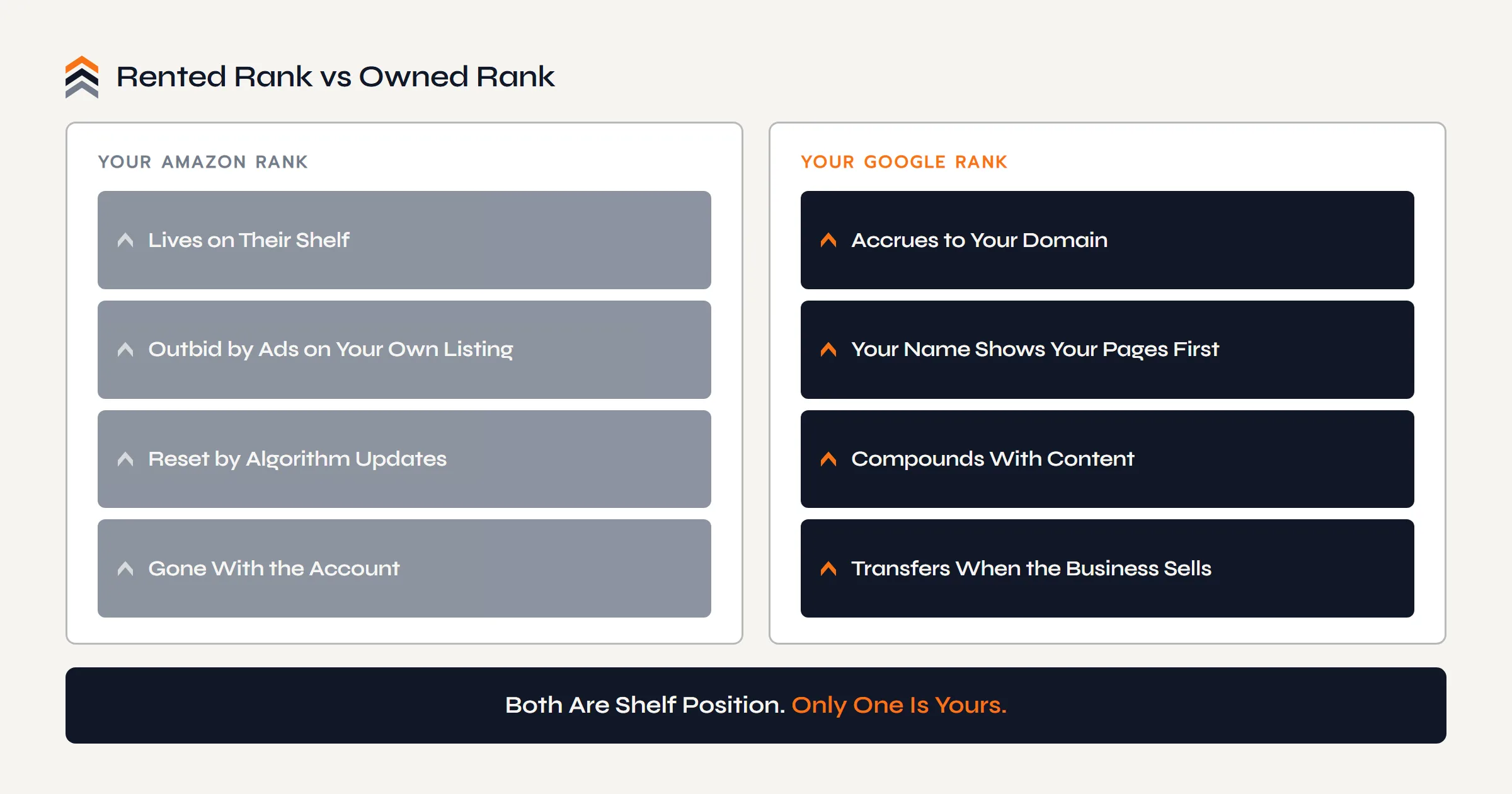
What changes is the deed. An Amazon rank is position on a rented shelf: the platform can reprice it with an algorithm update, auction the space above it to your competitors, or delete it with the account. A Google rank accrues to your domain, and your domain is yours.
You are already an SEO. Amazon just owns your rankings.
What Ecommerce SEO Actually Involves
Strip the industry noise and ecommerce SEO is one sentence: making your store the best answer Google can give to searches your buyers actually run. The searches come in two kinds, and the demand layer of the brand build needs both.
Word searches are questions and categories: the problem your product solves, the comparisons buyers weigh, the category they shop. Your pages answer them or a competitor's do. Product searches are already a product: those get answered by the Shopping shelf, which is its own guide, Google Shopping for Amazon Sellers. This guide is the words side.
The work itself divides across four fronts of the store, covered below: product pages, collection pages, content, and the technical foundation under all of it. No dark arts, no tricks that expire with the next update. Answers, structured well, on a site that loads fast and belongs to you.
Amazon Rank vs Google Rank
The comparison that makes the whole subject click for sellers, side by side.
| What Matters | Amazon Rank | Google Rank on Your Domain |
|---|---|---|
| Where It Lives | Their shelf, their account. | Your domain, your property. |
| Who Sets the Rules | A9, revised without notice. | Google's algorithm, revised without notice. The shelf position still belongs to your domain. |
| The Space Above You | Auctioned to competitors, on your own listing. | Earned, and your brand searches show your pages first. |
| If the Account Closes | Gone by morning. | Unaffected. It never lived there. |
| What It Costs to Hold | Ad spend that climbs with competition. | Content and upkeep. No bill per click. |
| At Exit | Transfers thin, with the account. | Transfers whole, with the domain. |
The Four Fronts of an Ecommerce Site
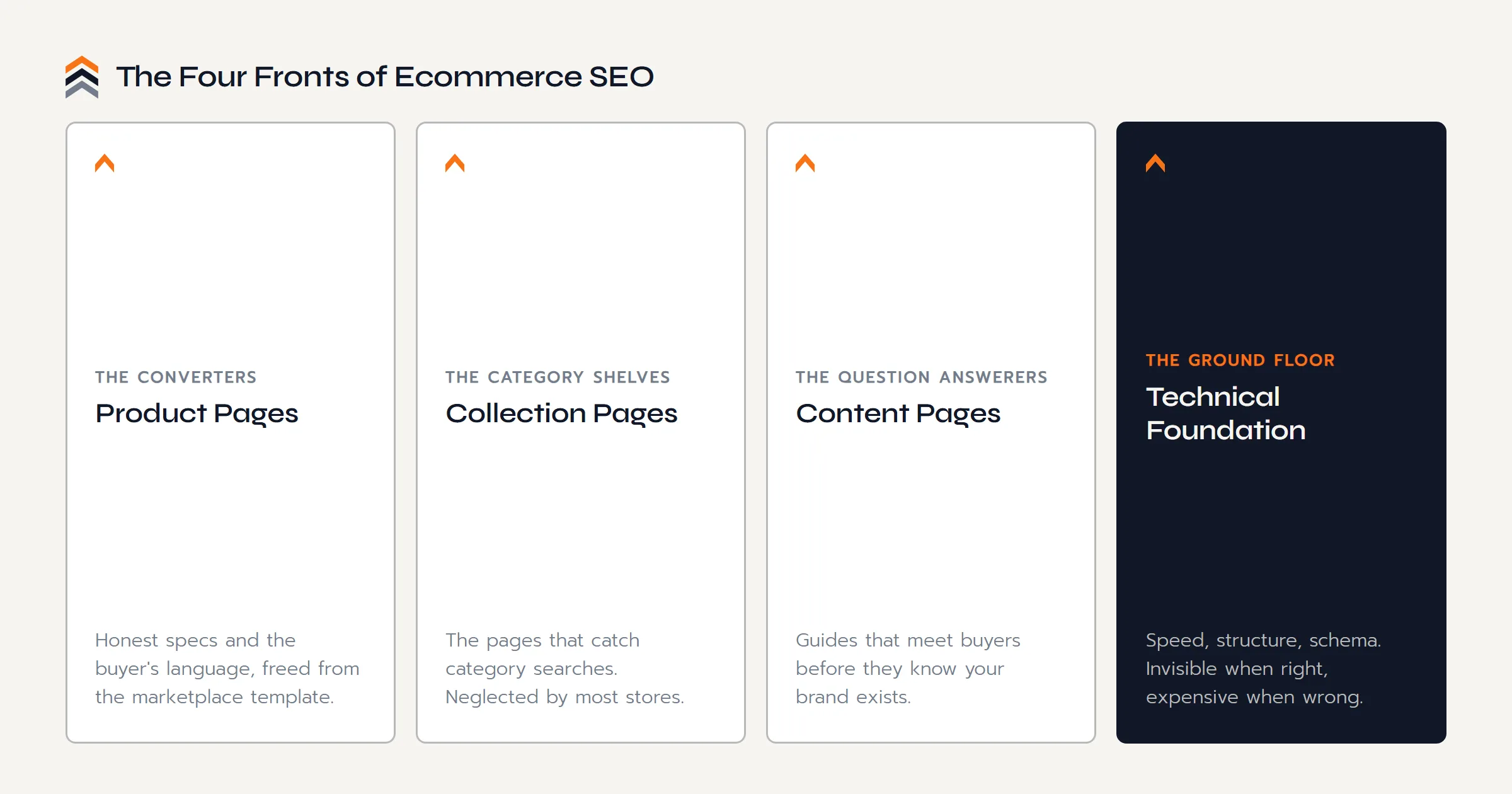
SEO work lands on four kinds of pages, and each has a distinct job:
- Product pages, the converters. Real descriptions in the buyer's language, honest specs, photography that answers questions. The Amazon listing discipline you already have, freed from the marketplace's template.
- Collection pages, the category shelves. The pages that catch "walnut desk organizers" rather than one product's name. Most stores neglect them; they are often the biggest category wins.
- Content pages, the question answerers. Guides and comparisons that meet buyers before they know your brand exists. The slowest front and the widest one, and the content marketing guide is its playbook.
- The technical foundation, the ground floor. Speed, clean structure, working links, product schema. Invisible when right, expensive when wrong.

How Much of Your Business Do You Actually Own?
Rankings are one asset on a longer list. The Push Roadmap is a free 12 page PDF with the Ownership Scorecard: score where your brand stands today and see the move to owned ground mapped out.
Sent straight to your inbox.
Start With the Searches You Already Own
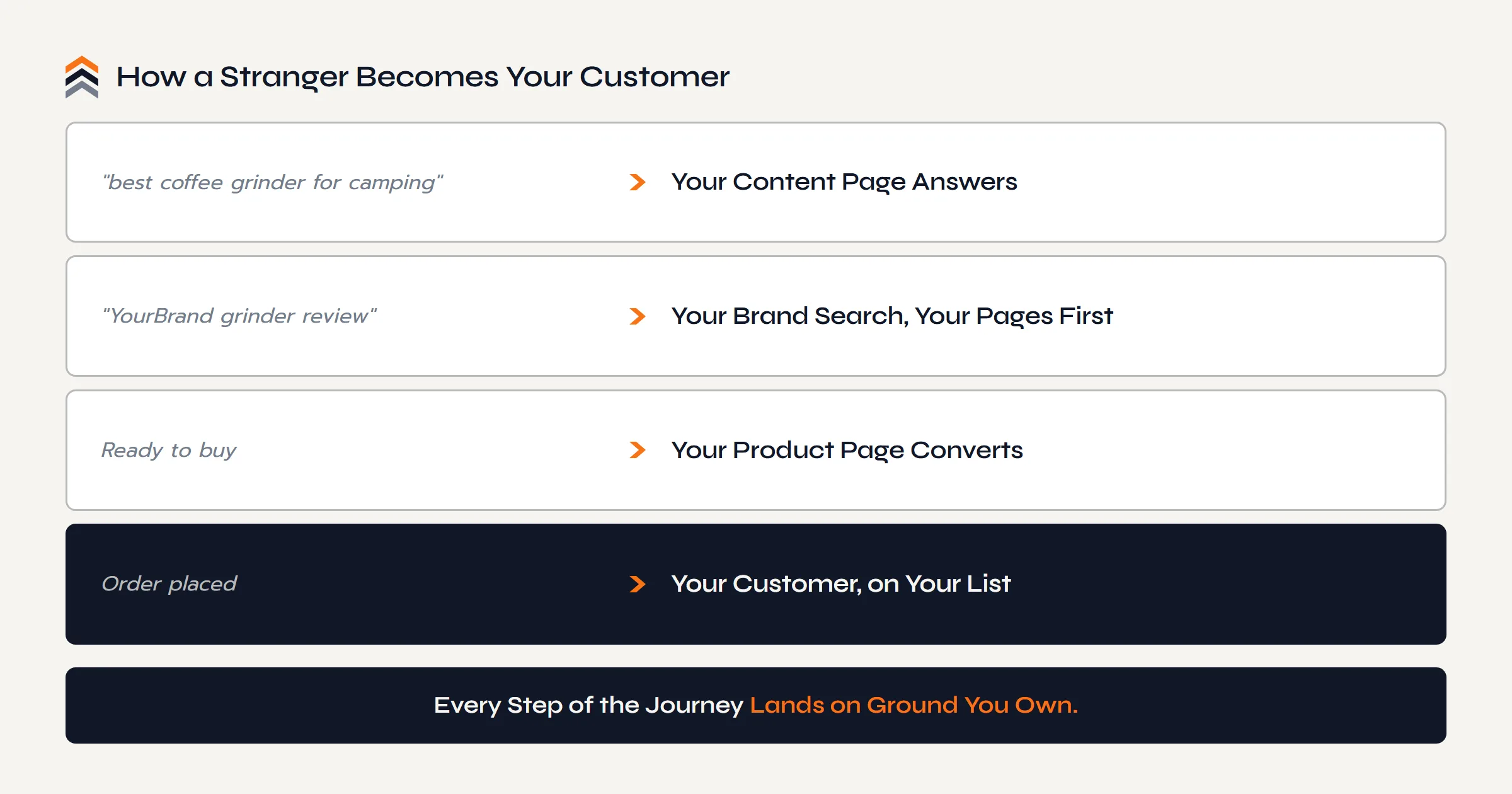
The standard advice says start with keyword research. For an Amazon seller the honest advice is simpler: start with your own name. Every order you have shipped taught someone your brand, and a slice of them Google it later. Today those searches land on your listing hemmed in by competitors' ads, on a reseller, or on nothing.
Those are the easiest rankings your store will ever earn, because Google wants the brand's own site to answer its own name. Claim them, and the site is productive in its first weeks while the longer game loads.
Then work outward in the order of intent: the category terms your collections can win, then the questions your content can answer better than anyone who has not shipped ten thousand units of the thing.
A Quick Test
Three searches, right now, in an incognito tab:
- Your brand name. Who owns the first page?
- Your product category. Whose store ranks?
- A question a buyer asks before choosing. Whose content answers it?
Every result is demand somebody owns. The rest of this guide is about becoming one of them.
What to Expect, Honestly
SEO's compounding is real and so is its patience requirement. Brand searches respond in weeks. Collection and content rankings build over months as the domain earns trust, and anyone promising a schedule is guessing with your money. What can be said honestly: the work never bills per click, does not reset when a budget pauses, and stacks, so page two's climb to page one happens while you sleep.
Ad spend stops the day you stop. Rankings keep showing up for work.
An Honest Note
Before anyone sells you a miracle:
- Nobody controls Google. Not us, not any agency. The work improves the odds; it cannot promise the position.
- Competitive categories are competitive here too. The advantage goes to specificity: your exact product, your exact buyer, answered better.
- SEO is a habit with a head start, not a project with an end date. The build provides the head start; the publishing rhythm is the habit.
Compounding rewards the brand that starts early and stays boring. Start early. Stay boring.
Why the Build Decides the Ceiling
Here is the part sellers rarely hear from SEO vendors: a large share of ecommerce SEO is settled before any content is written. Site structure that makes sense to a crawler, pages that load fast on a phone, product schema that feeds rich results, URLs that mean something, a platform whose ceiling is the sky rather than a template. Get those wrong and every later hour of SEO work pushes against them.
That is why the platform choice carried an SEO row in its comparison, and why our builds treat structure, speed, and schema as construction, not add-ons. The demand layer climbs from whatever floor the build pours.
Questions Sellers Ask
What Is Ecommerce SEO in Plain Terms?
Making your store the best answer Google can give to the searches your buyers run: their questions, their categories, your brand's name. The work lands on four fronts, product pages, collection pages, content, and technical health, and the reward is demand that arrives without a bill per click.
My Amazon Listing Already Ranks on Google. Is That Enough?
That ranking is real and it is Amazon's. The click lands on a listing beside competitors' ads, the customer becomes the marketplace's, and the asset builds equity for a domain you do not own. A brand site does not fight that listing; it takes its rightful place above it for your name, and the customer finally lands on ground that is yours.
Is SEO Worth It When I Can Just Run Ads?
They are different tools, not rivals. Ads buy reach today and stop the day the budget does; rankings build slowly and keep working after the work is paid for. Most strong brands run both eventually. The reason SEO deserves the early start is the compounding: the sooner it begins, the sooner the free demand line crosses the paid one.
How Long Does Ecommerce SEO Take to Work?
Brand-name searches respond within weeks, because Google wants your site answering your name. Category and content rankings are a months-long climb that accelerates as the domain earns trust, and no honest person attaches a date to it. Judge progress by direction and coverage rather than a deadline, and be suspicious of anyone who promises page one.
Do I Need a Blog?
You need content that answers your buyers' real questions, and a blog is simply the usual container for it. Ten pages that answer the ten questions people actually ask before buying your product outrank a hundred filler posts. What to write, and how content earns its keep for a product brand, gets its own guide later in this series.
Can My Platform Hurt My SEO?
Yes, mostly by capping it. Template-bound builders limit structure and speed; rented platforms limit how deep the technical work can go. WordPress's ceiling is the highest of the mainstream options, which is one of the reasons we build on it. The full comparison, including the SEO row, is in Choosing Your Platform.
Do I Have to Do the SEO Myself?
The structural half arrives with a proper build: our sites ship with the on-page foundations, speed, and schema in place. The ongoing half, publishing content and tending pages, is a habit someone has to own: you, a writer, or a marketing partner. What we do not do is sell ranking promises, because nobody controls the outcome. Anyone who says otherwise is selling weather.
Does SEO on My Site Help My Amazon Business Too?
More than you would guess. A brand visible on Google earns branded searches, and branded search volume is a signal Amazon's own algorithm rewards. Content that ranks introduces the brand to buyers who finish the purchase wherever they prefer, including your listing. The channels feed each other; the difference is which one keeps the equity from the work.
The Conclusion
Ecommerce SEO is not a new discipline you have to learn from zero. It is the discipline you already practice, aimed at a shelf you own. Product pages that convert, collections that catch categories, content that answers real questions, a foundation built fast and clean: four fronts, one habit, no per-click bill.
Start with the searches your orders already created, work outward with the patience the compounding deserves, and let the build set a ceiling worth climbing toward. Every position earned this way is an asset on your balance sheet instead of your landlord's.
Your sales can live on Amazon. Your brand should not.
The Next Move
You Have Read the Argument.
Pick Your Path.
Ready to Build
A free call, no pitch script. Walk us through your Amazon business and get a straight answer on what your own site would take.
Book a Free CallStill Weighing It
The Push Roadmap is the free PDF version of this decision. Put a number on where your brand stands before you commit to anything.