
The obvious way to reduce Amazon dependence is to sell less on Amazon. It is also the wrong way. Amazon is probably your best sales channel, and shrinking it does not make the business safer. It makes a fragile business smaller.
Sellers usually arrive at this question after a scare: an account flag that took a week to clear, a fee update that repriced the whole year, a suspension story from someone one mastermind away. The instinct is to loosen Amazon's grip by pulling revenue out of it. The better move is to keep every dollar of that revenue and change what would happen if it stopped.
This guide is about that second move: what dependence actually is, how to measure yours in five minutes, the diversification plays that quietly fail, and the four assets that work. If you are still weighing the channels themselves, start with the full comparison in Selling on Amazon vs Selling on Your Own Website.
What Amazon Dependence Actually Is
Ask how much revenue should come from Amazon and you will collect numbers: keep it under eighty percent, under seventy, under half. The numbers miss the point. Revenue share measures where your sales happen. Dependence measures what survives if they stop.
Picture two sellers, both doing ninety percent of their revenue on Amazon. The first has nothing else: no website, no list, no presence anywhere the marketplace does not control. The second runs a brand site that ranks for its own name, holds an email list built from years of orders, and takes a steady trickle of direct sales. Same split. Completely different businesses. If both accounts closed tomorrow, the first seller loses a business. The second loses a channel.
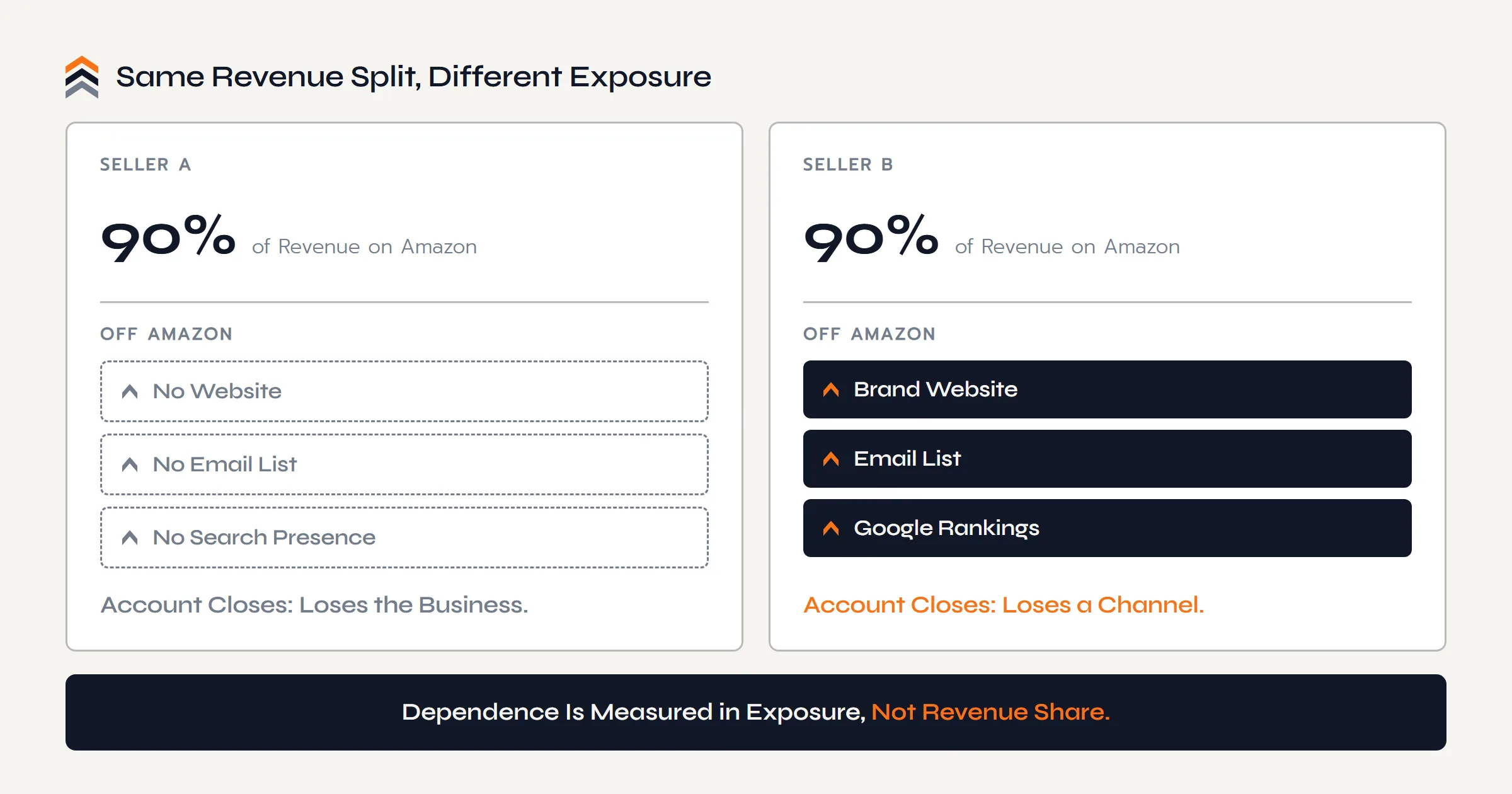
So that is the working definition for the rest of this guide. Dependence is the share of your business that exists only inside Amazon's walls: the customers you cannot contact, the rankings attached to their domain, the demand with no second route to you. You reduce it by moving that share onto ground you own, not by moving the sales.
Dependence is not the share of revenue Amazon brings in. It is the share of your business that disappears if Amazon does.
The Switch-Off Test
Here is the audit, and it takes five minutes, not a spreadsheet. Imagine the account closes tonight. Wrongly, temporarily, it does not matter. Walk through tomorrow morning.
A Quick Test
The switch-off test. Answer each one as of tonight:
- Could a customer who loves your product still find your brand tomorrow?
- Could you reach even a hundred of your past customers by tomorrow evening?
- Is there anywhere your product can be bought that you control?
- Would your brand exist anywhere Amazon's servers do not?
Count the nos. Each one is a dependence you are carrying, and each one has a matching asset later in this guide.
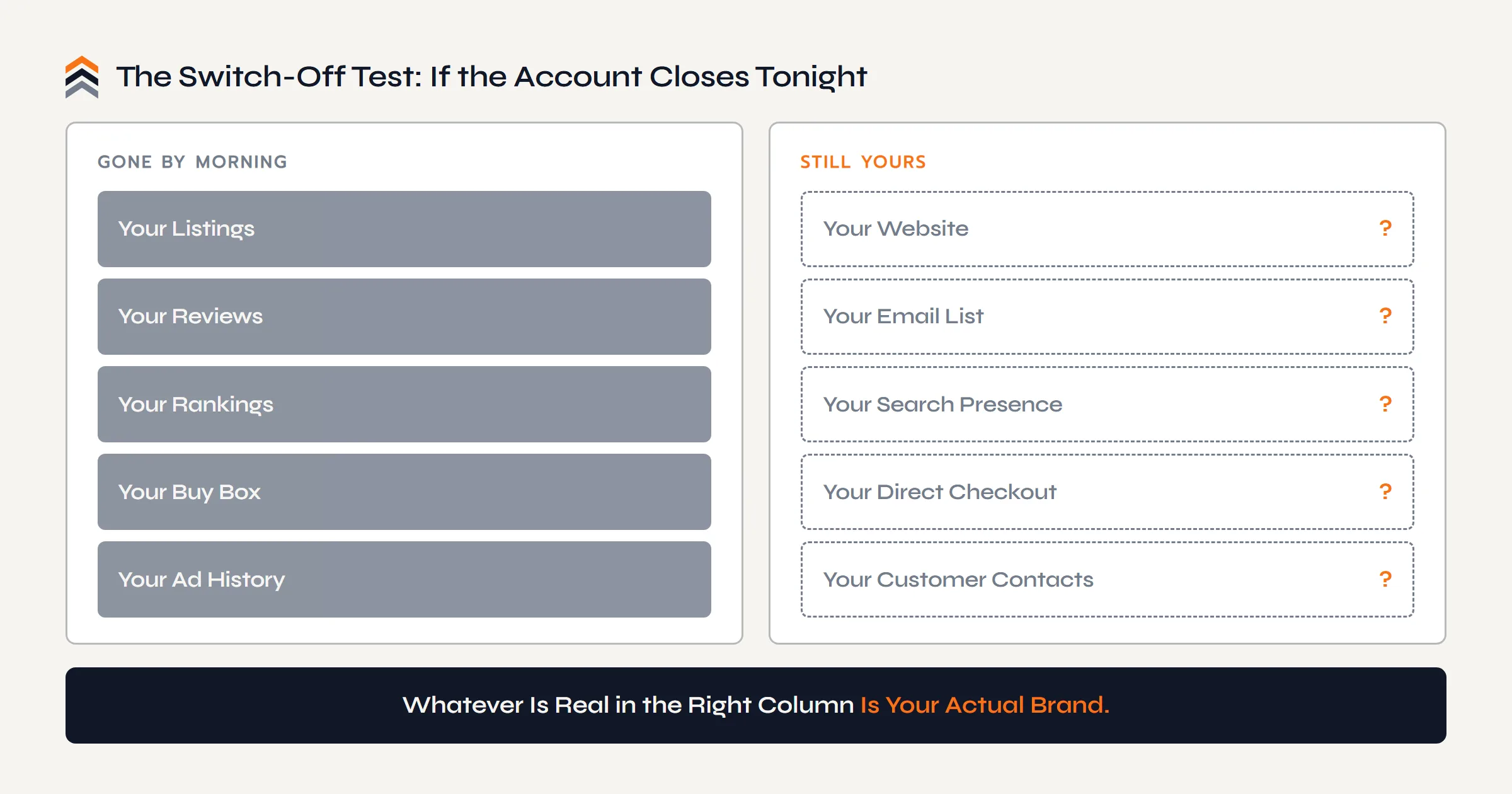
For most Amazon-first sellers the honest score is four nos, and it is worth saying plainly: that is normal, not negligent. The marketplace never asks you to build any of these things, because every one of them is something the platform prefers to keep. The test is not there to alarm you. It is there to turn a vague unease into a short, fixable list.
Why Dependence Deepens on Its Own
Dependence is not a mistake you made. It is the default outcome of doing Amazon well.
Every good move on the platform deepens the root system. FBA takes over fulfillment, so your logistics live in their warehouses. PPC finds your customers, so your demand arrives through their auction. Rankings compound on their domain. Prime badges, Subscribe and Save, Brand Registry perks: each one makes the channel work better and the exit heavier. None of this is a trap in the sinister sense. Amazon builds tools that reward depth because depth is good business for both sides.
It stays good business right up until you want something the marketplace does not sell: a customer you can talk to, a margin no fee update can touch, equity a buyer will pay for. Those are the outcomes the whole off-Amazon move exists to produce, and no amount of depth on rented ground produces any of them.
Three Ways Sellers Get Diversification Wrong
Diversify is the standard advice, and most versions of it quietly fail the switch-off test. Three patterns come up again and again.
- Selling less on Amazon. Capping the channel that works punishes revenue without touching risk. A seller at fifty percent Amazon with nothing owned is exactly as exposed to a single decision as one at ninety. Smaller, too.
- Adding more marketplaces. Walmart, eBay, Etsy. Real revenue, worth having, and worth seeing clearly: each one is another platform whose rules, fees, and customers belong to someone else. Spreading across landlords lowers the odds that one bad day hits everything, and it builds no equity at all. It is diversified renting, the same pattern we flag when sellers pick a rented platform for their own website.
- Waiting for the scare. The most common plan is no plan: build the second channel after the account wobble finally comes. But these are slow-compounding assets. A domain earns trust with age, a list grows order by order, rankings accrue quarter by quarter. The worst week to start building them is the week you suddenly need them.
You do not reduce dependence by selling less. You reduce it by owning more.
The Four Assets That Reduce Dependence
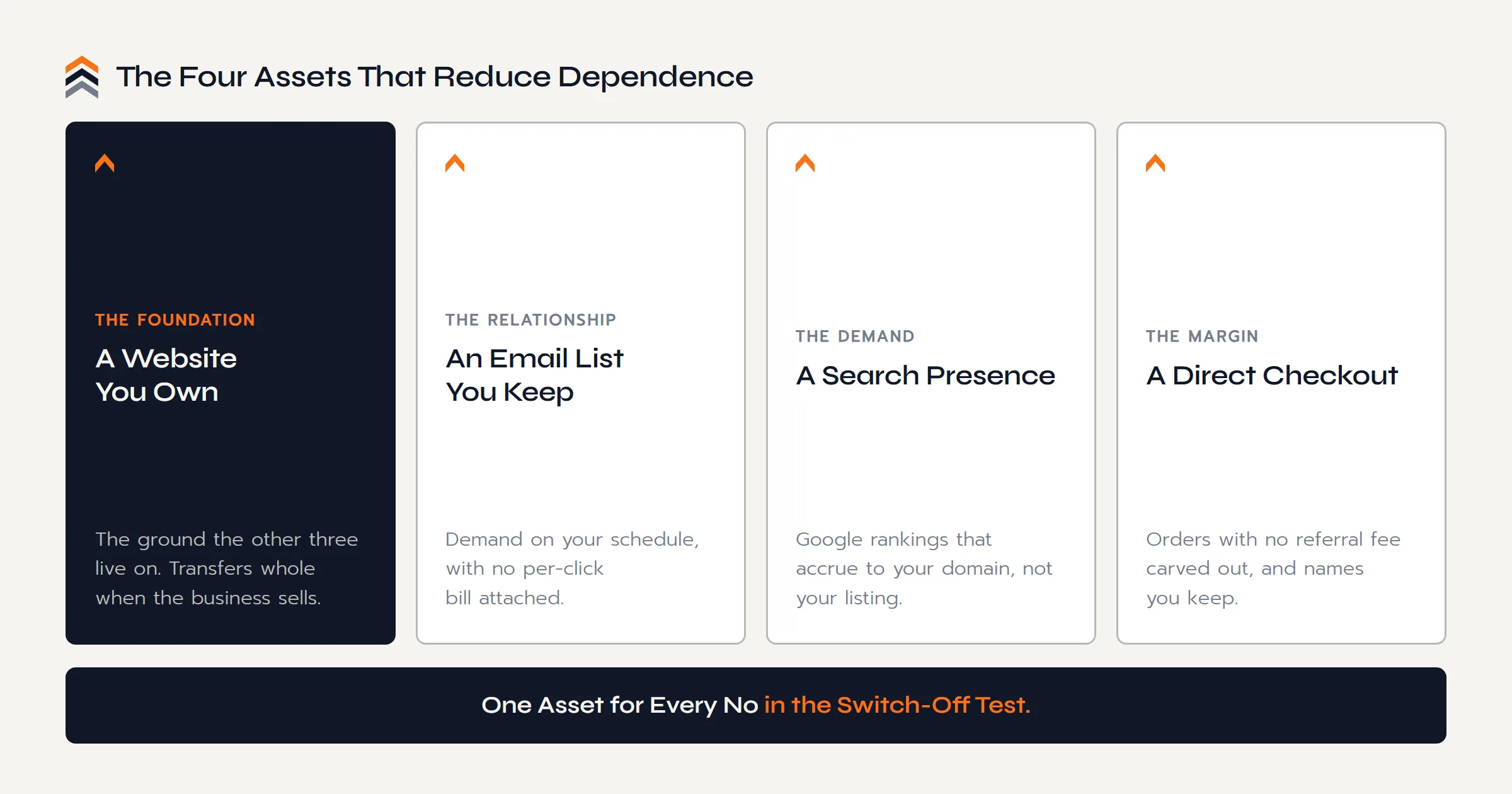
Every no in the switch-off test maps to an asset. There are four, and they are the same four every strong consumer brand ends up holding.
- A website you own. The foundation in the literal sense: the one property on this list the other three attach to. It is your brand's permanent address, the place brand searches resolve, the container for the list and the checkout, and the piece that transfers whole if you ever sell the business. Whether yours is ready for one has its own honest answer in Do Amazon Sellers Need Their Own Website?
- An email list you keep. The sharpest contrast with the marketplace, which has shipped your product to thousands of people without ever handing you a way to reach one of them. A list is demand you can trigger on your own schedule, at no per-click price, and it starts working from the first name on it. Turning those names into loyal brand fans has its own guide.
- A search presence of your own. Google demand that lands on your domain instead of your listing. It compounds the way the marketplace flywheel does, except the ranking belongs to you and keeps paying without a bid attached.
- A direct checkout. Even a modest one changes the arithmetic: orders with no referral fee carved out, customers whose names you actually hold, and proof to any future buyer that the brand sells beyond one platform. To see the arithmetic on your own product, run the free Amazon margin calculator.
Notice what is not on the list: another marketplace, a social following, an ad account. All three are useful, and all three live on rented ground. This list is the owned kind.

How Much of Your Business Do You Actually Own?
The switch-off test told you where the nos are. The Push Roadmap is a free 12 page PDF with the Ownership Scorecard: score where your brand stands today and see the move to owned ground mapped out.
Sent straight to your inbox.
The Sequence: Where to Start
The order matters more than the pace, because each asset feeds the next. The website comes first: it is the ground the rest stand on, and nothing else on the list has anywhere to live without it. Email capture starts the day the site does, so every visitor and every order can become a contact you keep. Search presence grows on top, because content and rankings need a domain to accrue to. And the direct checkout turns all of it into orders that owe no referral fee.
That sequence is the what and the where. The how is a build decision, and it is the part we do for a living: our builds ship exactly this stack, and every one ends with the ownership handover: your files, your domain, your list, your logins. The four assets, built out layer by layer, are the subject of The Complete Guide to Building Your Brand Beyond Amazon.
An Honest Note
Reducing dependence is not this year's job for every seller:
- Still validating the first product? Prove demand on the marketplace first. Dependence on a channel only matters once there is a business to lose.
- Reselling other people's brands? These assets build brand equity, and there is no brand of yours to attach them to yet.
- In a cash crunch? The second channel is bought with profit from the first. Stabilize, then build.
If any of these is you, the right amount of Amazon dependence, for now, is all of it. Just hold that position on purpose, and revisit it.
Keep Selling on Amazon the Whole Time
Nothing in this guide asks you to touch your Amazon business. It keeps doing what it is unbeatable at: discovery in front of shoppers holding a card, fulfillment at Prime speed, conversion on the biggest product search engine there is. That revenue is exactly what funds the assets above.
The two channels also feed each other more than sellers expect. A brand people can find on Google earns the branded searches Amazon's algorithm rewards. For registered brands, traffic you send to your own listings can earn back part of the referral fee through Amazon's Brand Referral Bonus. And your FBA stock can ship your website's orders through multi-channel fulfillment, so the second channel does not need a second warehouse.
Alongside, never instead. The point of reducing dependence was never to leave Amazon. It is to make staying a choice.
Questions Sellers Ask
How Much Amazon Dependence Is Too Much?
There is no magic percentage, because the revenue split is the wrong dial to watch. A seller at ninety percent Amazon with a working website, list, and search presence is safer than a seller at sixty percent with nothing owned. Run the switch-off test instead: the number of nos, not the revenue share, is your real dependence score.
Should I Sell Less on Amazon to Reduce My Risk?
No. Shrinking your best channel reduces income, not exposure, and the marketplace genuinely is the best tool for what it does. Keep the sales and build beside them. The full picture of what each channel does best is in Selling on Amazon vs Selling on Your Own Website.
Is Expanding to Walmart or eBay Real Diversification?
Partially. More marketplaces spread the income, so one platform's bad day no longer hits everything, and that has real value. What they do not add is ownership: every new marketplace is another set of rules, fees, and customers that belong to someone else. Treat marketplace expansion as revenue work and the owned assets as equity work. A durable brand does both, in that order of urgency reversed.
Can I Charge a Different Price on My Own Website Than on Amazon?
You can, but know the one rule that matters: pricing your product meaningfully lower elsewhere can cost your Amazon listing its Featured Offer placement under the marketplace's fair pricing policy. Most brands keep the sticker price consistent across channels and give the owned channel its edge through bundles, subscriber perks, and first access instead of undercutting.
Can I Reduce Dependence Without Building a Website?
Only slightly. A social following helps, but it lives on rented ground with its own algorithm and its own terms. Even an email list needs somewhere to send people that you control. The website is the one asset on the list that is owned outright, which is why the sequence starts there. Whether your business is ready for one is covered honestly in Do Amazon Sellers Need Their Own Website?
Does FBA Increase Amazon Dependence?
Yes, in fulfillment terms: your inventory sits in Amazon's warehouses under Amazon's storage rules. It is also, for most sellers, still the right call, because the logistics are excellent and the Prime badge converts. The eyes-open version is to use that same stock for your website's orders through multi-channel fulfillment, so the second channel launches without a second warehouse.
How Long Does It Take to Reduce Amazon Dependence?
There is no honest schedule, and anyone selling you one is guessing. What can be said is that each asset starts working the moment it exists: the site answers brand searches from day one, the list is usable from its first hundred names, and rankings compound from whenever the content starts. That is the strongest argument for starting before the scare rather than after it.
The Conclusion
Amazon dependence is not measured at the revenue line, and it is not fixed there either. It is measured by what survives the switch-off test, and it is fixed with assets: a website that is yours, a list you keep, search demand on your own domain, a checkout with your name on the receipt.
The sequence is short and it never touches your sales. Foundation, capture, demand, direct orders. Every step moves a piece of the business from the platform's side of the wall to yours while the marketplace keeps doing what it does best. That model has a name here: The Push Concept, and it is not anti-Amazon. It is pro-ownership.
Your sales can live on Amazon. Your brand should not.
The Next Move
You Have Read the Argument.
Pick Your Path.
Ready to Build
A free call, no pitch script. Walk us through your Amazon business and get a straight answer on what your own site would take.
Book a Free CallStill Weighing It
The Push Roadmap is the free PDF version of this decision. Put a number on where your brand stands before you commit to anything.