
You do not have an Amazon business. You have an Amazon revenue stream. The difference between those two sentences is what this guide is about.
Imagine two brands, both doing $50,000 a month on Amazon. Five years on, the first owner holds a seller account. The second holds the same account, plus a website that ranks on Google, an email list that produces reorders on demand, and customers who search for the brand by name. The revenue was identical the whole way. The businesses are not worth the same, and it is not close.
That gap is the subject of this comparison: what each channel actually does better, what the fees really look like on a real order, the risk nobody prices in, and the situations where a website is the wrong move. It is the same model behind The Push Concept, the thinking every Sellers Push build follows.
The Real Question Is Ownership
Put two screenshots side by side. An Amazon listing converting at a healthy rate, and a young brand site getting a fraction of the traffic. On sales alone, the listing wins every time. It is also the wrong comparison.
The two channels are not doing the same job. Amazon sells your product. A website builds your business. One produces this month's revenue. The other decides what you actually hold when the month is over: the customer, their email address, the next sale at no acquisition cost, and a brand that exists somewhere other than a search results page.
So the real question is not which channel sells more. It is what you want to be holding three years from now: a bigger seller account, or a brand with its own ground. The rest of this guide compares the two jobs so you can answer that on numbers instead of mood.
What Each Channel Actually Is
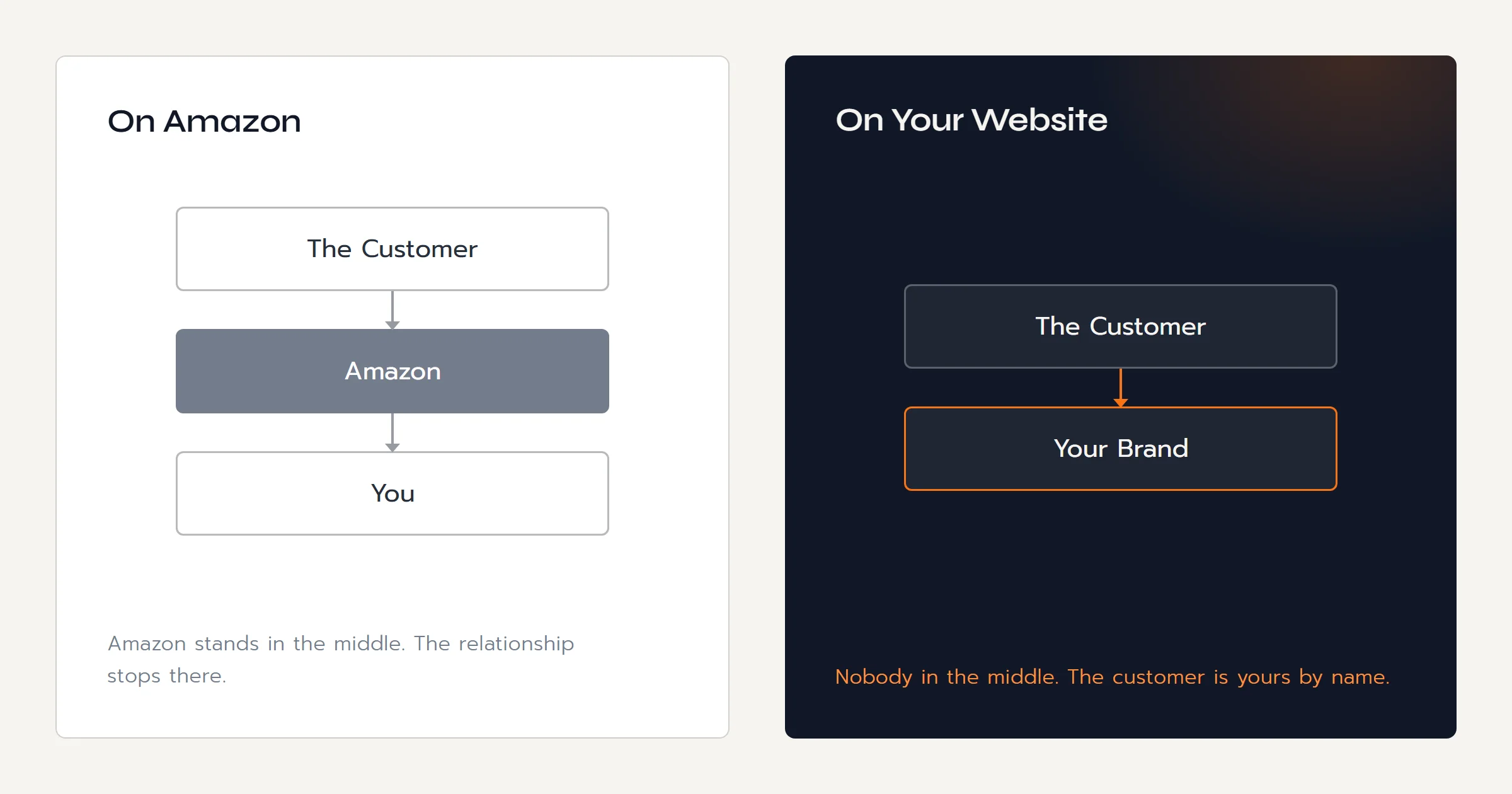
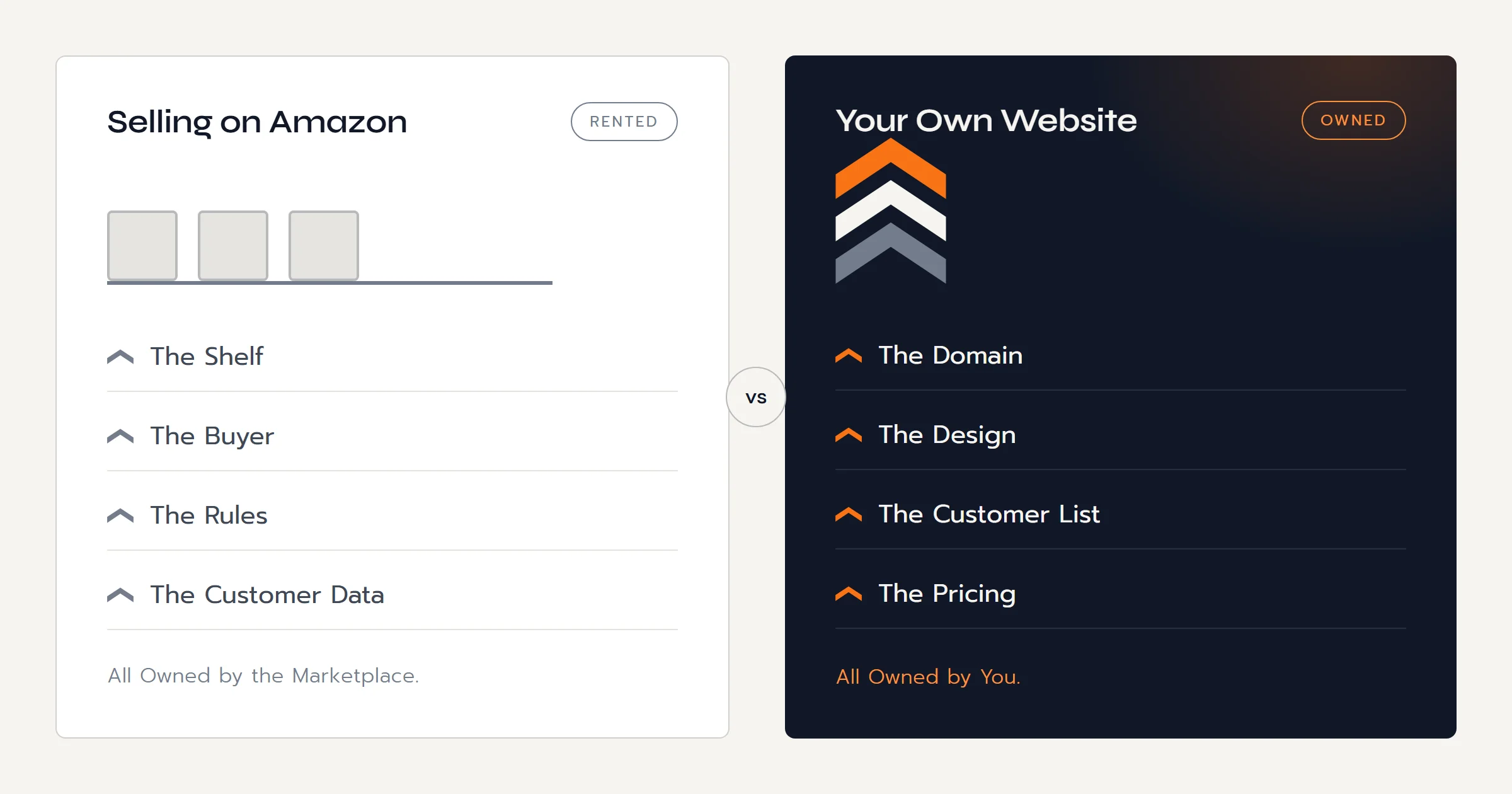
Selling on Amazon is renting a shelf in the world's busiest store. You bring the product and pay the fees; Amazon brings the customers, the trust, and the logistics. As a deal for cash flow, it is exceptional. It is also rented: the shelf, the buyer, and the rules all belong to the landlord.
Your own website is ground you hold the deed to. The domain, the design, the customer list, the pricing, every word of the story: yours. Nobody can change the rules on it or raise the rent. The trade is that nobody sends you customers either. Demand has to be built, through Google, content, email, and ads.
Neither one is good or bad. They are different instruments.
Amazon compounds revenue. A website compounds ownership.
The Side by Side Comparison
The whole picture in one view. Every row is expanded in the sections that follow.
| What Matters | Selling on Amazon | Your Own Website |
|---|---|---|
| The Customer | Stays with Amazon. No email, no contact, no relationship. | Yours by name: email, history, and the next sale. |
| Fees per Order | Referral fee, around 15% in most categories, plus FBA fees. | Payment processing, around 3%, plus fulfillment you choose. |
| Demand | Built in. Millions searching with a card in hand. | Built by you: Google rankings, content, email, ads. |
| Trust at First Sale | Instant. Prime badge, familiar checkout, easy returns. | Earned, through design, proof, and brand. |
| Design and Story | A template listing in a grid of competitors. | Fully yours, from first pixel to last word. |
| Pricing Control | Squeezed between the fee stack and the lowest bidder beside you. | Yours. Preference lets you price on value. |
| If the Account Breaks | Income pauses with it while the appeal runs. | Unaffected. It keeps selling. |
| Value at Exit | Transfers thin. An account on rented ground. | Transfers as brand equity: domain, list, demand. |
Where Amazon Wins
An honest comparison starts by giving Amazon its due, because its advantages are enormous and no website replaces them.
- The demand is already there. More product searches start on Amazon than anywhere else. Those are buyers, not browsers, and no young brand site starts with anything close to that.
- Trust is instant. The Prime badge, a checkout the buyer has used a hundred times, returns they never worry about. Strangers buy from strangers in seconds because Amazon vouches for the middle.
- Fulfillment is solved. FBA turns logistics into a fee. Storage, picking, two day delivery, returns: handled, at a scale no small brand can match alone.
- Speed to the first sale. A new listing can sell this week. A new website needs months of demand building before it carries real weight.
If the goal this quarter is cash flow, Amazon wins, and it is not close. Nothing in this guide argues otherwise.
Where Your Own Website Wins
Everything Amazon keeps, a website hands to you. These are the four outcomes that matter to the business, not to the channel.
- You keep the customer. An Amazon sale ends at the sale. You get the payout; Amazon keeps the person. Every reorder is won again on a search page where competitors bid on your keywords. On your site, the buyer is yours by name, and the second sale, the cheapest revenue a brand ever earns, costs an email instead of an ad budget.
- You keep the margin. The referral fee stack stays in your pocket on every direct order. Even a partial direct channel lifts your blended margin across the business.
- Google sends you buyers Amazon never will. A website can rank, build search demand, and pull in customers who never opened Amazon. That is new demand, not shifted demand.
- You become a brand, not a listing. Design, voice, story, proof: the things that make a customer choose you on purpose. Preference is pricing power today, and at exit it is the difference between selling an account and selling a company. Buyers pay for what transfers.
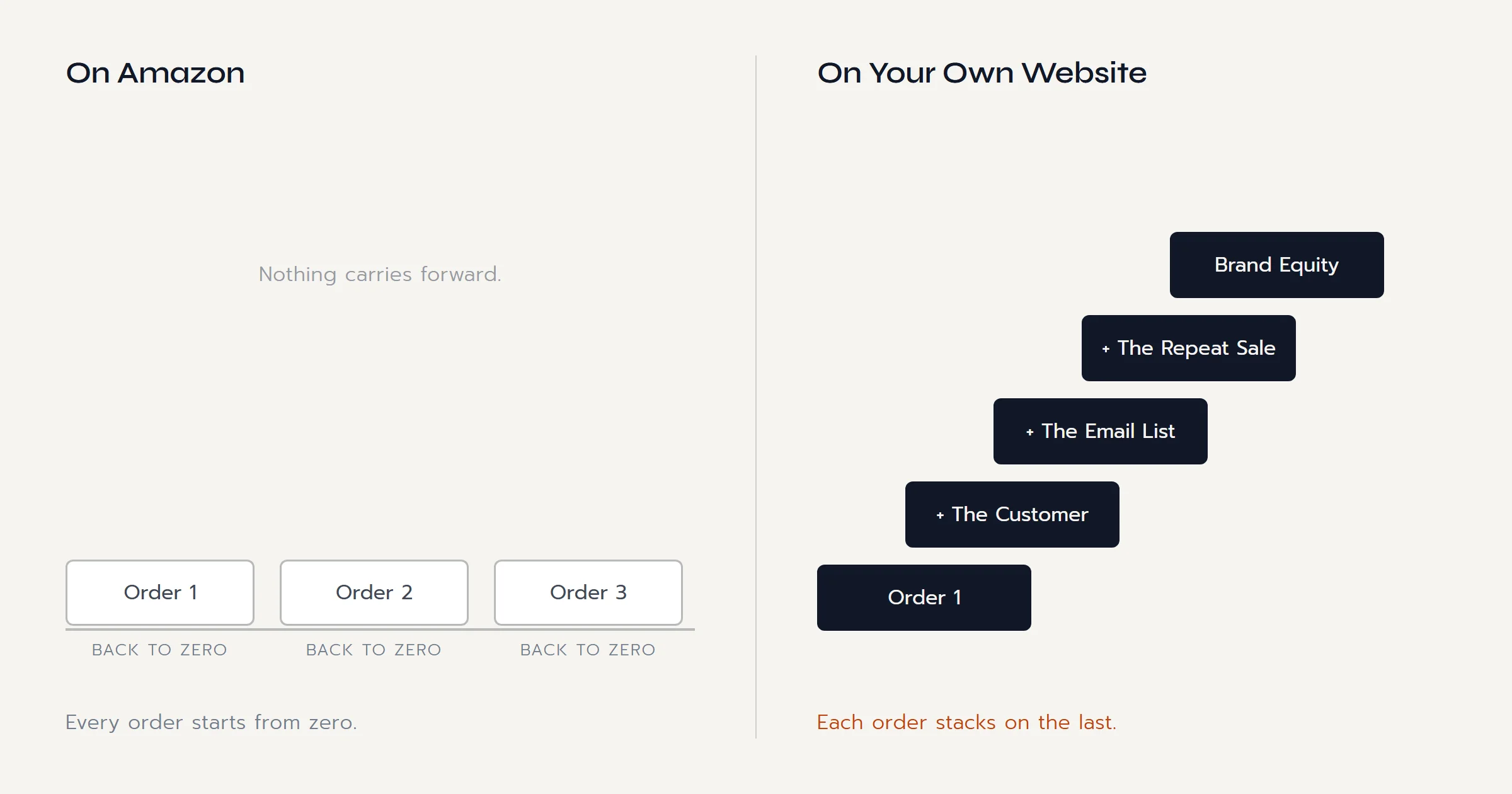
Every Amazon sale starts from zero. Every website sale starts from a customer you already own.
A Quick Test
Suppose a buyer looks at two brands with identical revenue.
- Business A owns a seller account.
- Business B owns the same account, plus a website, the email list behind it, Google rankings that pull buyers in daily, and customers who reorder direct.
Which one commands the higher offer, and why is the answer instant? That difference is brand equity, and it is built long before anyone thinks about selling. Revenue transfers thin. Ownership transfers whole.
The Fee Math on a Real Order
Take a $40 product, small standard size, and follow one order down each path. Round numbers, both sides before advertising.
| On a $40 Order | Amazon | Your Own Website |
|---|---|---|
| Marketplace / Platform | Referral fee, 15%: about $6.00 | None |
| Payment Processing | Included in the referral fee | About 3% plus 30 cents: about $1.50 |
| Fulfillment | FBA, roughly $5.50 for a typical small item | Roughly $5.50 to $7.00 via a 3PL, or shipped from your existing FBA stock |
| Total Fees | About $11.50 | About $7.00 to $8.50 |
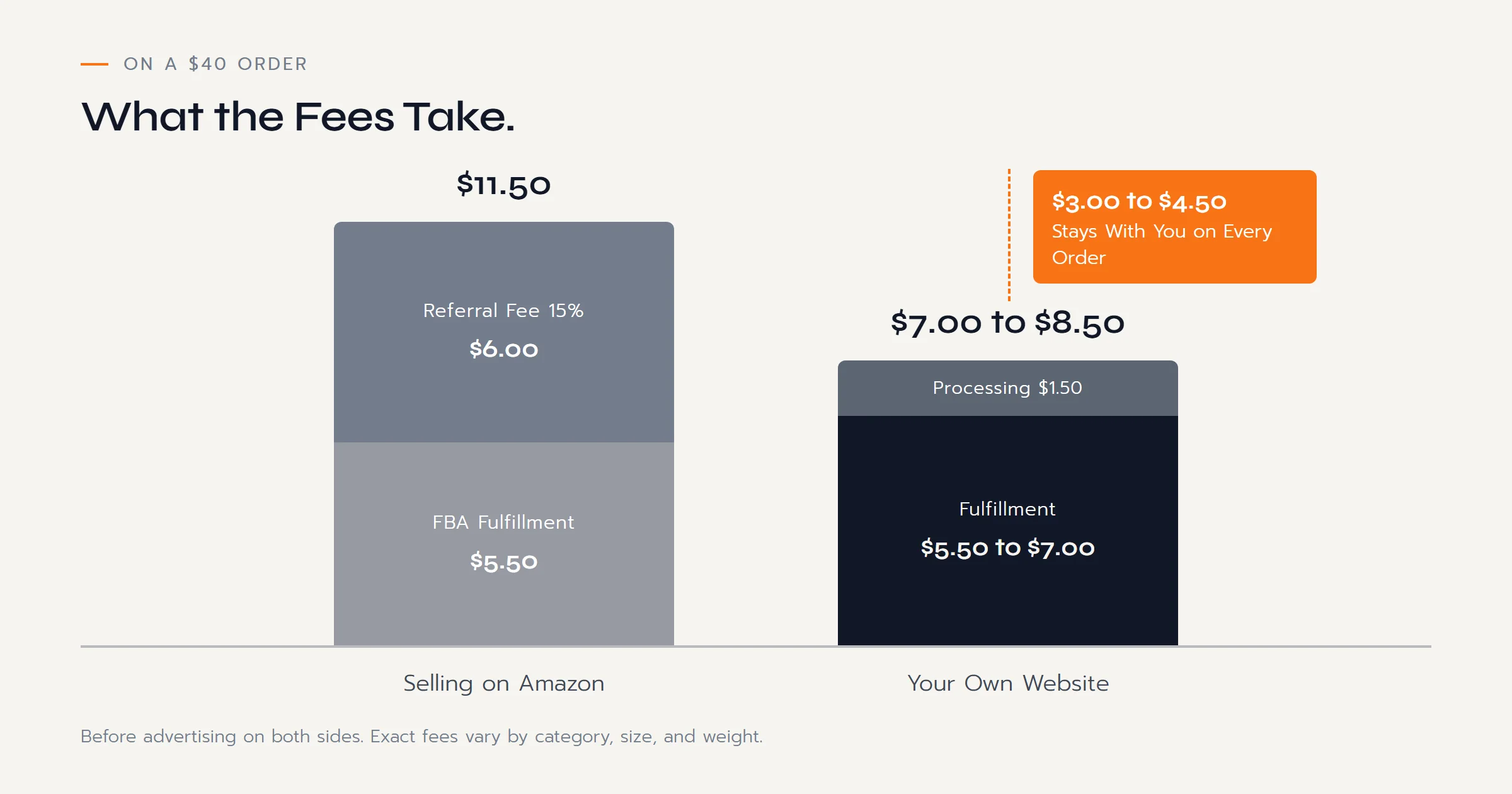
Roughly three to four and a half dollars more per order stays with you. On a thousand orders a year, that is real money. And it is still not the point.
The point is what the spend builds. Traffic is not free on your website either; you pay for it in content, search work, and ads. But on Amazon, demand is rented per order, forever: the referral fee and the PPC bill arrive on every sale, including the fifth sale to the same customer. On your own site, the spend compounds into assets. A ranking keeps pulling without a per-click bill. An email list costs nothing to sell to twice.
Rented demand resets to zero after every order. Owned demand accumulates.
Exact fees move around by category, size, and weight, and Amazon updates its schedule regularly. Check current numbers before modelling your own product. The shape of the math does not change. To run this table on your own product, the free Amazon margin calculator does the same comparison with your price and category in about a minute.

How Much of Your Business Do You Actually Own?
Before another year of building rented revenue, put a number on it. The Push Roadmap is a free 12 page PDF with the Ownership Scorecard: score where your brand stands and see the move mapped out.
Sent straight to your inbox.
The Risk Nobody Prices In
Concentration. When Amazon is the only channel, the entire income stream sits behind one login, governed by rules you do not write, enforced at machine scale. A flagged keyword, a competitor complaint, a category policy update, and a listing or an account can pause while the appeal works through the queue. Honest sellers get caught in it every week.
This is not a reason to fear Amazon. It is a reason not to stand entirely on it. A brand site is the channel no marketplace decision can touch: it keeps selling while an appeal runs, and it turns a shutdown into a bad week instead of a crisis. Measuring that exposure, and lowering it without giving up a dollar of the channel, has its own guide: Reducing Amazon Dependence.
There is a quieter version of the same risk. Amazon sees every data point of demand in your category, and regulators in the US and Europe have documented how marketplace data has been used competitively. You cannot control that. You can only decide how much of your business lives inside it. We keep the full breakdown of these gaps, and what each one costs, on What You Don't Own.
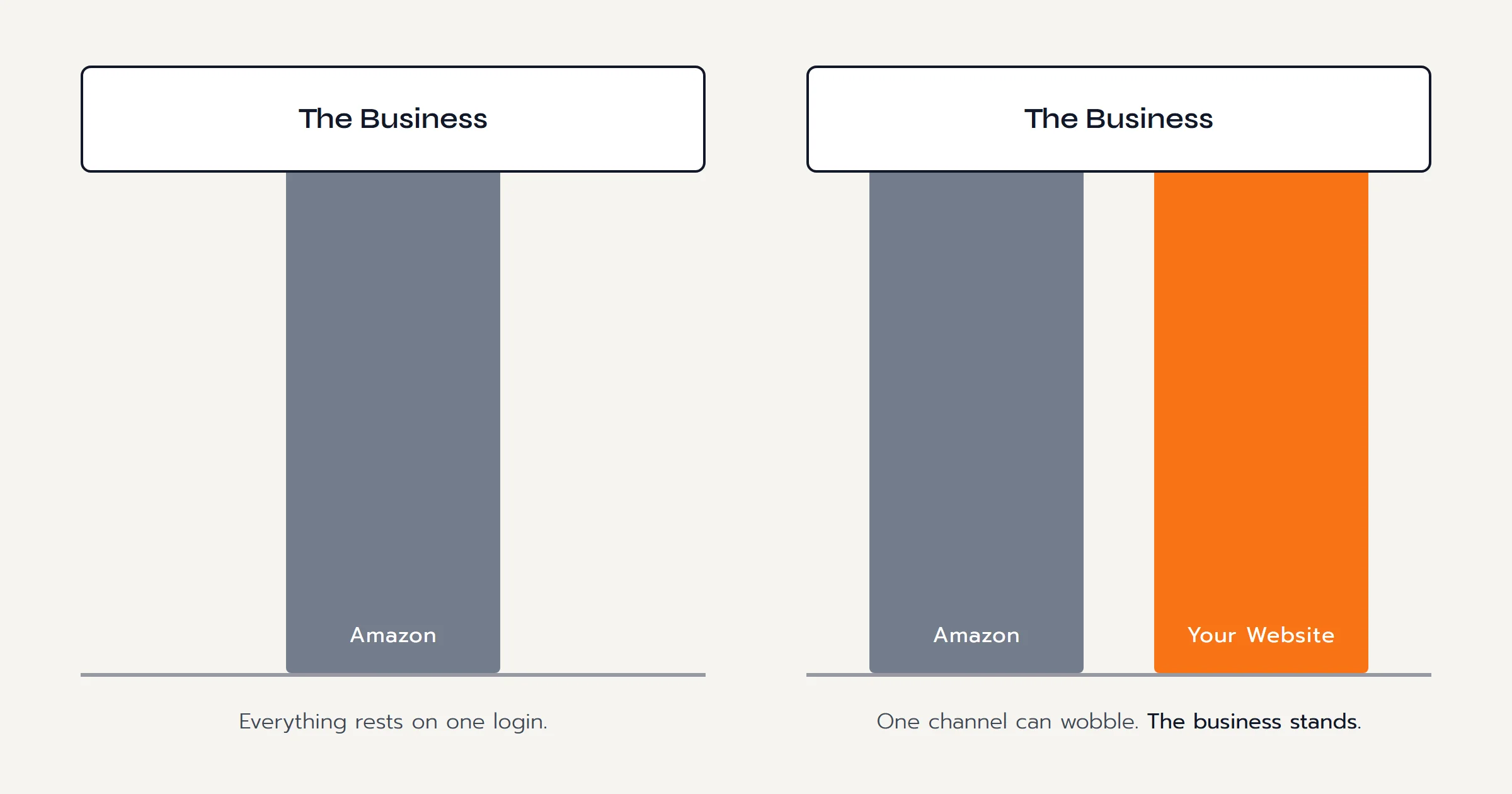
Selling on Both at the Same Time
Yes, you can, and it is the standard play for established brands, not a workaround. The same brand on both channels, each doing the job it is best at. What actually carries over when you add the second channel, and what stays put, is walked through in Amazon to Your Own Store.
A few things worth knowing about running the pair:
- Brand Registry and a website reinforce each other. Registry protects your listings inside Amazon; the website builds the brand that exists outside it. One trademark serves both.
- Your FBA stock can ship your website's orders. Amazon's multi-channel fulfillment fills orders from other channels out of the same inventory, so a website does not require a second logistics operation on day one.
- One rule to respect: Amazon prohibits redirecting its buyers off the marketplace. No links in listings, no package inserts asking for direct orders. The compliant route is bigger anyway: build a brand memorable enough that buyers search for it on Google. That search is yours to win, and Amazon has no say in it.
When Your Own Website Is Not the Right Move Yet
A guide that only ever says yes is a sales page. There are three situations where we would tell you to wait.
An Honest Note
- If you resell other brands' products, through arbitrage or wholesale, there is no brand of yours to own yet. A website adds little until there is something of yours to build it around.
- If sales are not steady yet, cash flow comes first, and Amazon builds cash flow faster than any website will. Win the listing battle before opening a second front.
- If you are mid launch with no bandwidth, wait. A website is a project. Started at the wrong time, it steals exactly the focus your Amazon growth needs.
If one of those is you, stay put for now. The groundwork below is free and will be just as useful in six months.
What Established Brands Actually Do
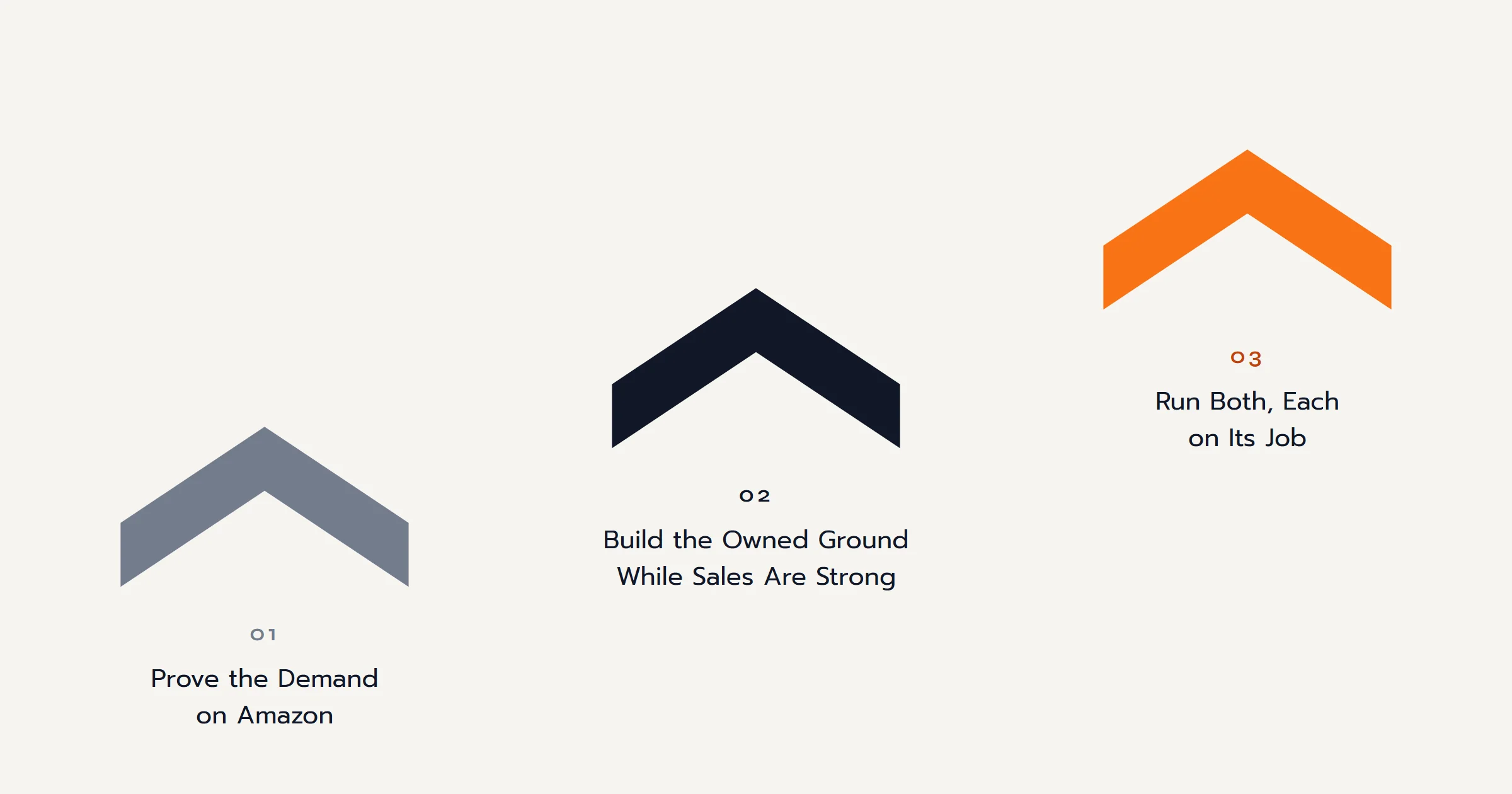
The pattern across brands that make this move well is a sequence, not a choice. The whole route, mapped layer by layer, is in The Complete Guide to Building Your Brand Beyond Amazon.
- Prove the demand on Amazon. Rented demand is the fastest, cheapest way to find out whether the product wins. That is what the marketplace is for.
- Build the owned ground while sales are strong. The best time to build the website is when nothing is wrong: cash flow is steady, there is no crisis forcing the timeline, and the brand gets built with intention instead of urgency. That window is exactly what our build packages are designed for.
- Run both, each on its job. Amazon stays the reach engine. The website becomes the ownership engine: the customer list, the direct margin, the Google demand, the asset. Neither replaces the other, and neither is supposed to.
The sellers who struggle are the ones who wait for a reason: the suspension, the fee increase, the copycat undercutting them. By then the website is triage instead of strategy. The ones who do it well build the second channel before they need it.
Questions Sellers Ask
Is It Better to Sell on Amazon or Your Own Website?
For reach and cash flow, Amazon. For ownership, margin, and brand, your own website. For an established seller the answer is almost always both: the marketplace for what it does best, owned ground beside it for everything the marketplace keeps.
Can You Direct Amazon Customers to Your Website?
Not directly. Amazon's policies prohibit diverting its buyers off the marketplace, so links in listings and package inserts asking for direct orders put your account at risk. What you can do is build a brand memorable enough that customers search for it on Google, and make sure your website is what they find. That route is fully compliant and worth more anyway.
Does Amazon Give Sellers Their Customers' Contact Details?
No. Buyer names, emails, and order histories stay with Amazon, and its policies prohibit using order data to market to customers. After thousands of sales you can hold a strong revenue stream and still not be able to reach a single buyer directly. That customer relationship is exactly what an owned website builds, order by order.
Do You Need a Website to Sell on Amazon?
No. Amazon does not require one, which is exactly why most sellers never build one, and why the ones who do stand out. The website is not for Amazon's benefit. It is for yours: the customer list, the direct sales, and the brand equity an account alone never produces. The full answer, including the four signals it is time, is its own guide: Do Amazon Sellers Need Their Own Website?
Does Building a Website Hurt Your Amazon Sales?
No. The website runs beside the account, not against it, and the two tend to feed each other: a brand people can find on Google builds the branded searches Amazon's algorithm rewards, and shoppers who research you off Amazon often finish the purchase on it. The risk runs the other way. An account with no second channel has no floor under a bad week.
Can You Use FBA to Ship Orders From Your Own Website?
Yes. Amazon's multi-channel fulfillment ships orders from any channel out of your existing FBA inventory. Per-unit costs run higher than standard FBA, but it means a new website can take orders on day one without a warehouse, and you can move to a 3PL later if the volume justifies it.
What Is the Best Platform for a Seller's Own Website?
Any mature ecommerce platform can run a brand site, so the real question is ownership. We build client sites on WordPress and WooCommerce because the software is yours outright: no monthly platform rent, no feature paywalls, and the whole stack transfers with the business if you ever sell it. Renting a storefront off Amazon defeats the point of leaving rented ground. The full three-way comparison is its own guide: Choosing Your Platform: WordPress vs Shopify vs Wix.
What Does a Brand Website Cost?
Anywhere from a few hundred dollars for a template you assemble yourself to five figures at a big agency. Purpose-built for an Amazon seller, with the brand story, the product pages, and the ownership handover done properly, it is a four figure project. Our packages and prices are public on the Services page, so you can see exactly where you would land.
The Conclusion
Amazon or your own website was never the real question. Amazon is the best sales engine in retail, and if it is producing steady revenue for you today, nothing in this guide says to slow it down. The question is what all that selling leaves behind for you. On Amazon alone, the answer is a payout and a rank, and both live on rented ground.
So the honest conclusion is a sequence, not a side. Keep Amazon as the reach engine it is. Build the ground you own while sales are strong, so the customer list, the direct margin, the Google demand, and the brand equity start compounding for you instead of for the marketplace. Then run both, each on its job.
And if the timing is wrong, wait with a clear conscience: a reseller catalog, unsteady sales, or a mid-launch crunch are all real reasons to hold. The sellers who get this right are not the ones who move fastest. They are the ones who build the second channel before they need it.
Your sales can live on Amazon. Your brand should not.
The Next Move
You Have Read the Argument.
Pick Your Path.
Ready to Build
A free call, no pitch script. Walk us through your Amazon business and get a straight answer on what your own site would take.
Book a Free CallStill Weighing It
The Push Roadmap is the free PDF version of this decision. Put a number on where your brand stands before you commit to anything.