
Ask Amazon whether you need a website and the answer is no. Nothing in Seller Central requires one, no policy checks for one, and the payouts arrive either way. You can build five figures a month without owning so much as a domain.
Most sellers hear that as permission. It is worth hearing as a warning instead: everything Amazon does not require you to build is something Amazon is content to keep. The customer list you never collected. The brand searches you never caught. The story nobody can find. None of it is required. All of it is the difference between a seller account and a business.
This guide answers the question the way an owner should ask it: what a website actually produces that an account cannot, the four signals the answer has turned to yes for your brand, and the situations where waiting is genuinely the right call. The thinking behind it is The Push Concept, the model every Sellers Push build follows.
The Short Answer
No, you do not need a website to sell on Amazon. You can register, list, sell, and scale without one, and no rule will ever force the issue. Anyone telling you a website is mandatory is selling you one.
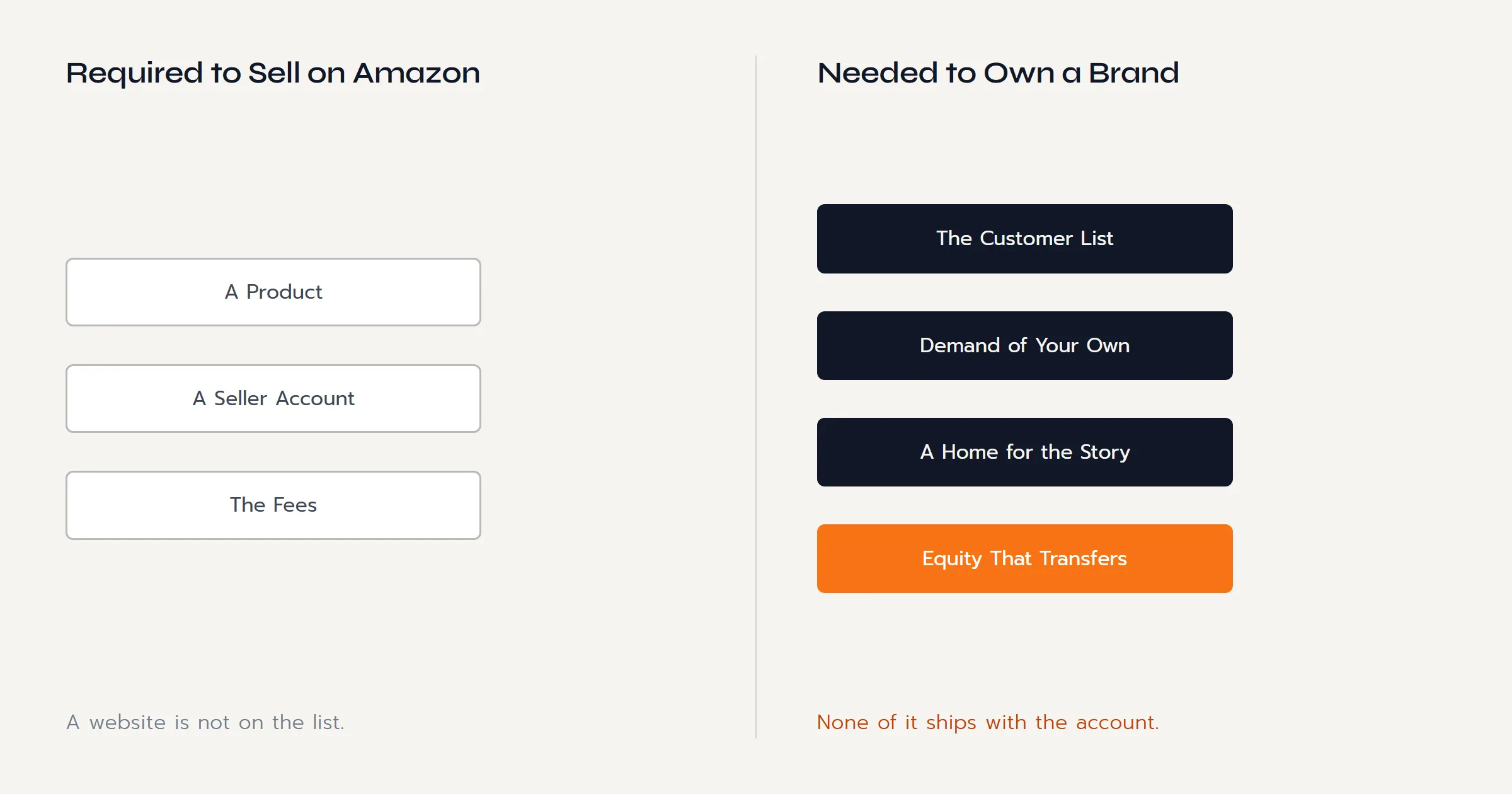
But sellers do not ask this question because of a rule. They ask because something feels unfinished: real revenue, real customers, and somehow nothing that feels like a brand. That instinct is correct, and it has nothing to do with compliance. "Do I need a website" is two questions wearing one sentence. Required to sell? No. Needed to own anything beyond the account? Yes, and the gap between those two answers decides what you are holding three years from now.
A website is not a requirement of selling. It is a requirement of owning.
What Amazon Gives You Without a Website
An honest answer starts here, because the account alone is a serious machine and pretending otherwise would be selling, not teaching.
- The demand is built in. More product searches start on Amazon than anywhere else, and they come from buyers with a card in hand, not browsers.
- Trust is instant. The Prime badge, a checkout the buyer has used a hundred times, returns nobody worries about. Strangers buy from strangers in seconds.
- Fulfillment is solved. FBA turns storage, picking, two day delivery, and returns into a line item.
- The first sale comes fast. A new listing can sell this week. No website matches that speed from a standing start.
That list is why the honest answer to "required" is no. If the goal this quarter is revenue, the account alone gets you there, and a website will not speed it up. The question is what happens to everything else while the revenue runs.
And if you want the two channels weighed row by row, fee math included, that comparison is its own guide: Selling on Amazon vs Selling on Your Own Website.
What an Account Alone Never Gives You
Scale fixes most problems. It never fixes these four, because they are not problems of size. They are what the marketplace keeps by design, at ten orders a day or a thousand. We keep the full breakdown on What You Don't Own; here is the short version.
- The customer relationship. You can ship ten thousand orders and finish without a single email address. Every buyer is Amazon's customer shopping your listing, and every reorder is won again on a search page.
- Demand of your own. Rankings, brand searches, and the traffic they bring belong to whoever owns the page they land on. Without your own ground, the demand you earn lands on someone else's.
- A home for the story. On a listing, your brand is a logo above bullet points in the same template as the seller beside you. Preference, and the pricing power that follows it, needs somewhere to live.
- Equity that transfers. When a brand sells, buyers pay for what transfers whole: the domain, the list, the demand. An account by itself transfers thin.
You can sell for years without one. You cannot own without one.
A Quick Test
Open Google and search your brand name, exactly the way a happy customer would.
- If your own website comes first, you are ahead of most sellers reading this page.
- If your Amazon listing comes first, look at what sits around it: that is real estate competitors can bid on, including on your own brand name.
- If nothing of yours appears at all, your brand currently exists only inside a marketplace you do not control.
That results page is the need, made visible. A brand that cannot be found off Amazon does not exist off Amazon.
The Four Signals the Answer Is Yes
Need is not a mood. It shows up in the numbers, and it usually shows up in one of these four ways.
- Buyers are searching for you by name. Brand searches on Google are demand you already earned. Right now they land on a listing beside your competitors, or on nothing at all.
- Your product gets reordered, and every reorder costs ads. In a repeat-purchase category, paying acquisition fees for the same customer twice is the most expensive habit on the P&L. A customer list ends it.
- Ad costs keep climbing. When PPC eats a little more margin every quarter, the business needs one channel where demand does not arrive with a per-click bill attached.
- An exit is somewhere on your horizon. Even three years out. Equity is built long before the listing goes up, and buyers pay for assets, not history.
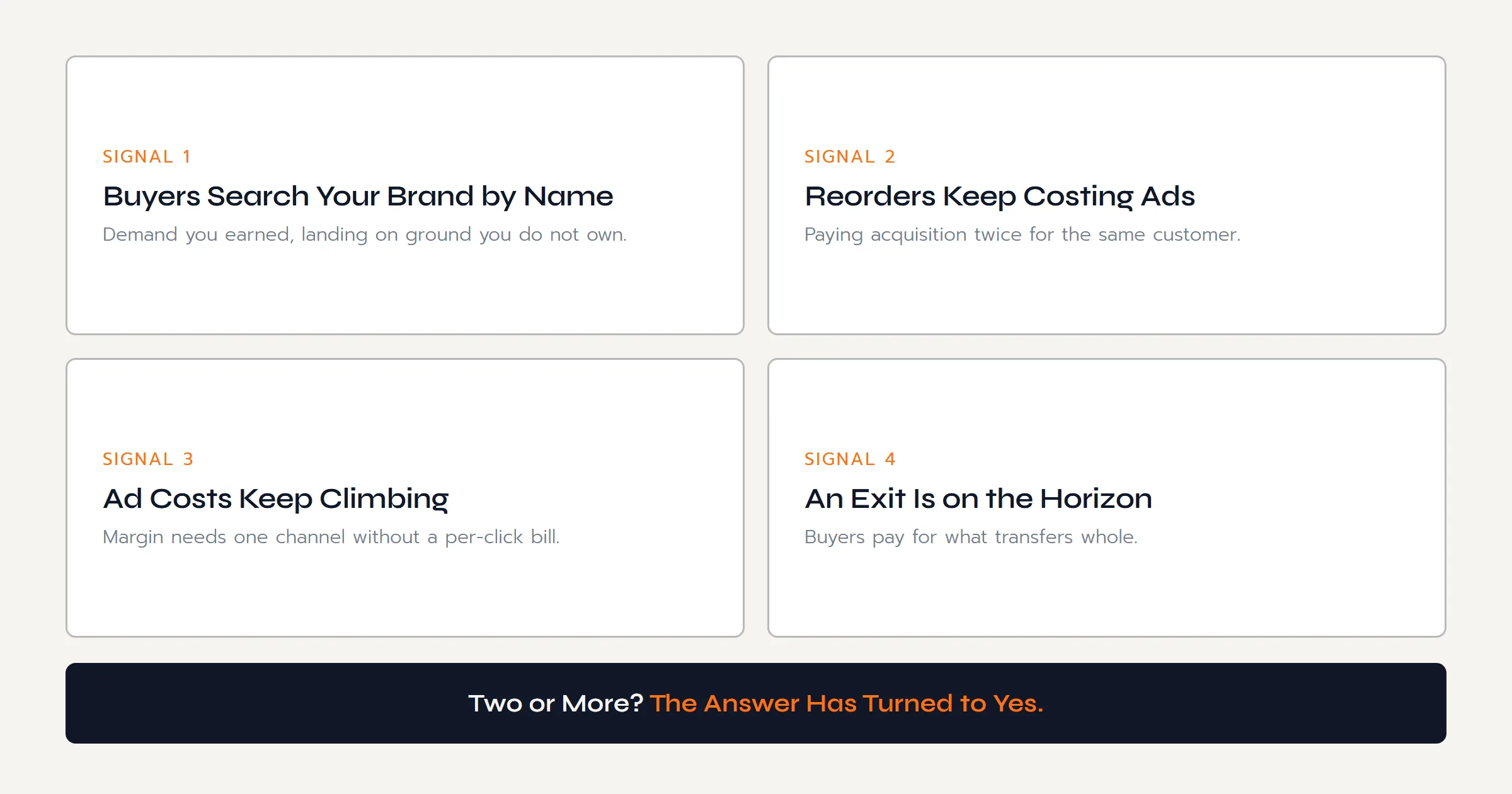
One signal is a nudge. Two or more is the business telling you the answer has changed, whatever the rules say. And if the count came back at two or more, the playbook for lowering that exposure without touching your Amazon sales is Reducing Amazon Dependence.

How Much of Your Business Do You Actually Own?
Before another year of building rented revenue, put a number on it. The Push Roadmap is a free 12 page PDF with the Ownership Scorecard: score where your brand stands and see the move mapped out.
Sent straight to your inbox.
What a Brand Website Actually Does
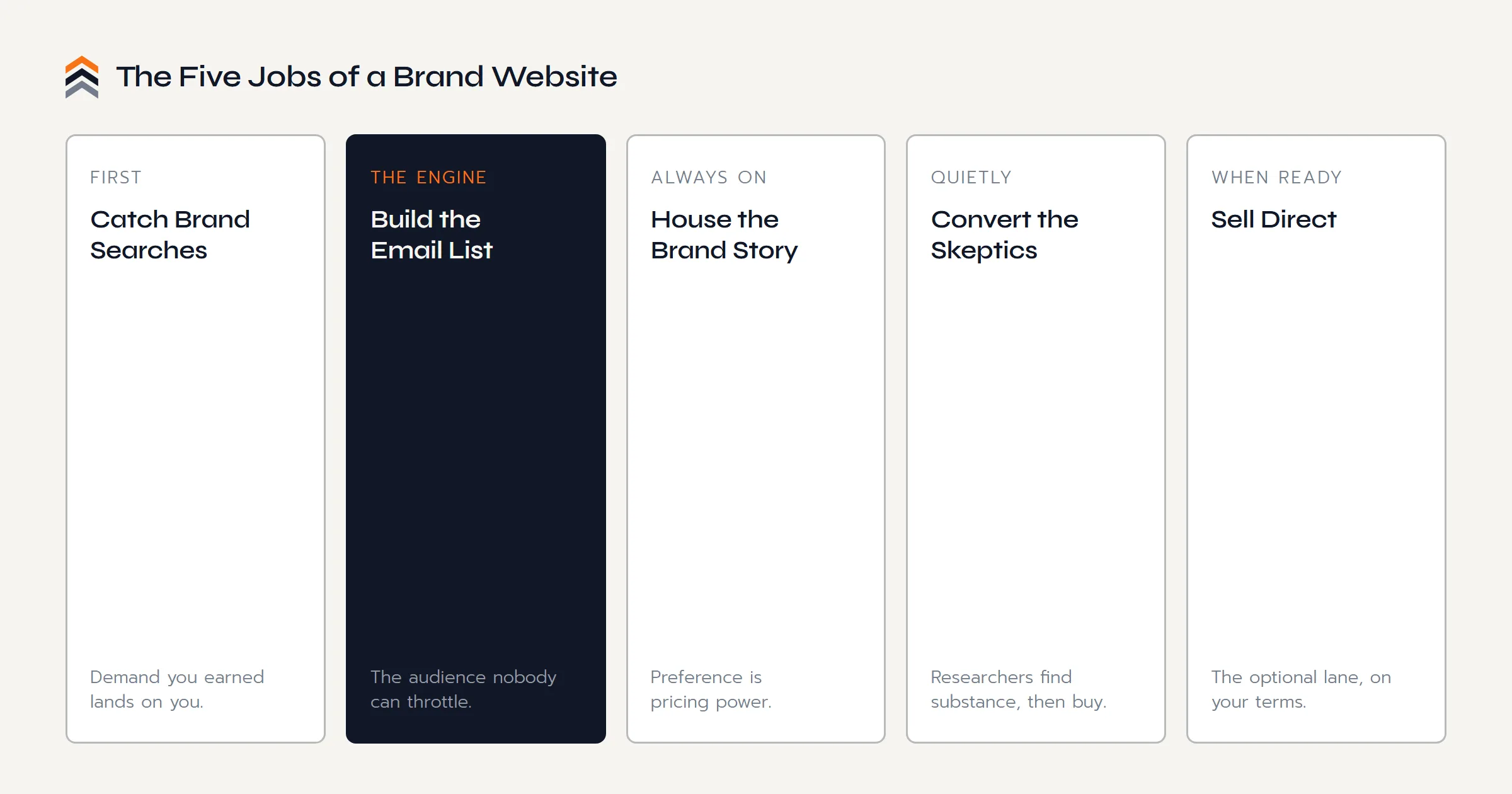
The word "website" undersells the asset, the way "paperwork" undersells a deed. For an Amazon seller, a brand site has five jobs, listed here in the order they usually start paying.
- It catches the demand you already earned. Brand searches finally land on ground you own instead of a results page you share with competitors.
- It turns buyers into a list. Email capture is the quiet engine of the whole move: the only audience no platform can throttle, and the cheapest reorder a brand ever makes.
- It gives the brand a home. The story, the proof, the design that no listing template allows. This is where preference is built, and preference is pricing power.
- It converts the skeptics. A meaningful share of shoppers research a brand before buying. When they look you up and find substance, the sale they were hesitating on closes, often back on Amazon.
- It sells direct when you are ready. The optional lane. Some brands open it on day one, some years later, some never. The rest of the asset pays either way.
And two things it does not do, in the interest of the honest answer: it does not replace Amazon, and it does not bring traffic just by existing. Demand still has to be built, through search, content, and email. The difference is where that work lands. On rented ground it rents; on your own ground it compounds.
When You Genuinely Do Not Need One Yet
The honest answer has to include the no. There are three situations where we would tell you to keep your money for now.
An Honest Note
- If you resell other brands' products, through arbitrage or wholesale, there is no brand of yours to own yet. Build or buy one first; the website comes after.
- If revenue is not steady yet, cash flow beats infrastructure. Amazon builds cash flow faster than any website will, and the move works best funded by a listing that already wins.
- If you are mid launch with no bandwidth, wait. A website is a project, and a project started at the wrong time steals exactly the focus your Amazon growth needs.
If one of those is you, wait with a clear conscience. The question will still be here when the timing is right, and the answer will be easier to fund.
How Sellers Usually Start
The move is almost never account-to-full-store in one jump. The pattern that works is a ladder, one rung at a time. The whole climb, end to end, is mapped in The Complete Guide to Building Your Brand Beyond Amazon.
- A brand home first. The story, the proof, and email capture on your own domain, with product pages that can simply route buyers to your Amazon listings. Linking from your site to Amazon is fully compliant, and for registered brands Amazon's Brand Referral Bonus even rewards the traffic.
- Then get found. Search work and content so that Google demand, including those brand searches, lands on you. This is where the compounding starts.
- Then sell direct, when the numbers say so. A full store, with your existing FBA stock shipping the orders through multi-channel fulfillment if you want it to. No second warehouse required on day one.
That ladder is exactly how our build packages are tiered, and every rung ends the same way: with the ownership handover. Files, domain, logins, list. Yours.
Questions Sellers Ask
Is a Website Required to Sell on Amazon?
No. Registration asks for business, tax, and banking details, not a domain, and no seller program checks for a website afterward. Requirement is the wrong lens though: the case for a website is about what you own, not what Amazon asks for.
Can My Amazon Storefront Count as My Website?
It is a page inside Amazon, so the URL, the layout, the traffic data, and the rules all belong to the marketplace. A storefront is a good shelf display and worth setting up, but it captures no emails, holds no Google real estate of yours, and disappears with the account. It is a display, not a home.
Can You Sell on Amazon and Your Own Website at the Same Time?
Yes, and for established brands it is the standard play, not a workaround. The two channels do different jobs: Amazon for reach and cash flow, your own site for the customer list, the margin, and the brand. We weigh the two side by side, fee math included, in Selling on Amazon vs Selling on Your Own Website.
Is Social Media Enough Instead of a Website?
Social profiles are rented ground too: the algorithm decides your reach, the platform holds the audience, and an account can be restricted as abruptly as a listing. Social is a strong reach engine and worth running, but it is a weak ownership engine. The email list your own site captures is the only audience nobody can throttle.
Does Amazon Punish Sellers for Having Their Own Website?
No. Amazon's rules stop you from diverting its buyers off the marketplace: no links in listings, no package inserts pointing to your own checkout. Owning a website breaks no rule at all. Amazon's own brand tools, like Attribution and the Brand Referral Bonus, exist precisely because serious brands run their own ground and send traffic in.
Do You Need a Website for Amazon Brand Registry?
No, Brand Registry requires a trademark, not a website. Worth noticing though: the tools it unlocks, like Amazon Attribution and the Brand Referral Bonus, exist to measure and reward traffic you send from outside Amazon. The marketplace itself assumes a serious brand has ground of its own.
What Kind of Website Should a Seller Start With?
Rarely a full store on day one. The proven first rung is a brand home: the story, the proof, email capture, and product pages that route to your listings. Search visibility comes next, and direct selling when the numbers justify it. Our packages follow that ladder, with prices public on the Services page.
The Conclusion
No, Amazon does not require a website, and this guide will not pretend otherwise. If the account is producing and the brand is young, run it hard. Requirement was never the point.
The point is what accumulates underneath the revenue. Every month of selling produces two piles: the payout, which is yours, and the assets, which are somebody's. The customer, the email address, the demand, the story. Without ground of your own, the second pile belongs to the marketplace, and it is the pile a business is eventually valued on.
So watch the signals instead of the rules. When buyers search your name, when reorders keep costing ad money, when the PPC bill climbs, when an exit appears on the horizon, the answer has turned to yes. And the best version of the move is made while sales are strong, not after something breaks. When yes arrives, the next question is usually cost, and the free brand website cost estimator answers it with a straight range for your store, whichever way you would build.
Your sales can live on Amazon. Your brand should not.
The Next Move
You Have Read the Argument.
Pick Your Path.
Ready to Build
A free call, no pitch script. Walk us through your Amazon business and get a straight answer on what your own site would take.
Book a Free CallStill Weighing It
The Push Roadmap is the free PDF version of this decision. Put a number on where your brand stands before you commit to anything.