
Take every channel this series has covered and ask the same question of each: who stands between you and the customer? On Amazon, an algorithm and a referral fee. On Google, an algorithm you can court but never control. On social, a feed that shows your post to a sliver of the people who asked to see it. In ads, an auction that reprices your reach every morning.
Then there is email. You write, you press send, and it arrives. Nobody ranks it against a competitor. Nobody bids on the space above it. Nobody charges you when it is opened. The list is the only route to a customer where reach is not granted, ranked, or sold, and that is why it has outlived every platform that was supposed to replace it.
This guide opens the ownership shelf of the series, and it starts with the list on purpose: of all the assets in the full build, this is the cheapest to start, the hardest to take away, and the one a future buyer of your business can verify line by line.
The Last Channel Without a Middleman
The claim deserves precision, because it is the spine of the whole argument. Every discovery channel is somebody else's machine: brilliant machines, worth using, covered honestly across this series, and all of them making the same quiet charge for access. The toll is not always money. Sometimes it is rank you must defend, a feed that decides your post's reach, or the simple fact that the machine's owner can change the rules on a Tuesday.
Email has no such owner. The address was given to you by the customer, the message travels open infrastructure older than the web, and the only party who decides whether your next send matters is the person who opted in. There is one honest caveat, and it is not a middleman: the inbox has a doorman called consent. Spam filters exist to enforce what permission already demanded. Earn the address, send what you promised, and the door stays open.
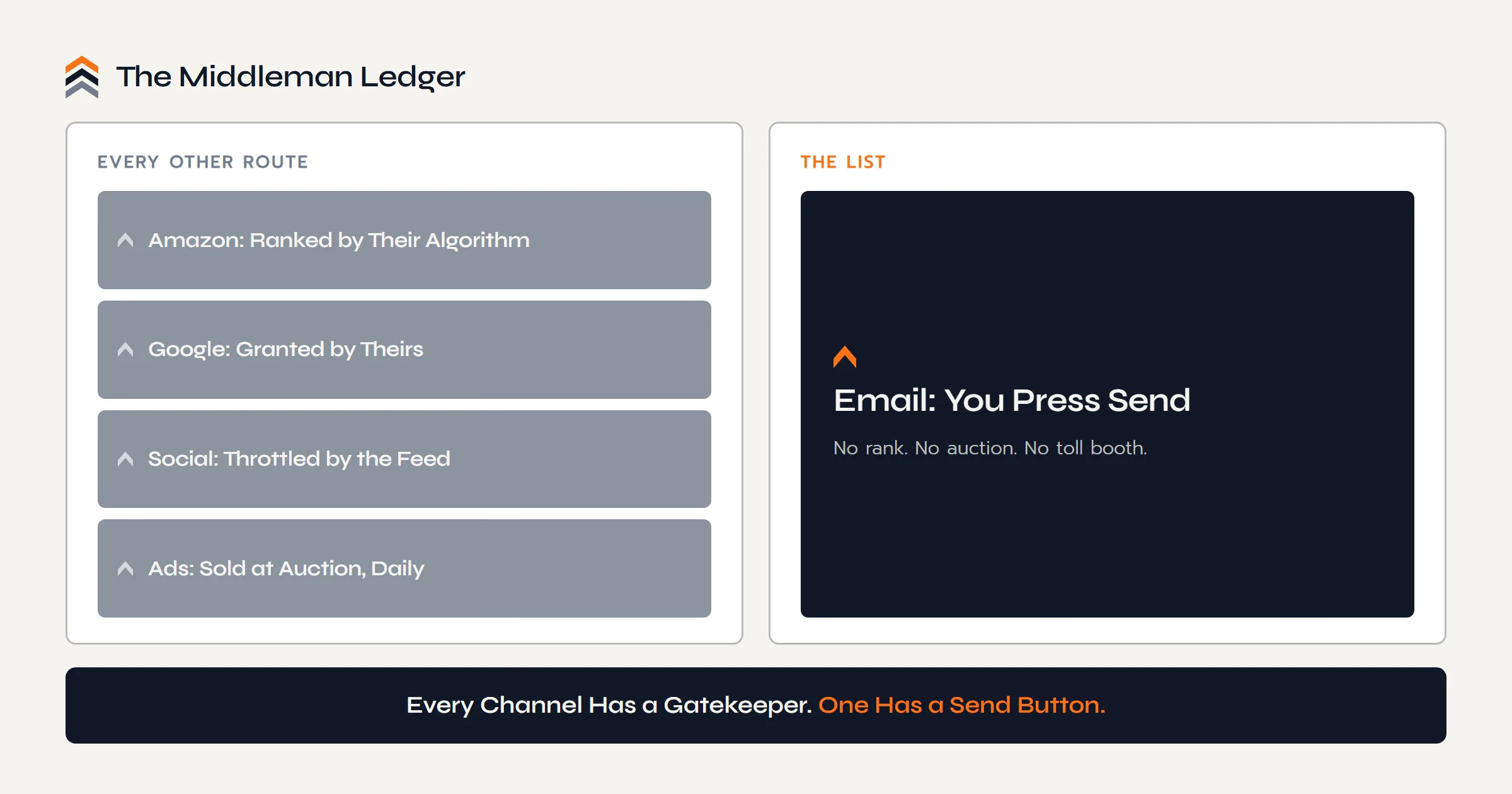
Every other channel decides whether you reach your customer. Email only asks whether you earned the welcome.
What a List Actually Is (Permission, Not Addresses)
Now the definition, because the word list undersells the thing. An email list is a ledger of permissions: people who heard the brand speak and said, in writing, keep talking. The address is just the receipt. This is why a bought list is not a shortcut but a different object entirely, addresses without permission, which the filters treat as intrusion, the law treats as violation, and the recipients treat as exactly what it is.
It is also why size is the wrong scoreboard, especially early. Five hundred subscribers who bought from you and chose to stay are a launch audience, a research panel, and a repeat-order channel with no acquisition fee attached. The same energy spent chasing a big number fills the ledger with people who never cared, and every future send pays for the padding. Grow the permission, and the number takes care of itself.
A Quick Test
The launch test. Three questions that price the asset you do not have yet:
- If you launched a product tomorrow, how many people could you tell directly, without paying anyone for the introduction?
- Of your last thousand orders, how many customers are able to hear from you ever again?
- If your listings went dark for a week, which channel could you still use tonight?
If the answers are none, none, and none: the list is the missing asset.
Demand You Trigger, Not Demand You Wait For
Set the list beside the two other demand assets this series has covered and its particular character shows. Rankings are demand you wait for: earned on your domain, collected on Google's schedule, whenever the searcher happens to arrive. The shopping shelf is demand that finds you, when a buyer searches for a product like yours. Both are worth building. Neither moves because you need it to.
The list is the only demand with a trigger in your hand. Launch week, a slow month, a restock worth announcing, a story worth telling: you choose the moment, and the moment costs the same whether you have three hundred subscribers or thirty thousand. That is the practical meaning of owning a channel, and it is the difference sellers feel the first time a single send outsells a day of the listing's traffic.
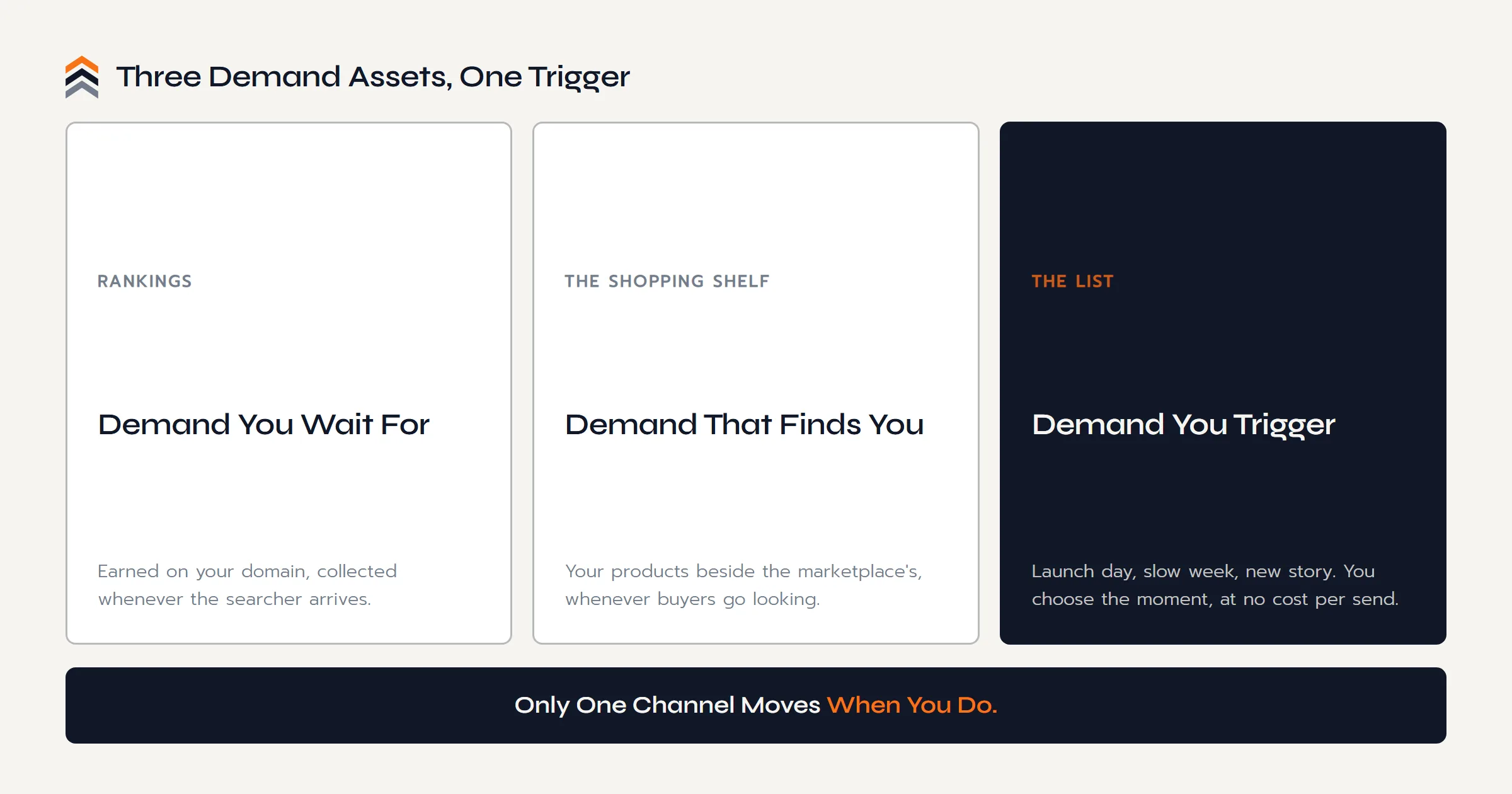
Rankings are demand you wait for. A list is demand you trigger.
How Much of Your Business Do You Actually Own?
The list is the asset this whole guide argues for. The Push Roadmap is a free 12 page PDF with the Ownership Scorecard: score where your brand stands today and see the move to owned ground mapped out.
Sent straight to your inbox.
Building the List From an Amazon Business
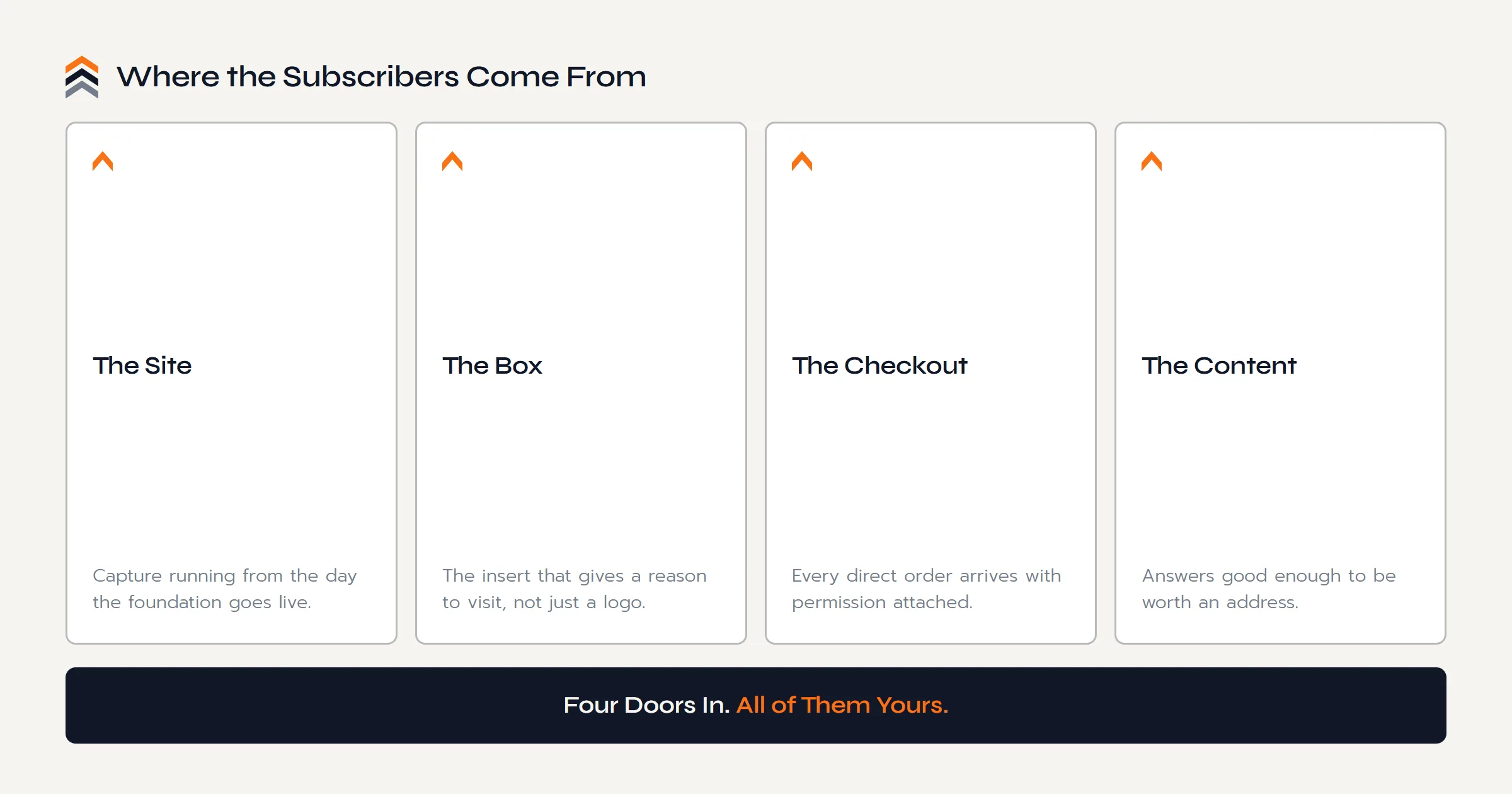
The marketplace will not hand you the names; the loyalty guide covers exactly why, and why that is a fair deal rather than a scandal. So the list gets built at the four doors the marketplace does not control:
- The site. Capture running from the day the foundation goes live: a visible form, a reason to use it, and a welcome that arrives while the visitor still remembers signing up. This is day one plumbing in every build we ship, not a plugin bolted on later.
- The box. The insert rides inside every Amazon order you ship, and it is the one owned surface that reaches all of them. Give it a job bigger than a logo: a reason to visit home, offered within the marketplace's rules.
- The checkout. Every direct order arrives with permission attached, or at least the clean opportunity to ask for it. A store that sells without growing the list is leaving the better asset on the table.
- The content. The answers and guides from the content guide earn addresses on their own: a reader who just got real help is the most willing subscriber there is. The trade has to be honest, value for address, and you are looking at our version of it right now, one band above this list.
What to Send (So People Stay)
Here is where most sellers stall, because they judge email by the mail they personally delete. The deleted kind is what happens when a brand has a list and nothing to say. You are not in that position: the brand shelf of this series already stocked the shelves. Send the story in chapters. Send the mastery pieces that make customers better at owning the product. Send first word on what is coming, to the people who asked to hear it. And send the occasional plain, honest offer, which lands entirely differently with someone who has been receiving value all year.
Cadence matters less than the contract. Monthly, kept for years, beats weekly abandoned by June, and every send should pass the same test the content passed: would a buyer thank you for it. The unsubscribe, when it comes, is not a failure. It is the list doing its own quality control, leaving behind exactly the people the asset was for.
An Honest Note
Three limits, before the send button goes to anyone's head:
- Never buy addresses. A bought list is spam with an invoice. The filters know, the law agrees, and the sender reputation you burn took years to build.
- Lists decay. Addresses go stale, inboxes get abandoned, people move on. Capture is not a launch task; it is a tap that stays open for the life of the brand.
- Email amplifies; it does not conjure. A list cannot make people want a product they do not want. It makes the people who already want it easier to reach.
The inbox has no gatekeeper. It has a doorman: permission.
Questions Sellers Ask
Can I Start the List From My Amazon Order Data?
No. Order data exists for fulfillment, the addresses are masked, and using any of it for marketing is against the terms you sell under. The loyalty guide covers why the marketplace holds that line. The list starts at zero, on ground you own, and that is less discouraging than it sounds: it means every name on it actually chose you.
How Big Does the List Need to Be Before It Matters?
Smaller than you think. A few hundred real buyers is already a launch audience and a repeat-order channel, and the early smallness is a feature: people reply, and the replies teach you things no dashboard will. There is no magic threshold. The list starts mattering with the first send that sells something, and that can happen embarrassingly early.
Which Email Platform Should I Use?
At this size, any reputable platform does the job, and the brand names you have heard of are all fine. Judge on three things instead: your list exports cleanly whenever you want it (the ledger is yours, the tool is rented), the automations you need actually exist (a welcome series and a post-purchase flow cover most of it), and the pricing does not punish growth. Everything else is interface taste.
How Often Should I Send?
On whatever schedule you can keep for years, which for most product brands is monthly or twice monthly. The contract with the subscriber is consistency and usefulness, not frequency. Silence for six months makes the next send feel like a stranger's; daily sends make the brand feel like a fire alarm. Pick the rhythm you can honor, then honor it.
Are Open Rates Even Real Anymore?
Fuzzier than they were, as privacy features increasingly mark mail as opened whether a human read it or not. Treat opens as weather, not scripture, and watch the signals that cannot be faked: clicks, replies, and orders that follow a send. A list that quietly produces repeat purchases with unimpressive open rates is a healthier asset than the reverse.
What Do I Offer for the Address?
Something a buyer of your product genuinely wants: the buying guide for the category, the mastery content that makes ownership better, warranty registration that actually means something, or early access that is honestly early. The trade must survive the moment the PDF arrives; if the subscriber feels tricked, the address is dead on delivery. Value first, address second, always in that order.
Is SMS Better Than Email?
Sharper, not better. A text gets more attention and spends more goodwill, under stricter consent laws and at higher cost per message. It is a fine second channel for a brand whose email list already runs well: shipping updates, restock alerts, the rare genuinely urgent thing. Start with email, where mistakes are cheaper and the format lets a brand actually speak.
What Happens to the List if I Sell the Business?
It transfers with the brand, and buyers price it accordingly, because it is the one audience asset they can verify line by line: real subscribers, real engagement, real revenue per send. Keep the paperwork boring: a privacy policy that permits transfer with the business, and consent collected honestly from the start. Done right, the list is not just an asset at exit. It is evidence the brand was real.
The Conclusion
Every channel in this series is worth its chapter: the marketplace that sells, the rankings that compound, the shelf that lists you, the content that teaches. But each one reaches your customer through somebody else's machine. The list is where the brand finally speaks for itself, to people who asked, at moments you choose.
Start it before it feels necessary, because the day it feels necessary is the day you will wish it were three years old. A form on the site, a card in the box, a welcome worth receiving, one useful send a month. That is the entire startup cost of the only channel nobody can take away.
Your sales can live on Amazon. Your brand should not.
The Next Move
You Have Read the Argument.
Pick Your Path.
Ready to Build
A free call, no pitch script. Walk us through your Amazon business and get a straight answer on what your own site would take.
Book a Free CallStill Weighing It
The Push Roadmap is the free PDF version of this decision. Put a number on where your brand stands before you commit to anything.