
Strip the jargon off first-party data and what is left is older than the internet: it is what a business remembers about the people it serves, learned directly, kept with permission. The corner shopkeeper who knew the regular's usual order and asked whether the last bag ran out early was holding first-party data. The term got complicated. The thing never did.
For an Amazon seller the subject has an uncomfortable edge, because somebody already keeps a perfect memory of your customers, and it is not you. Every purchase, every reorder, every browse across your category sits in the marketplace's ledger, powering its store, its recommendations, and its own decisions. The memory exists. It just was not issued to you.
The ownership shelf opened with the email list, the channel nobody can throttle. This guide is the asset that rides on it: the memory that turns a list of addresses into a brand that knows its people.
What First-Party Data Actually Is
The parties, once, in plain words. Third-party data is information about people gathered by strangers: tracked across websites, packaged by brokers, sold by the pound. Browsers, phones, and regulators have spent a decade strangling it, deservedly. Second-party data is someone else's records shared with you by arrangement. First-party data is the only kind with a future: what customers tell you and show you directly, on your own ground, knowing they are doing it.
For a product brand it is concrete and short: who bought what and when, the preferences they stated in plain questions, what they browse and search on your site, and the record of what they agreed to receive. That is the whole inventory. It is the shopkeeper's memory, formalized, and every durable use of it passes the shopkeeper's test: the customer would nod if they saw you using it.
On the Marketplace, You Are the Third Party
Now assign the seats honestly. On Amazon, the first party to your buyer is Amazon: it observes the purchase directly, holds the identity, and remembers everything. You receive what the loyalty guide already inventoried: honest, useful aggregates. Repeat rates, demographic bands, search terms. Worth reading, worth acting on, and categorically not a memory of people. In the relationship between you and the person who owns your product, you are the outside party being told about it in summary form.
There is no villain in that sentence. The marketplace observes its own store; that is its right and its business model. But it explains a feeling every serious seller knows: running a six-figure catalog while being unable to answer the simplest question a corner shopkeeper could. Who are my best customers? The dashboard shrugs in percentages.
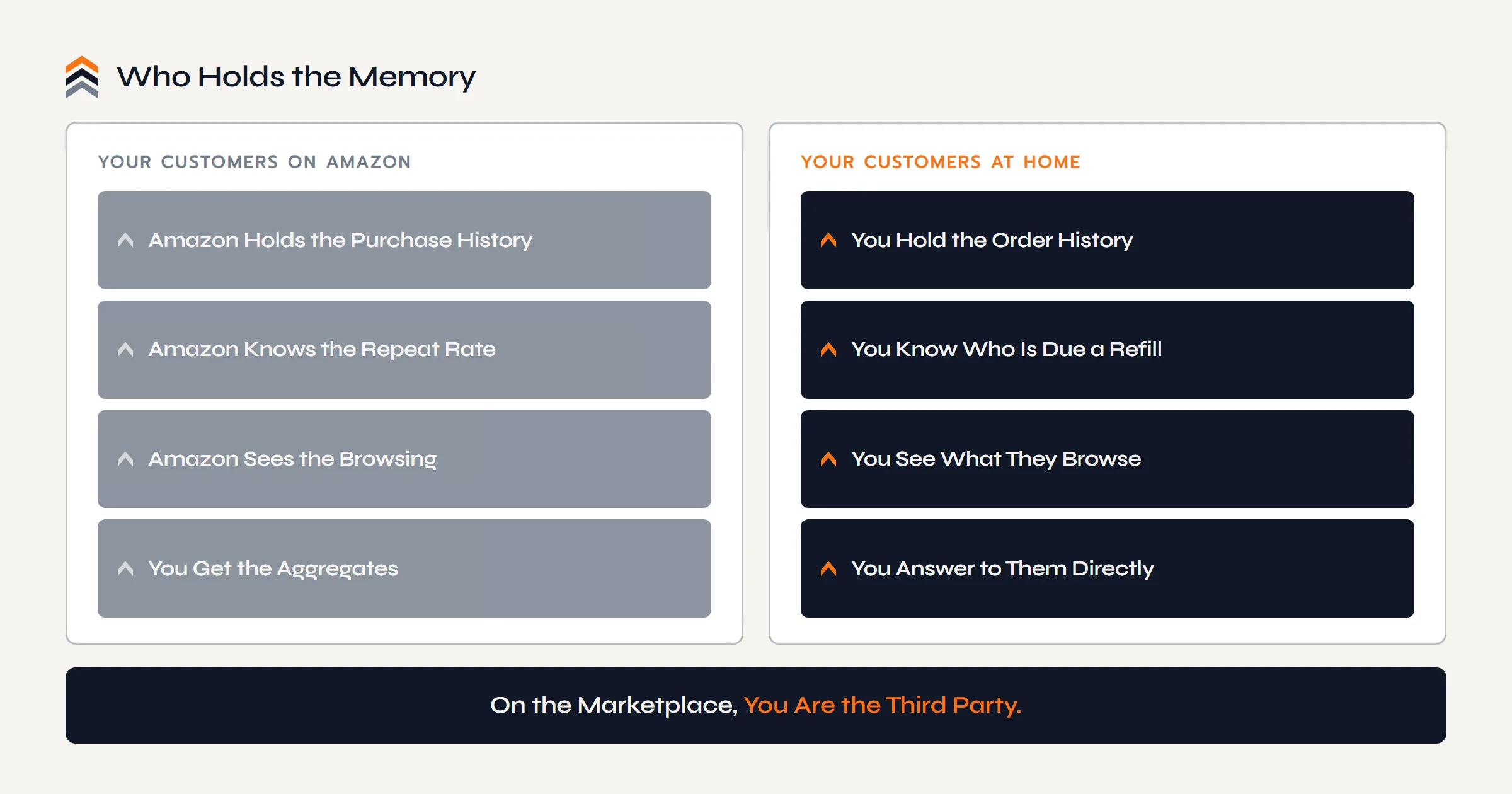
The marketplace's memory of your customers is perfect. Yours was never issued.
What Memory Buys You
The value of first-party data for a product brand is not a dashboard. It is a set of small, compounding advantages that only exist when the memory is yours:
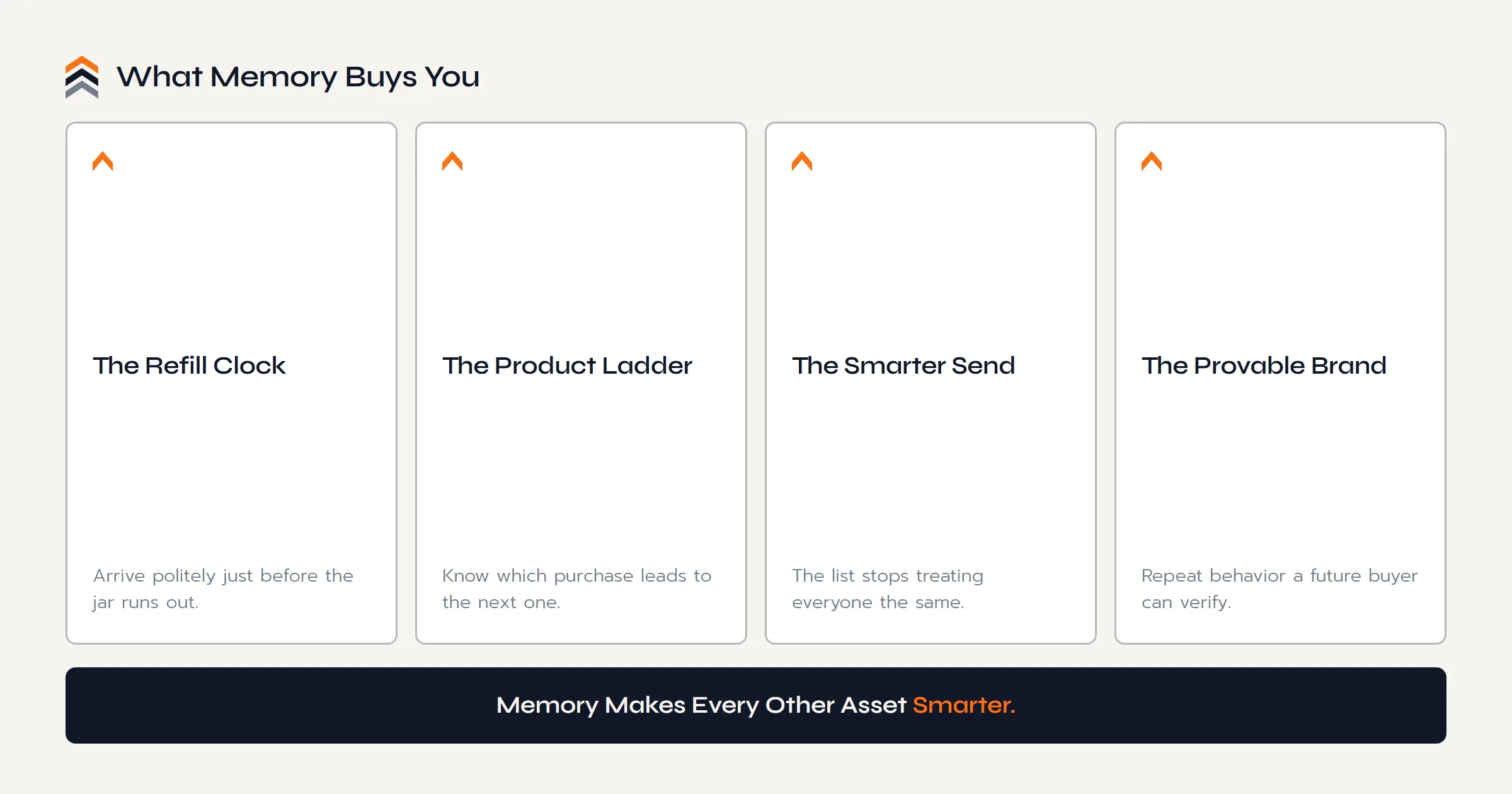
- The refill clock. Consumables have a rhythm. A brand that knows the last order date can arrive politely just before the jar runs out, which is the most welcome marketing there is.
- The product ladder. Which purchase leads to which next purchase, in your real catalog rather than your assumptions. The ladder tells you what to launch, what to bundle, and what to put in the welcome series.
- The smarter send. The list without memory sends everyone the same thing. With it, the refill reminder goes to the runner-out, the launch goes to the person who asked for that variant, and the story goes to the newcomer.
- The provable brand. Repeat rate, lifetime value, cohort behavior: at exit, these numbers are the difference between selling a listing and selling a brand, because they are the evidence a buyer can verify.
A Quick Test
The memory test. Three questions a shopkeeper could answer about their shop:
- Which of your products do customers most often buy second?
- How many of your customers are due to run out of something this month?
- If you launched the variant people keep asking for, could you tell exactly the people who asked?
If every answer lives in someone else's dashboard, the memory is not yours.
How Much of Your Business Do You Actually Own?
The memory of your customers is one asset on the ownership list. The Push Roadmap is a free 12 page PDF with the Ownership Scorecard: score where your brand stands today and see the move to owned ground mapped out.
Sent straight to your inbox.
Collecting It Like a Shopkeeper
The method matters as much as the asset, because data collected badly is not an asset at all. Four rules cover a product brand completely:
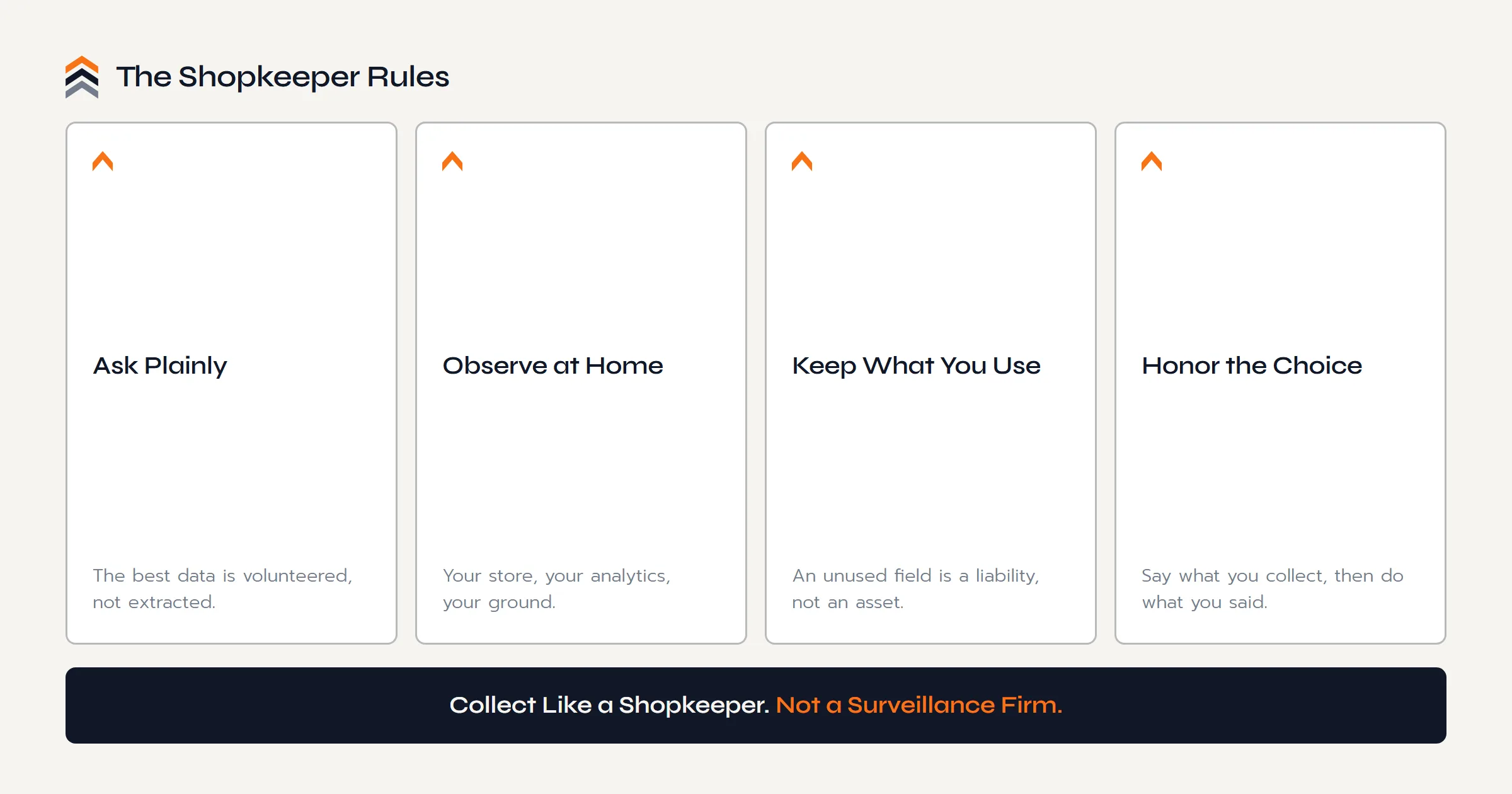
- Ask plainly. The best first-party data is volunteered: the preference question in the welcome email, the how-did-you-hear, the which-size-do-you-wish-existed. People answer real questions from brands they chose.
- Observe at home. Your own store gives analytics, searches, and order history that are yours to learn from, and the customer standing in your shop expects the shopkeeper to notice what they picked up.
- Keep only what you use. A field you never act on is not an asset; it is a liability with storage costs. The shopkeeper remembered the usual order, not the customer's whole life.
- Honor the choice. Consent records are part of the data, not paperwork around it. The privacy laws differ in their letters and agree entirely in spirit: say what you collect, then do what you said.
First-party data is not surveillance. It is the shopkeeper's memory, formalized.
The Buy With Prime Question
No honest guide to owning your customer data can skip the product Amazon built for this exact moment. Buy with Prime puts an Amazon checkout on your own site: shoppers pay with their Amazon account, Prime handles the delivery promise, and the badge that converts on the marketplace converts on your domain. To its credit, the program shares customer order information with the merchant, which is more than the marketplace ever handed you, and for some brands the fulfillment convenience is real.
We gave it a clear-eyed evaluation for client builds, and we chose not to install it yet. Two reasons, both practical. First, the order writes to two ledgers: the customer checks out as Amazon's customer, on Amazon's rails, in the middle of the one property this whole series exists to make yours. The dependency your site was built to reduce gets rebuilt at the checkout, which is the arithmetic the dependence guide warns about wearing a friendlier badge. Second, our standing rule for anything bolted into a client's revenue path: when a third party's technology fails inside your checkout, the lost orders are yours, not theirs. We hold every integration to that bar, and this one has not cleared it.
The honest closing note: it is a trade, not a trap. A brand whose audience is overwhelmingly Prime-loyal, or one that wants Amazon logistics without running its own, may price the trade differently, and the program keeps evolving. Just make the decision with this guide's lens on: the asset being negotiated is the memory, and whoever holds the checkout holds the pen.
An Honest Note
Three limits, before data gets oversold the way it always is:
- Data sharpens judgment; it does not replace it. The dashboard removes the guessing. Somebody still has to decide.
- Small catalogs need small data. Order history, a few stated preferences, and consent records answer most questions a product brand actually has.
- Hoarding is not owning. Every field you collect is a promise to protect it. Collect less, use more.
Data you use is an asset. Data you hoard is a liability.
Questions Sellers Ask
What Counts as First-Party Data for a Product Brand?
Four things, all plain: order history on your own store, preferences customers stated directly, behavior on your own site, and the record of what each person agreed to receive. If it was learned on your ground, from the customer, with their knowledge, it is first-party. If it was bought, borrowed, or scraped, it is not, whatever the invoice says.
Is Collecting This Legal?
Yes, when done the way this guide describes: disclosed plainly, consented to, and honored afterward. The privacy laws vary by region and keep evolving, but they converge on the same spirit: no secrets about what you collect, no surprises in how you use it, and a working way out for anyone who changes their mind. When in doubt, ask for less.
Do I Need Special Software for This?
Not at seller scale. The industry will happily sell you a customer data platform with a six-letter acronym; your store and your email tool already hold the memory this guide describes, joined by nothing fancier than the customer's email address. Master what those two systems know before paying anyone to centralize it.
What Data Does Amazon Actually Give Me?
With Brand Registry, genuinely useful aggregates: search terms, repeat purchase rates, demographic bands, market basket hints. Read them; most sellers do not. Just be clear about the category: they are summaries about crowds, refreshed on Amazon's terms, inside Amazon's walls. Analysis is not memory, and none of it introduces you to a single customer.
Isn't This Just the Email List Again?
They are one asset seen from two sides. The list is the channel: who you may speak to. The data is the memory: what you know when you do. A list without memory sends everyone the same message forever; memory without a channel knows things it can never act on. Built together, which is how they grow naturally, each one makes the other worth more.
What Is Buy With Prime in One Paragraph?
Amazon's checkout and Prime delivery, embedded on your own site: shoppers pay with their Amazon account, the badge converts, the merchant receives customer order information, and the order runs on Amazon's rails inside your domain. We evaluated it for client builds and have not installed it yet; the section above carries the full reasoning, trade and all.
Can Data Really Change Product Decisions?
It changes them from guesses into choices. The second-purchase ladder tells you what to launch next. The stated preferences tell you which variant has waiting demand. The refill rhythm tells you what a subscription should cost and when to offer it. None of it decides for you; all of it retires the arguments that used to be settled by whoever spoke loudest.
What Happens to the Data When I Sell the Business?
It transfers with the brand, the same as the list, and it is often what the buyer studies hardest: verifiable repeat behavior is the closest thing ecommerce has to audited loyalty. Keep it clean along the way, honest consent, a privacy policy that permits transfer with the business, and the memory becomes part of the price instead of part of the risk.
The Conclusion
The marketplace will keep its perfect memory of your customers, and it will keep sharing summaries. Nothing in this guide asks you to resent that; the deal was always the deal. The move is simply to start keeping your own: the orders on your ground, the preferences people volunteer, the consent honestly gathered, the memory that makes the list smarter and the brand provable.
Start with the shopkeeper's questions. What do your customers buy second? Who is due to run out this month? The day you can answer from your own ledger, the business has something it never had on the marketplace: a memory of its own, and everything a memory compounds into. And if you want a baseline before you start, the free Amazon Ownership Score puts a number on the data pillar, and the four beside it, in two minutes.
Your sales can live on Amazon. Your brand should not.
The Next Move
You Have Read the Argument.
Pick Your Path.
Ready to Build
A free call, no pitch script. Walk us through your Amazon business and get a straight answer on what your own site would take.
Book a Free CallStill Weighing It
The Push Roadmap is the free PDF version of this decision. Put a number on where your brand stands before you commit to anything.