
A brand website costs anywhere from about $100 if you build it yourself to $10,000 or more for a full agency build, with most serious small brands landing in the low thousands for a custom site, plus roughly $15 to $50 a month to keep it running. That range is real, and this article breaks down exactly what moves you along it. First, one thing worth settling: whether an Amazon seller needs a website at all is a separate question from what it costs, and the price only matters once you have answered the first.
Here is the part most cost guides skip. The scary number people picture is almost entirely a one-time labor decision, not an ongoing bill. And for an Amazon seller, cost is the wrong lens on its own, because you are not weighing a website against zero. You are weighing a one-time asset you own against the fees you already pay Amazon every year and never get back. So we will do both: the straight cost answer first, then the comparison that actually decides it.
The Short Answer
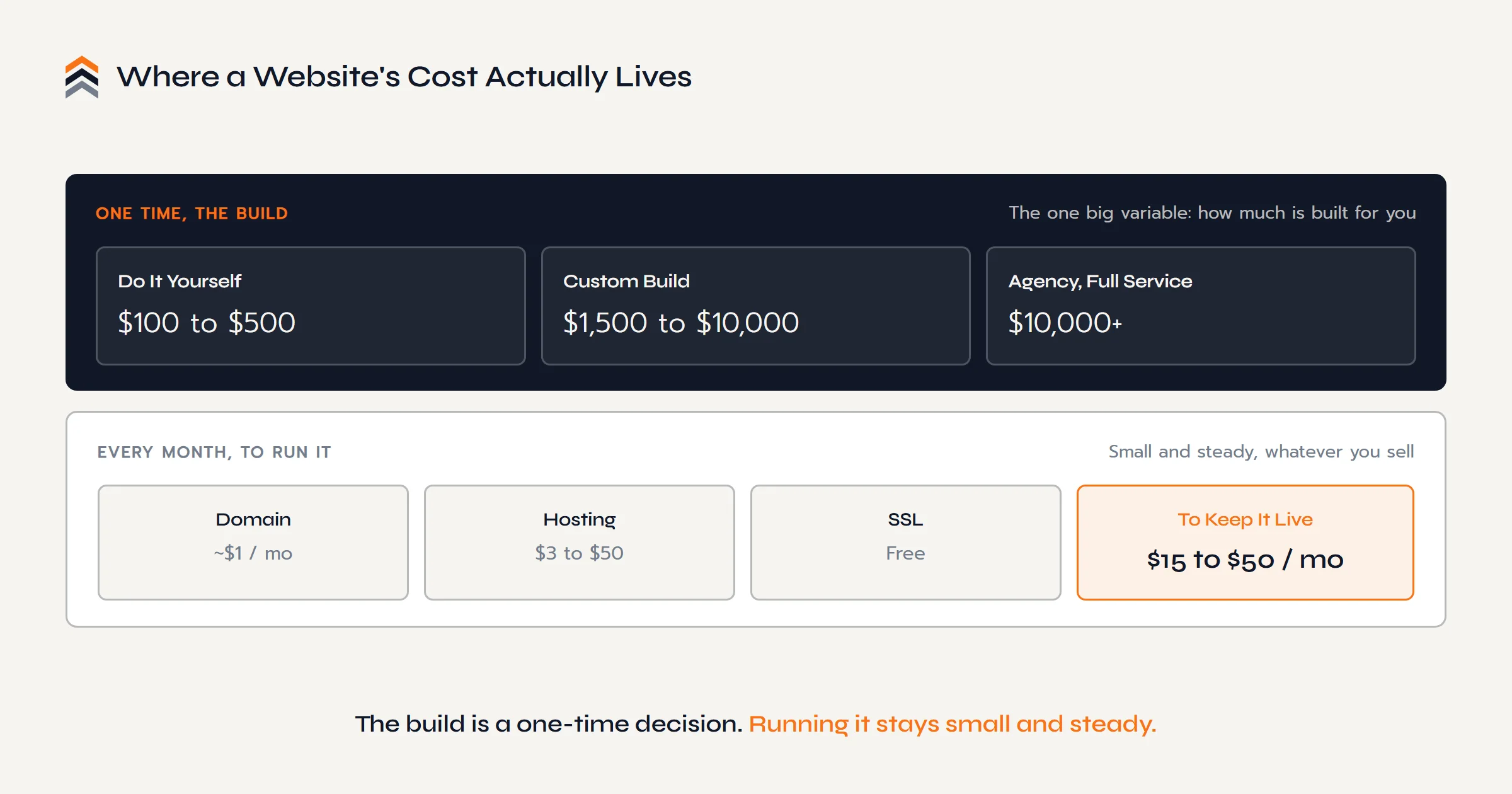
Strip away the sales pitch from every platform trying to quote you, and website cost sorts into two very different buckets: the one-time build, and the small monthly cost to keep it live. The build is where the whole range lives. If you want your own number rather than the market's, the free brand website cost estimator turns four answers about your store into a range in about a minute:
- Do it yourself. A site builder or a basic WordPress store, roughly $100 to $500 to start.
- A custom build. A freelancer or a small studio designing it for you, roughly $1,500 to $10,000.
- A full-service agency. $10,000 and up, sometimes far up, for complex catalogs and custom features.
Running it is the cheap part, and it barely moves. A domain is about $10 to $20 a year, reliable hosting is $3 to $50 a month, and an SSL certificate is now free with most hosts. Call it $15 to $50 a month to keep a real store online, whether you sell ten products or ten thousand.
What You Actually Pay For
The word cost hides a handful of separate things. Here is each one, and the plain reason it is on the list:
- Domain. Your address on the web, about $10 to $20 a year. It is the one piece that is unmistakably yours, the name a customer types instead of searching a marketplace.
- Hosting. Where the site actually lives, $3 to $50 a month. Cheap, and it is space you control rather than shelf space you rent.
- Theme or design. The look, free to a few hundred dollars. It is how the brand reads in the first three seconds, so it earns its keep.
- Plugins and extensions. The features, like checkout, shipping, and email, usually $29 to $299 a year each. You add only what your store needs instead of paying for a bundled tier.
- Payment processing. The card fee, about 2.9 percent plus 30 cents a sale. It is standard everywhere, Amazon included, and on your own store it is the only per-sale cut you pay.
- Design and development. The labor, from $0 if you do it to $10,000 and up if a team does. This is the single line that moves your total, and it is a one-time choice.
- Maintenance. Updates, backups, and security, modest for a small store. Predictable, and far less than a slice of every sale.
DIY, Freelancer, or Agency?
Same website, three very different price tags, and the right one depends less on your budget than on your time and how much you want handled for you:
| Who Builds It | Roughly | Best When |
|---|---|---|
| You, on a builder or WordPress | $100 to $500 | You have the time and a simple catalog |
| A freelancer or small studio | $1,500 to $10,000 | You want it done right, without an agency retainer |
| A full-service agency | $10,000+ | Complex needs, done entirely for you |
For most Amazon sellers, the middle tier is the sweet spot: a proper custom brand site, built by someone who does it for a living, without agency-scale invoices. That is exactly the lane we built our own packages to fill. Wherever you land, the bigger lever is the platform underneath, and it changes the math more than any single quote.
The cost people fear is a one-time build. The cost that actually adds up is the one they never see on an invoice.
Why WooCommerce Costs Less to Own
One line on the search results causes more confusion than any other: is there a platform fee? It depends entirely on what you build on, and the choice between WooCommerce and Shopify is the real cost decision hiding under the price tag.
With Shopify, yes, a small cut of every sale on top of card processing, unless you use its own payment system. On Amazon, a much larger cut. With WooCommerce, the open-source software this kind of store is built on, there is none. You pay your host, your domain, and the same standard card fee every store pays. No slice of each sale goes to a platform, because there is no platform standing between you and the customer. That is the entire difference between renting a store and owning one, and it is why the platform you build on matters more than the build quote.
The Comparison That Actually Matters
Up to here we have looked at what a website costs on its own. That is the wrong place to stop. The more useful question for a business is not what a website costs in isolation, but whether to judge that one-time number by itself, or against the costs you are already paying to sell somewhere else. So set the two side by side.
Because as an Amazon seller you are not choosing between a website and nothing. You already run a store, and you already pay for it, just not in a way that arrives as a bill. That bill is real; it is simply deducted before the money ever reaches you, and it stacks up from several layers:
- The referral fee. About 15 percent of the sale price in most categories, taken on every single order.
- FBA fulfillment fees. A per-unit charge by size and weight to pick, pack, and ship, if you use Fulfilled by Amazon.
- Storage fees. A monthly charge on the inventory sitting in Amazon warehouses, and it climbs in the fourth quarter.
- Advertising. Close to mandatory now to stay visible, and often 10 percent of revenue or more on its own.
- Returns and refunds. The handling and the lost margin land on you, not on the platform.
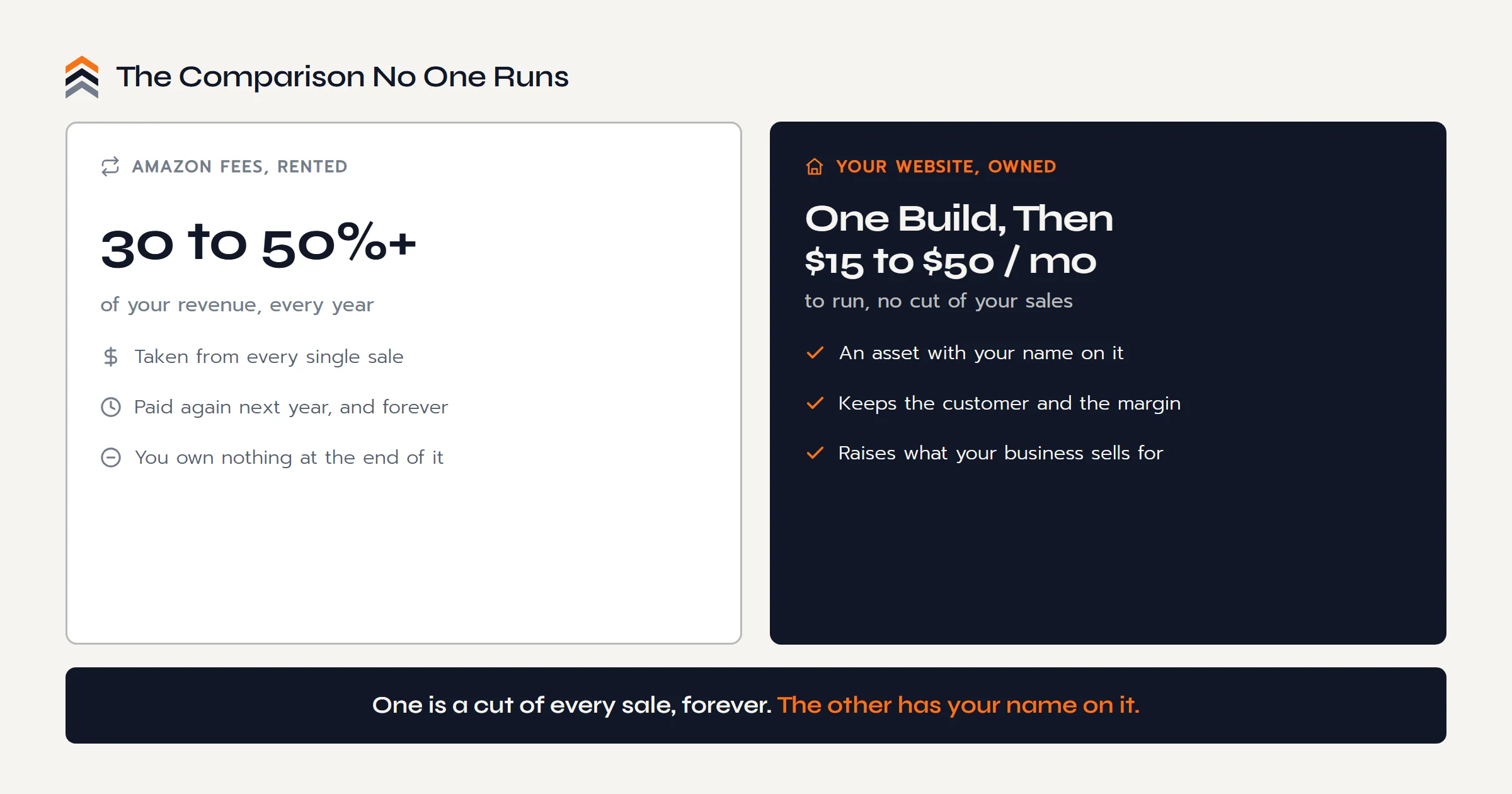
Add those layers together and the totals that sellers and analysts report land in a wide band. Marketplace Pulse's analysis puts the typical private-label seller past 50 percent of revenue once every fee is counted; more conservative estimates that lean less on advertising put it nearer 30 to 40 percent. Where you land depends on your category, whether you use FBA, and how hard you run ads. Either way it is the largest cost in your business, it repeats every year, and at the end of it you own nothing. That is the real risk of leaning your whole business on one channel you do not control.
Now set that beside a website. A one-time build in the low thousands, then $15 to $50 a month, and the asset is yours. In plenty of cases a single year of Amazon fees costs more than a website does across its entire life. Seen that way, the website is not an added expense at all. It is the first cost in your business that builds something you keep, which is the heart of the fuller comparison of Amazon and your own store.

See What You're Really Paying to Rent.
The Push Roadmap is a free 12 page PDF with the Ownership Scorecard. Put a number on how much of your brand you actually own today, and see the whole move mapped in order.
Sent straight to your inbox.
Is a Brand Website Worth the Cost?
For an Amazon seller, the honest answer is usually yes, and not for a soft branding reason. Three concrete ones:
- You stop renting the customer. Every sale on your own site hands you the email, the behavior, and the chance to sell again, all the first-party data Amazon keeps for itself.
- You keep the margin. No referral cut means the exact same sale is simply worth more to you.
- You raise what the business is worth. Buyers pay higher multiples for a brand that owns its channel and customer list. Amazon businesses tend to trade around 2.5 to 4 times profit, and diversification, your own site and audience, moves you toward the top of that range instead of the bottom, where a single-channel account sits.
None of this requires walking away from Amazon. It requires giving your brand one place it owns, built around the brand itself rather than the platform. The cost of that is knowable and one-time. The cost of never doing it renews every year.
An Honest Note
Two things can be true at the same time:
- A website is not instant traffic. Building it is step one; people still have to find it. It does not come with Amazon's built-in demand, and pretending otherwise sets you up to be disappointed.
- But it is the only cost that compounds. Every dollar you spend on Amazon rents another month. This one buys an asset that is still yours next year, and worth more.
Amazon rents you a month. A website you own for good.
Questions Sellers Ask
How Much Does It Cost to Build a Brand Website?
A brand website costs roughly $100 to $500 if you build it yourself on WordPress or a site builder, $1,500 to $10,000 for a custom build by a freelancer or small studio, and $10,000 or more for a full-service agency. The single biggest variable is how much is built for you, not the software.
How Much Does a Website Cost Per Month to Run?
About $15 to $50 a month for a real online store. That covers hosting at roughly $3 to $50 a month, a domain at $10 to $20 a year, and an SSL certificate that is now free with most hosts. The recurring cost stays small and steady no matter how much you sell.
How Much Does a WooCommerce Website Cost?
A WooCommerce store can start near $100 to $500 for a DIY setup and run to $5,000 to $20,000 or more for a custom build. WooCommerce itself is free, open-source software. You pay for hosting, a domain, a theme, and any paid extensions your store actually needs, usually $29 to $299 a year each.
Is There a Platform Fee for WordPress or WooCommerce?
No. Unlike Shopify, which adds a small cut of each sale unless you use its own payments, and unlike Amazon, which takes a large cut, WooCommerce charges no platform fee at all. You pay your host, your domain, and the standard card processing fee. No slice of every sale goes to a middleman.
Is WooCommerce Cheaper Than Shopify?
Usually, over time. Shopify is a monthly subscription starting around $29 plus a per-sale platform fee unless you use Shopify Payments. WooCommerce has no subscription and no platform fee; you pay for hosting and extensions instead. WooCommerce is cheaper long term and you own the asset, in exchange for handling hosting and updates yourself.
How Much Does It Cost to Maintain a Website Yearly?
For a small brand store, maintenance runs from around $180 a year at the DIY end to a few thousand if you pay someone to manage updates, backups, and security. Most sellers spend modestly here. It is predictable, and it is far less than a single percentage point of what Amazon takes.
Is a Website Worth It Compared to Selling Only on Amazon?
For most brand owners, yes. Amazon fees run roughly 30 to 50 percent or more of revenue every year, and you own nothing at the end. A website is a one-time asset that keeps the customer, the margin, and equity you can sell. It does not replace Amazon; it gives you ground Amazon cannot take back.
The Conclusion
So, how much does a brand website cost? A few hundred dollars if you build it yourself, a few thousand for a custom site done well, more for a full agency build, and $15 to $50 a month to run whatever you choose. That is the honest number, and for most sellers it is smaller than they feared.
But the number that should decide it is the other one: the 30 to 50 percent of revenue you already hand Amazon every year, for something you will never own. Against that, a brand website is not the expense. It is the first thing you buy in this business that is actually yours, and it is still yours, and worth more, the year after you pay for it.
Your sales can live on Amazon. Your brand should not.
The Next Move
You Know the Number.
See What It Actually Buys.
Ready to Build
A free call, no pitch script. Walk us through your Amazon business and get a straight answer on what your own brand site would take, and cost.
Book a Free CallStill Weighing It
The Push Roadmap is a free PDF with the Ownership Scorecard. Put a number on how much of your brand you actually own today.