
A brand website needs a small set of pages, a handful of trust and performance features, and one thing most checklists skip entirely: the specific pieces that turn a visitor into a customer you own. Nearly every guide gives you the same generic list, home page, product page, contact page, and stops there. That list is not wrong, but it was written for a business starting from nothing. As an Amazon seller you are not starting from nothing, and whether you need a website at all is a question you have likely already answered. So this covers the full baseline, then the part that actually matters for you.
Here is the difference that reshapes the whole list. A generic website checklist optimizes for existence: does your site have the basics. You have a harder and better problem. You already have a product, real sales, and proven demand. What you lack is anything you own. So your real must-haves are not the basics of having a website. They are the handful of things a marketplace listing is structurally incapable of giving you.
The Pages You Need
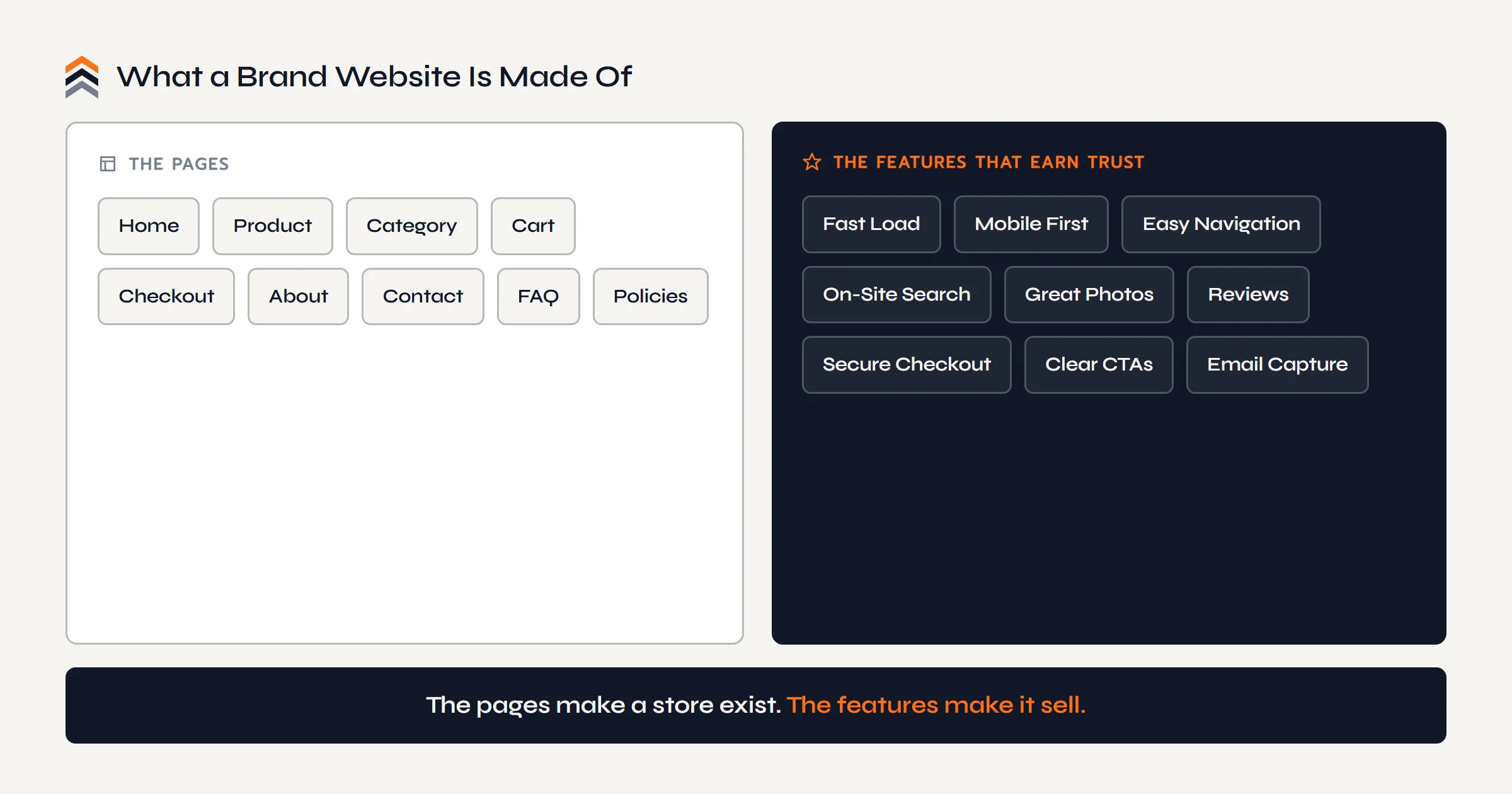
Start with the pages, because they are the easy part and the part every store shares. A brand website does not need dozens of pages to launch. It needs a clear, small set:
- Home. The front door that says who you are and points to where to go next.
- Product pages. One per item, where the sale is actually made.
- A category or shop page. The grid that groups your range and, written well, ranks in Google.
- Cart and checkout. Ideally with guest checkout, since forcing an account is one of the top reasons carts get abandoned.
- About. The one page a listing can never be, which gets its own section below.
- Contact. A real way to reach a human, which is itself a trust signal.
- FAQ and policies. Shipping, returns, and privacy, shown before checkout rather than buried after it.
Five to ten pages is a perfectly serious place to launch. You are not building a magazine. You are building a place to buy.
The Features That Earn the Sale
Pages make a store exist. A second layer makes it sell, and this is where Amazon sellers, used to Amazon handling everything, tend to underinvest. The features that actually move the needle are the ones that build trust and cut friction:
- Speed. A fast site is not a luxury. Google's research found that improving mobile load time by a tenth of a second lifted retail conversions by around 8 percent, and the odds of a visitor leaving climb sharply as a page slows past a few seconds.
- Mobile-first design. Most of your shoppers arrive on a phone. A site that fights them there loses them there.
- Clear navigation and on-site search. People who cannot find it cannot buy it, and a good search box is often the fastest path to a sale.
- Real product photography. On your own page there is no Amazon template to lean on. The images carry the brand, so they have to be good.
- Trust signals. Reviews, a visibly secure checkout, and clear policies. Surveys consistently find nearly nine in ten shoppers read reviews before buying, and cart abandonment across retail runs around 70 percent, much of it from unexpected costs or a checkout people do not trust.
- Clear calls to action. One obvious next step per page, not five competing ones.
None of this is exotic. It is simply the difference between a site that looks live and a site that converts.
The Five Amazon Never Let You Own
Now the part no generic checklist will tell you, because no generic checklist is written for someone who already sells on Amazon. Strip away the basics every site shares, and five must-haves remain, and they are not really features at all. They are the things a marketplace listing is structurally incapable of giving you:
- An email capture, so you own a list. Amazon does not give you your customers' email addresses, only a city and a postal code. A simple signup on your own site is the first time you get to keep the person who bought, and it feeds the first-party data Amazon withholds. It is the single most valuable thing your website does.
- A brand story, so the narrative is yours. An Amazon listing is a spec sheet in Amazon's template. Your about page is the one surface where you get to say why the brand exists, which is the whole point of brand storytelling a listing cannot do.
- A checkout you own, so you keep the margin and the relationship. No referral fee skimmed off every order, your own prices, your own data, and a customer who comes back to you rather than to a page of search results.
- A trust layer that is yours. On Amazon the reviews belong to the ASIN, not to you. On your site the reviews, the guarantees, and the story are assets you keep and control.
- Content and SEO, so demand is yours. Instead of renting Amazon's search box and paying to rank inside it, you earn demand from Google that lands on a site you own.
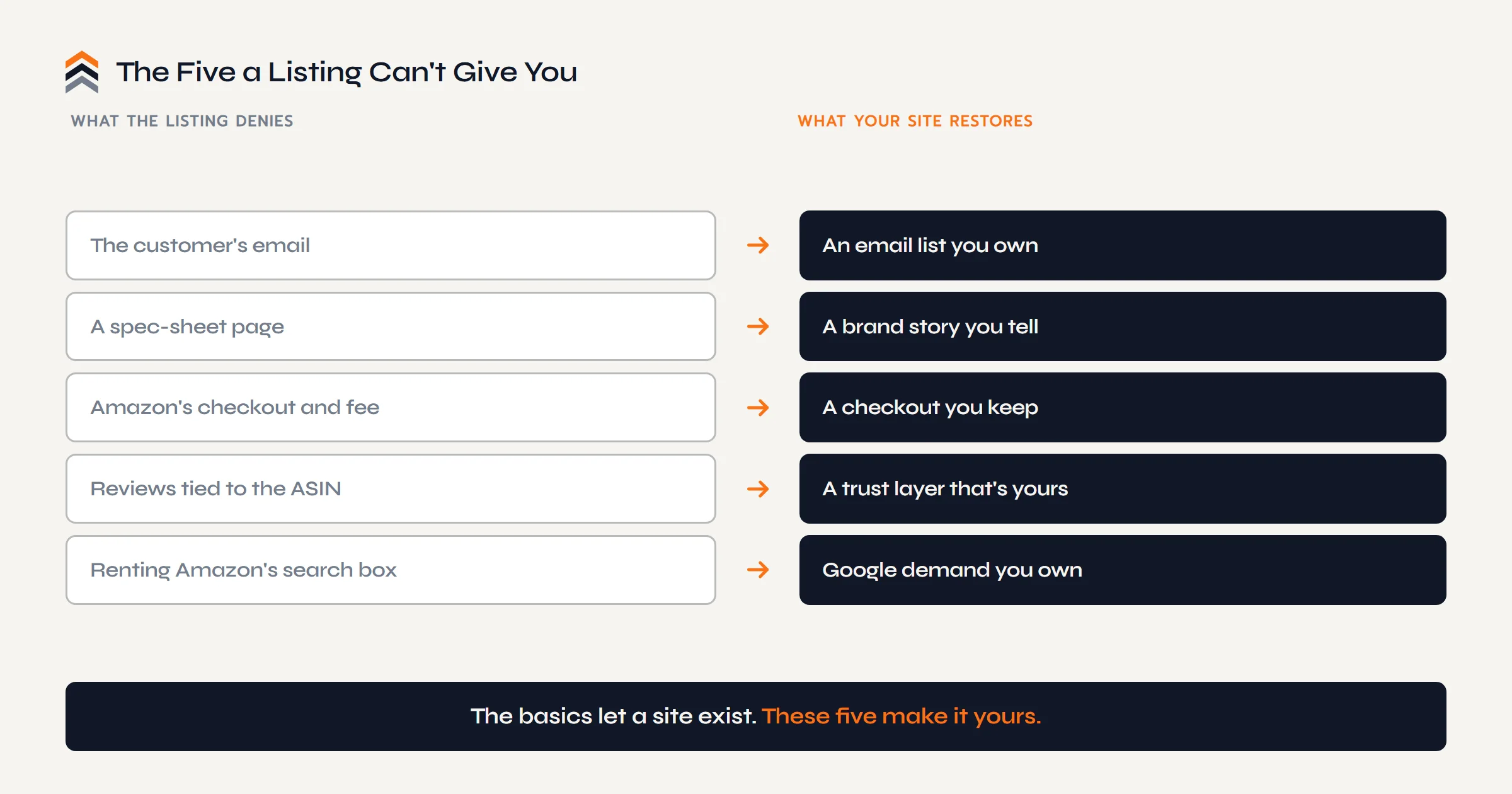
The basics make a site that looks live. These five make a site that is yours.
How Much of Your Brand Do You Actually Own?
The Push Roadmap is a free 12 page PDF with the Ownership Scorecard. Put a number on where your brand stands today, and see the whole move mapped in order.
Sent straight to your inbox.
Where a Seller Should Actually Start
If the full list feels like a lot, here is the good news: you do not build it all at once, and you do not build it in the order the generic guides imply. A business starting from zero builds outward from the basics. You should build outward from ownership.
In practice that means a lean, fast site with your core pages, and from day one the three pieces that start compounding: the email capture, the brand story, and a checkout that is yours. The rest, more content, more polish, deeper SEO, layers on over time. What matters is that from the first day it is live, every sale hands you something Amazon never did, a customer you can reach again. And that site costs less to build than most sellers fear, which is worth seeing clearly in what a brand website actually costs, or in a minute with the free cost estimator tuned to your own store.
An Honest Note
Two things can be true at the same time:
- A website is not a magic switch. The pages and features are table stakes. They let you compete; they do not win on their own, and a site still needs traffic and a reason to buy.
- But the five ownership pieces are the whole reason to build. Skip them and you have a prettier listing. Include them and you have an asset that grows.
Build the basics to compete. Build the five to own.
Questions Sellers Ask
What Pages Does a Brand Website Need?
At minimum: a home page, product pages, a category or shop page, cart and checkout, an about page, a contact page, and your FAQ and policies (shipping, returns, privacy). A blog is valuable for growth but not required on day one. Five to ten core pages is a serious starting point for a brand store.
How Many Pages Should an Ecommerce Website Have?
Fewer than most people expect to launch. A small brand store needs roughly five to ten core pages plus one page per product and category. You do not need dozens of pages to start. You need the essential set done well, then you add product, category, and content pages as the catalog and the brand grow.
What Makes a Good Brand Website?
A good brand website loads fast, works on mobile, is easy to navigate, and earns trust with real photography, reviews, clear policies, and a secure checkout. Beyond the basics, what makes it a brand website is ownership: an email list, a brand story, and a checkout that are yours, not a marketplace's.
What Are Trust Signals, and Do They Increase Sales?
Trust signals are the elements that reassure a shopper it is safe to buy: customer reviews, secure-checkout badges, clear return and shipping policies, real contact information, and guarantees. They increase sales by removing hesitation. Cart abandonment across retail runs around 70 percent, and distrust of a site is one of the leading causes.
Do I Need a Website if I Sell on Amazon?
You can sell without one, but a website is the only place you own the customer, the brand story, and the checkout. Amazon keeps the customer relationship and the data. A brand website is not a prettier listing; it is the one channel where the buyer, the margin, and the audience become yours.
How Important Is an About Page?
More important than sellers expect. The about page is the one surface a marketplace listing can never be: the place you say why the brand exists and who it is for. It builds the trust that turns a one-time buyer into someone who chooses you again, which a spec-sheet listing cannot do.
How Much Does Page Speed Affect Conversions?
A lot. Google's research found that improving mobile load time by a tenth of a second lifted retail conversions by around 8 percent, and the odds of a visitor leaving climb sharply as a page slows past a few seconds. On your own site, speed is a conversion lever you fully control.
The Conclusion
So, what does a brand website need? The same short list of pages every store shares, the trust and speed features that turn a visitor into a buyer, and, the part that actually matters for you, the five things a marketplace listing was never built to give: the email, the story, the checkout, the trust, and the demand. Get the basics right so you can compete. Get the five right and the site stops being a nicer storefront.
Because that is the real answer hiding inside the checklist. Every generic essential is a way to exist online. The five ownership pieces are the reason the whole thing is worth building at all, the point where a website becomes the first part of your business you truly own, on a brand built beyond Amazon.
Your sales can live on Amazon. Your brand should not.
The Next Move
You Know What It Needs.
Let's Build the Parts That Matter.
Ready to Build
A free call, no pitch script. Walk us through your Amazon business and get a straight answer on the site that would actually be yours.
Book a Free CallStill Weighing It
The Push Roadmap is a free PDF with the Ownership Scorecard. Put a number on how much of your brand you actually own today.