
WooCommerce and Shopify are the two platforms most Amazon sellers weigh when they finally decide to build a store of their own, and almost every comparison you will read pits them on features, themes, and price. Those matter, but they miss the split that actually counts. Shopify is a store you rent on someone else's platform; WooCommerce is a store you own outright. For a seller who is building a brand precisely so they stop renting, that difference is the whole decision, and it is the lens the wider choice of an ecommerce platform should be judged through when you set out to build a brand beyond Amazon.
We will give both platforms a fair hearing, because Shopify is genuinely good at what it does. But we build every client brand on WooCommerce, and by the end you will understand exactly why, and whether the same logic fits you.
The Real Difference: Rent vs Own
Shopify is a hosted service. You pay a monthly subscription and, in return, Shopify runs everything behind the scenes: the servers, the security, the software updates. It is fast, tidy, and completely managed. It is also completely theirs. Your store lives on their infrastructure, inside their rules, and continues only as long as you keep paying and keep agreeing to their terms.
WooCommerce is the opposite arrangement. It is a free, open-source plugin that turns WordPress into a full store, and it runs on hosting you control. There is no platform subscription and no company sitting above your business able to change the deal. You own the site, the database, the customer records, and every line of code. If that sounds familiar, it should. It is the same ownership question that separates a marketplace listing from a brand, applied one level down to the software your store runs on.
What Each One Actually Costs
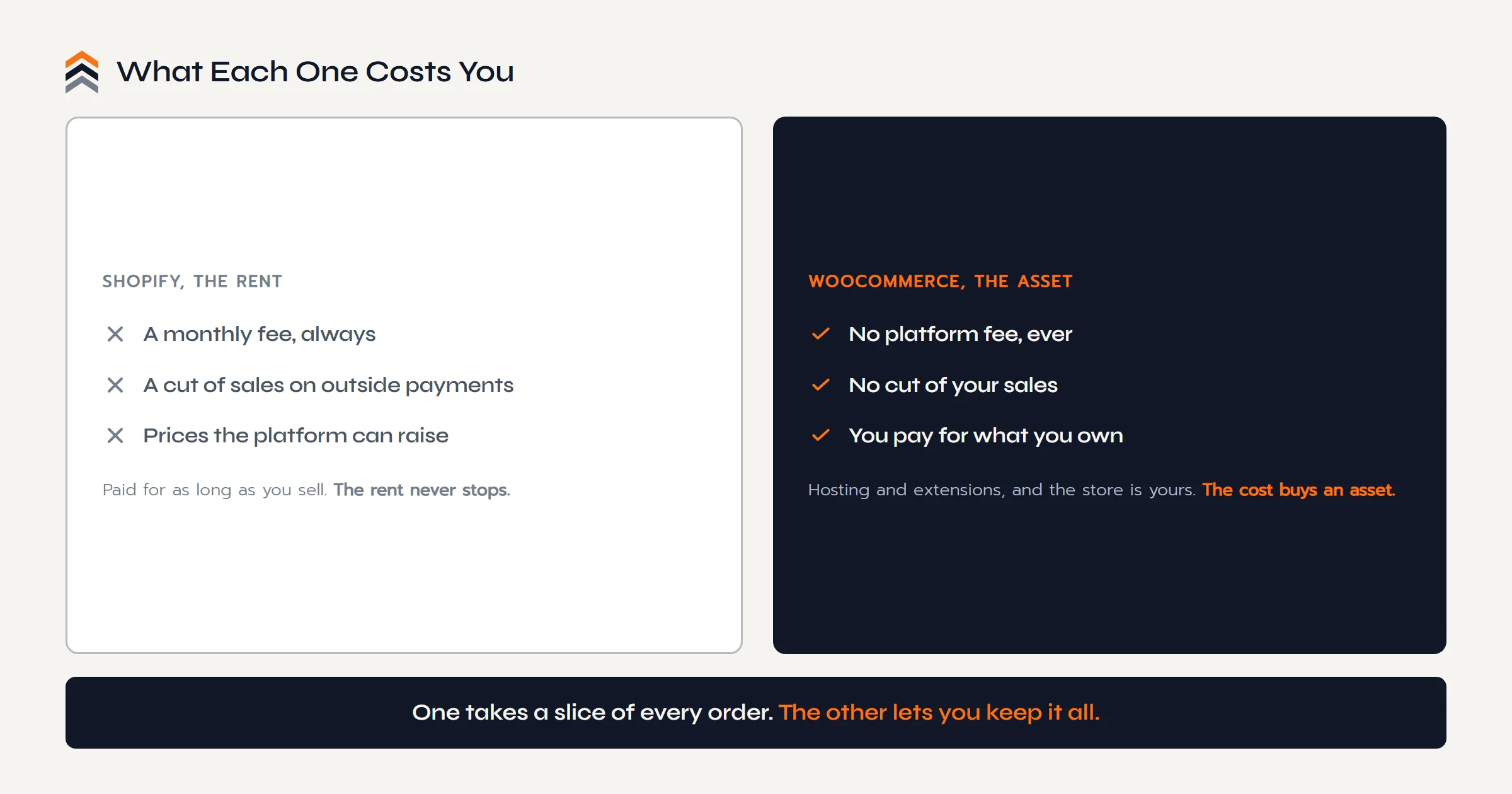
On paper Shopify looks simpler to price, and that simplicity hides the catch. As of 2026 its main plans run from roughly thirty dollars a month at the low end to a few hundred a month for its advanced tier, billed for as long as you sell. On top of that, Shopify charges a per-order transaction fee, up to around two percent, unless you use its own payment processor, Shopify Payments. Verify the current numbers before you rely on them, because Shopify has changed both its plan names and its prices more than once.
WooCommerce inverts the model. The plugin itself is free and takes no cut of a single sale. What you pay for are the pieces you own: hosting, a domain, a theme, and any premium extensions you choose to add. Realistically that lands somewhere from a few hundred to a couple of thousand dollars a year in platform costs, depending on how much you bolt on, before any builder or maintenance time. At low volume the two can end up close. At scale, the absence of a per-sale platform cut is where WooCommerce quietly wins, and the fuller picture of what a brand website costs makes that gap easier to see. For a range priced to your own store rather than the market's, the free cost estimator takes about a minute.
The Lock In Nobody Mentions on the Sales Page
Here is the part a hosted platform never puts in its pitch. Because Shopify sets the terms, Shopify can change them. It has raised its standard plan prices more than once in recent years, and lifted its top-tier platform fee by around a quarter in a single move, with merchants able to hold the old rate only by locking into a multi-year contract. None of that is a scandal. It is simply what it means to build your business on ground you rent. The landlord can raise the rent, and your only choices are to pay or to move everything.
The transaction fee works the same way. By charging extra when you use an outside payment gateway, Shopify gently pushes you onto its own rails, so that over time more of your store depends on staying inside its ecosystem. WooCommerce has no such lever to pull, because no one sits above your store. You can change hosts, swap payment providers, or move your whole site, and no platform has to approve it. Owning the customer relationship and the data, the thing that makes first-party data so valuable, starts with owning the store those things live in.
A rented platform can change the terms. An owned one answers to you.
Easy vs Yours: The Real Tradeoff
Give Shopify its due, because this is where it earns its price. Everything is handled for you: hosting, security, updates, compliance, and support all come in the box. For a founder building alone, on nights and weekends, that convenience is real and worth paying for. Shopify trades control for ease, and for the right person that is a fair trade.
WooCommerce makes the opposite trade. It is far more flexible and customizable, but the flexibility comes with responsibility: someone has to manage the hosting, the updates, the plugin compatibility, and the backups. If that someone is you, alone, at the start of a business, WooCommerce can feel like a lot. That is exactly why the tradeoff mostly disappears when a builder handles the technical side for you. You get the ownership and the flexibility without personally carrying the maintenance, which is the arrangement we set up for every brand we build.
The SEO Difference That Actually Matters
For a brand that wants demand from Google rather than paid demand from a marketplace, this section is the tiebreaker. WooCommerce runs on WordPress, the most mature content engine on the web, and it gives you full control of your URL structure, deep on-page settings through tools like Yoast or Rank Math, and a blog built for genuine content marketing. That control is the raw material of ecommerce SEO that actually compounds, and it is the same content edge that makes WordPress itself beat Shopify before a store is even added.
Shopify handles the fundamentals competently, and a typical store will rank fine on it. But it forces a fixed URL structure you cannot fully change, and it caps how deep you can tune the technical layer. Its blogging is functional rather than powerful. For a store that treats content as a growth channel, and any brand serious about owning its demand should, those ceilings matter. This is one of the concrete things a serious site needs, and it sits inside the wider set of features that make up what a brand website needs to earn its traffic.

Not Sure What Owning Your Brand Even Looks Like?
The Push Roadmap is a free 12 page PDF with the Ownership Scorecard. See the whole move from Amazon to a brand you own, mapped in order, before you pick a platform.
Sent straight to your inbox.
Which One an Amazon Seller Should Build On
Strip the comparison down to the person making it, and the answer sharpens. You are not a first-time founder deciding how to sell online. You already sell. You have a product, real revenue, and proven demand on Amazon. What you are missing is anything you own, and you are building a store specifically to fix that.
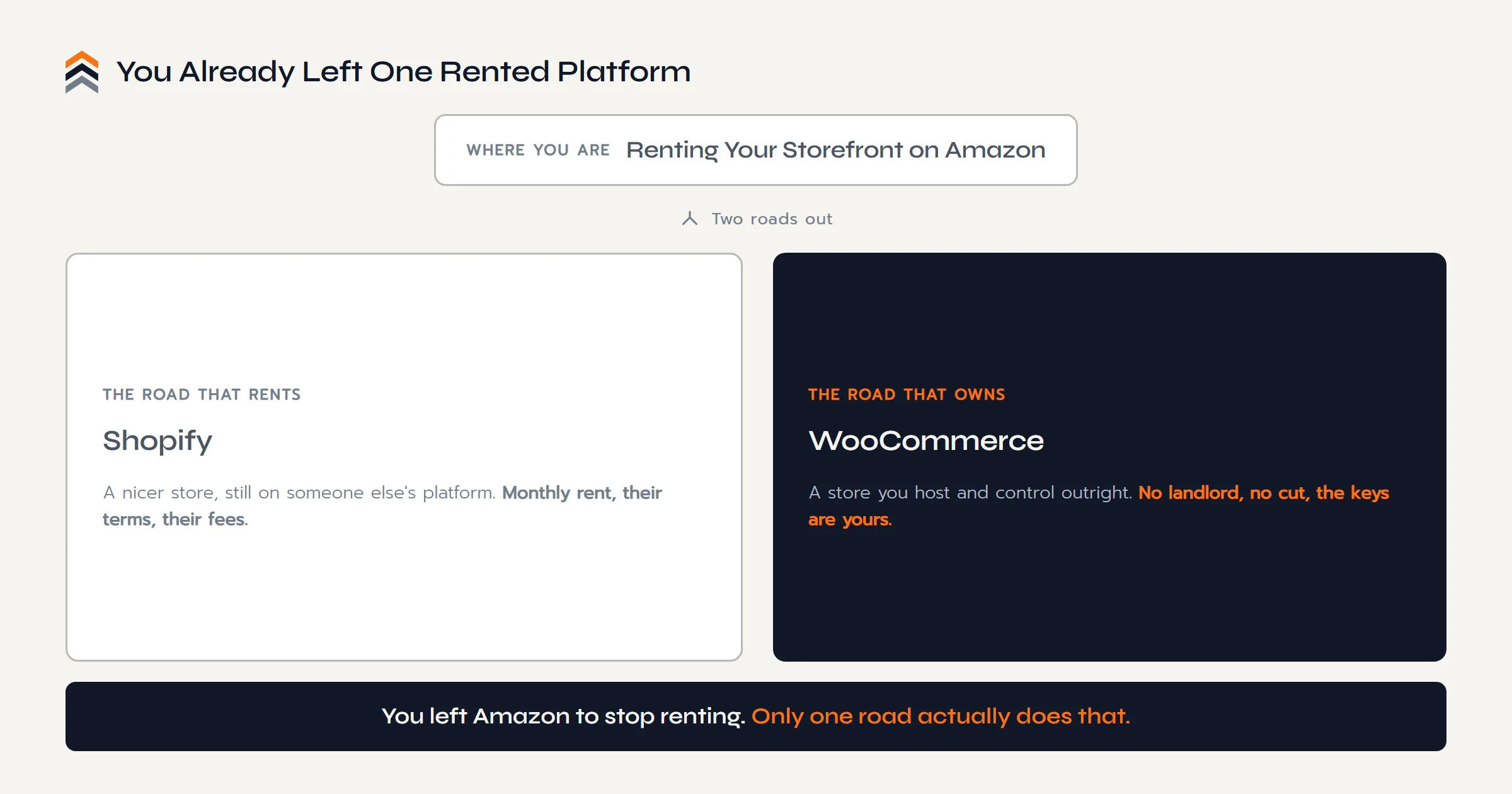
So look at the two options through that goal. You have spent years renting your storefront from one platform, on its terms, paying its fees, playing by its rules. Shopify, for all its polish, asks you to do the same thing again on a nicer platform: rent the store, pay the subscription, accept the terms, feed the fees. WooCommerce asks you to own it. For a seller whose entire reason to build is to stop renting, moving from one rented platform to another is a strange place to land.
To be clear about where the facts end and our judgment begins: the platform facts are not in dispute. Shopify is a hosted service you subscribe to; WooCommerce is open-source software you host and own. The conclusion we draw from those facts, from building these stores for a living, is that a seller whose whole goal is ownership should build on the one they own. That is the honest reasoning behind why we build on WooCommerce, and it is the same principle that runs through reducing your dependence on Amazon in the first place. The point was never to swap one landlord for another. It was to finally own the ground you build on.
An Honest Note
Two things are true at once:
- Shopify is a genuinely good product. If you want the fastest, most hands-off launch and you are running everything solo, it is a reasonable, respectable choice, and plenty of strong brands run on it.
- But ease is not the same as ownership. For a seller whose whole goal is to own the brand, the convenience of renting does not outweigh the value of owning, especially when a builder removes the maintenance burden anyway.
Pick Shopify for convenience. Pick WooCommerce to own it.
Questions Sellers Ask
Is WooCommerce Cheaper Than Shopify?
It can be, especially at higher volume. WooCommerce has no monthly platform fee and takes no cut of your sales, so you only pay for hosting, extensions, and payment processing. Shopify charges a subscription plus, if you do not use Shopify Payments, a per-order transaction fee. At scale, avoiding that per-sale cut is where WooCommerce pulls ahead.
Is WooCommerce Better Than Shopify for SEO?
For serious content and SEO, yes. WooCommerce runs on WordPress, so you get full control of your URL structure, deep on-page settings through Yoast or Rank Math, and the strongest blogging engine on the web. Shopify handles SEO basics well but forces fixed URL paths and caps how deep you can go.
Is Shopify or WooCommerce Better for Beginners?
Shopify is easier to launch alone. It hosts the store, handles security and updates, and works out of the box, which suits a first-time founder doing everything themselves. WooCommerce is more flexible but expects you or a builder to handle hosting and maintenance. If someone else builds and runs it for you, that tradeoff disappears.
Can You Switch From Shopify to WooCommerce?
Yes. Products, orders, and customers can be migrated from Shopify to WooCommerce with export tools or a migration plugin, and many brands make the move to escape platform fees and gain control. It takes planning to preserve URLs and SEO, but it is a well-trodden path and not a reason to stay locked in.
Does WooCommerce or Shopify Have Lower Transaction Fees?
WooCommerce charges no platform transaction fee at all. You pay only your payment processor, typically around 2.9 percent plus 30 cents per order, the same ballpark as Shopify Payments. Shopify adds an extra per-order fee on top, up to about 2 percent, if you use any gateway other than Shopify Payments.
Is WooCommerce Secure Compared to Shopify?
Both can be very secure, but the responsibility differs. Shopify manages security, PCI compliance, and updates for you. With WooCommerce, you or your builder handle hosting security, updates, and backups. On good managed hosting with someone maintaining it, WooCommerce is just as safe. The difference is who holds the keys, and on WooCommerce that is you.
The Conclusion
So, WooCommerce vs Shopify. On features they are closer than the loud comparisons suggest, and on ease Shopify has a real, honest edge. But the question underneath the comparison is not which platform is slicker. It is which one you own. Shopify hands you a beautiful store you rent for as long as you pay. WooCommerce hands you the keys.
For most people that is a genuine tradeoff. For many Amazon sellers building specifically to own their brand, that tradeoff often points in one direction, because the whole point was to own the thing this time. Choose the platform that makes the store yours, and let a builder carry the parts that used to make WooCommerce hard.
Your sales can live on Amazon. Your brand should not.
The Next Move
You Know the Difference.
Let's Build the One You Own.
Ready to Build
A free call, no pitch script. Walk us through your Amazon business and get a straight answer on the owned store that would actually fit it.
Book a Free CallStill Weighing It
The Push Roadmap is a free PDF with the Ownership Scorecard. Put a number on how much of your brand you actually own today.