
WordPress vs Shopify is one of the first choices an Amazon seller faces when they decide to build a brand beyond Amazon, and most comparisons rush straight to themes and checkout buttons. That skips the part that actually matters. These two are not the same kind of thing. Shopify is a hosted store you rent; WordPress is a content platform you own and host anywhere. For a seller who wants real demand coming from Google rather than paid demand from a marketplace, that difference shapes the whole build, and it deserves to sit at the center of the wider choice of an ecommerce platform.
We will give Shopify a fair hearing, because it is a genuinely good product. But the honest headline is this: if your growth plan leans on content and search, the platform that was built to publish has a real edge, and it is worth understanding exactly why.
Software vs a Storefront
Start with what each one actually is, because the labels get blurred. Shopify is a hosted, all-in-one platform. You pay a monthly subscription and Shopify runs everything behind the scenes: servers, security, updates, payments. It is fast, tidy, and completely managed, and it is also completely theirs. Your store lives on their infrastructure, inside their rules, for as long as you keep paying.
WordPress is a different animal. It is free, open-source software that you install on hosting you control, and it powers a large share of the web as measured by trackers like W3Techs. On its own, WordPress is a content management system, a publishing engine. To sell products on it you add WooCommerce, its ecommerce plugin, which turns it into a full store. That is worth flagging clearly, because it draws the line between this article and its sibling: if you want the head-to-head on the actual store and checkout, the fees, the cart, the payment rails, that is WooCommerce vs Shopify. This piece is about the layer underneath, the platform your whole site runs on, where the content and SEO story is decided.
Why WordPress Was Built to Publish
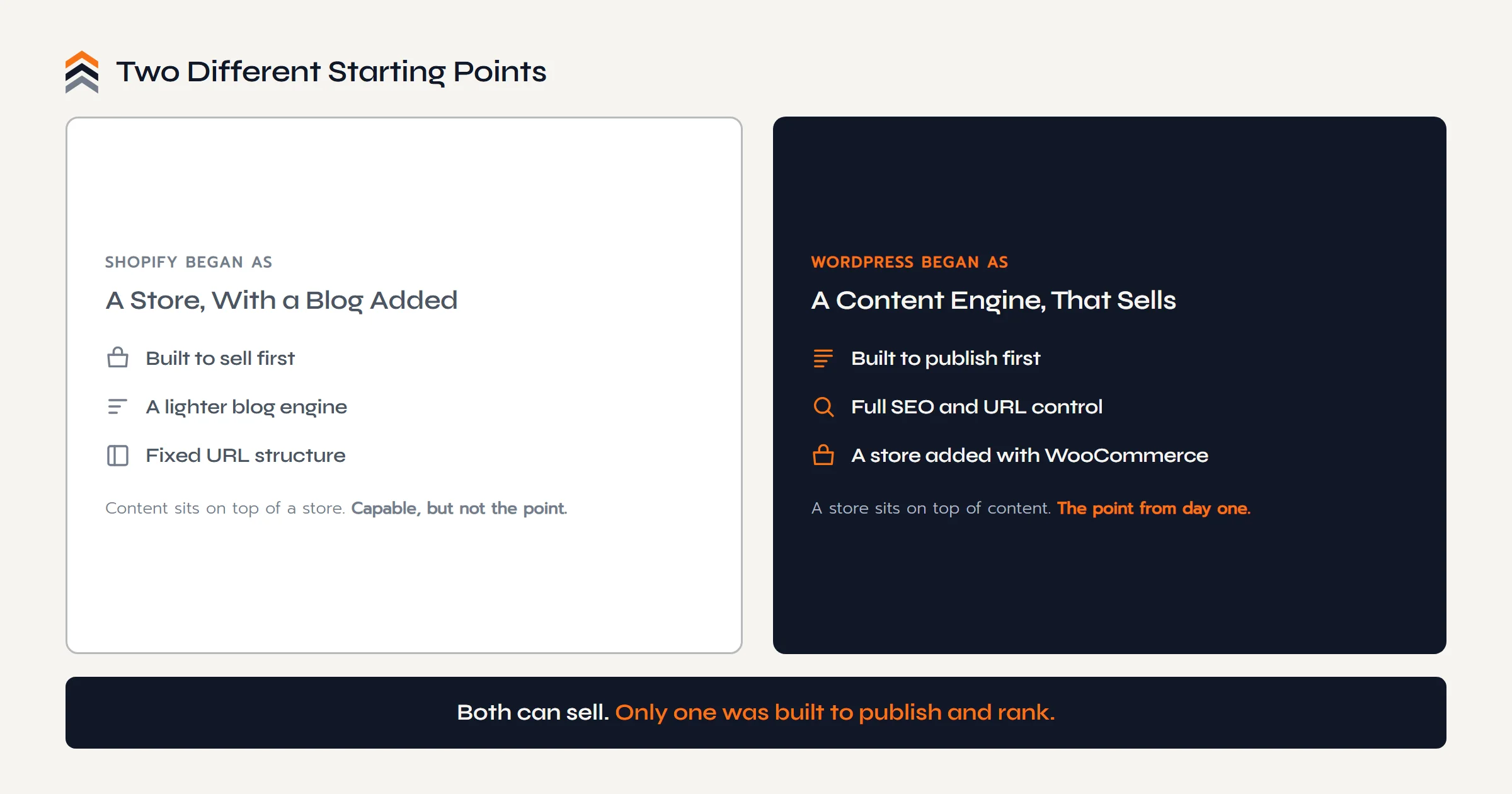
WordPress started life as blogging software, and two decades later that heritage is still its biggest advantage. Content is not a bolt-on feature it added to compete; it is the thing it was designed to do. That shows up in the everyday details: hierarchical categories and tags, custom content types, a genuinely powerful editor, and the ability to run hundreds or thousands of pages and posts without the system straining. For a brand that plans to publish guides, comparisons, buying advice, and stories over time, that depth is the raw material of a content strategy.
Shopify can blog, and it has improved, but the blog is a lighter engine sitting on top of a store. It offers basic tagging rather than deep content structure, and fewer editorial controls. For a shop that publishes the occasional post, that is fine. For a brand that intends to compete for search traffic with a real library of content, one platform gives you a newsroom and the other gives you a notice board. This is exactly the sort of thing that separates a plain shop from a site that earns its own traffic, and it sits inside the wider set of features that make up what a brand website needs.
The SEO Control That Decides It
For a brand chasing demand from Google, this is the section that settles it. WordPress hands you full control of your URL structure. You decide the paths, the hierarchy, and the words in every address, and you tune the technical layer as deeply as you like through mature tools like Yoast or Rank Math, meta titles, canonical tags, schema, redirects, sitemaps, the lot. That control is the foundation of ecommerce SEO that compounds over time, and it is the same control the deeper SEO basics for ecommerce guide assumes you have.
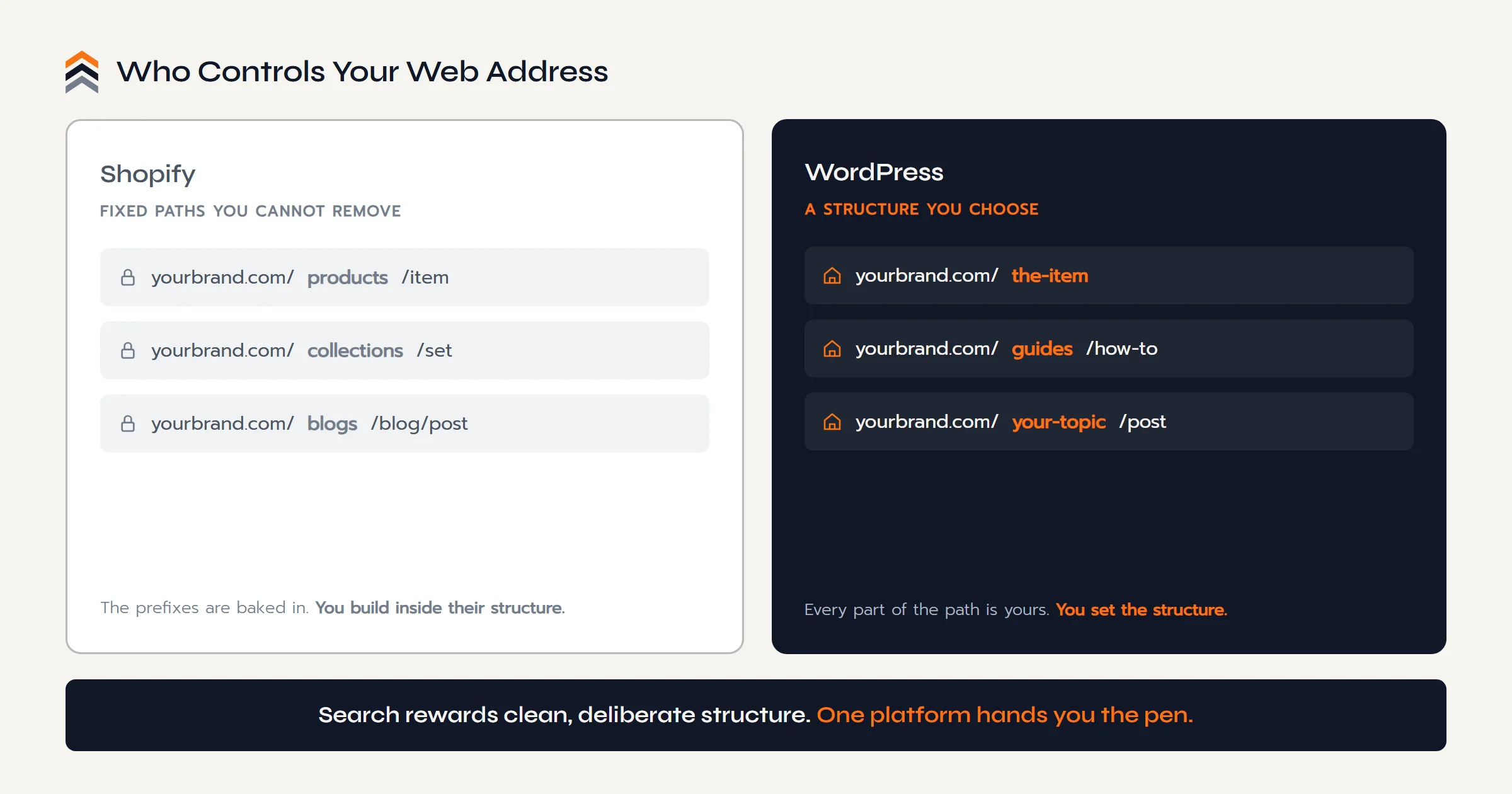
Shopify handles the fundamentals competently, and a well-built store will rank fine on it. It is genuinely fast out of the box and sets clean canonicals for you. But it forces a fixed URL structure you cannot fully change: products live under a products path, collections under a collections path, and blog posts under a blogs path, and those prefixes are baked in. You build inside the structure Shopify decided on, not one you design. For most stores that is a minor tax. For a brand treating content and search as a primary growth channel, that ceiling is real, and it is the honest reason we reach for WordPress when SEO is the point.
You Own the Software, Not Rent It
Underneath the content and SEO story is the same ownership question that runs through this whole site, applied to the software your brand runs on. With self-hosted WordPress, you hold the files and the database outright. You can move hosts, back everything up, export what you like, and extend the site however you need, and no single company can switch it off. With Shopify, you rent. The platform hosts everything, your export options are limited, and, as its own terms spell out, it can suspend or freeze a store for billing or policy reasons. For a seller who is building a website precisely to stop depending on a platform, that distinction is not academic.
Cost follows the same shape, and here the numbers move, so treat them as directional and check the current figures. As of 2026, Shopify charges a predictable monthly subscription that bundles hosting and security, which is convenient but never stops. WordPress flips the model: the software is free and you assemble and pay for the parts you own, hosting, a domain, a theme, any premium plugins, which can run cheaper at the low end and is far more variable. The fuller picture sits in what a brand website costs, but the pattern is the one you would expect: you either rent a bundle or you own the pieces.

Not Sure What Owning Your Brand Even Looks Like?
The Push Roadmap is a free 12 page PDF with the Ownership Scorecard. See the whole move from Amazon to a brand you own, mapped in order, before you settle on a platform.
Sent straight to your inbox.
You Do Not Always Have to Choose
Here is the nuance most versus articles miss. WordPress and Shopify are not strictly either-or. A common setup keeps WordPress as the owned, SEO-optimized content and marketing front end and uses Shopify only as the checkout engine, connected through the Shopify Buy Button or a plugin. You keep WordPress's content and search strengths while letting Shopify manage the payment side. It is a legitimate arrangement, and worth knowing exists.
We will be straight about our view, though. Running both means you still rent the commerce layer, and you take on two systems to maintain instead of one. In our experience, for a seller whose whole reason to build is ownership, the cleaner answer is WordPress with WooCommerce, one owned stack that does content and commerce together. But if a brand already lives on Shopify and simply wants a real content engine bolted alongside it, the hybrid is a reasonable bridge rather than a compromise you have to feel bad about.
Which One Fits an Amazon Seller
Bring it back to the specific person reading this. You are not a first-time founder deciding how to sell online. You already sell, on Amazon, with a real product and proven demand. What you are building now is the thing you own, and a large part of why you are building it is to open a channel Amazon does not control: people searching on Google and finding you.
Look at the two platforms through that goal and the answer sharpens. If the plan is a simple store with light content, run mostly solo, Shopify's speed and polish are a fair trade and it will serve you well. If the plan is to build a brand that earns search traffic through content it owns, WordPress is built for exactly that, and the ceilings you would eventually hit on Shopify never appear. To be clear about where facts end and judgment begins: the platform facts are not in dispute, WordPress is self-hosted software and Shopify is a hosted service. The conclusion we draw, from building these sites for a living, is that a seller optimizing for owned demand should build on the platform that was made to publish. It is the same logic that runs through reducing your dependence on Amazon in the first place: own the ground, then grow on it.
An Honest Note
Two things are true at once:
- Shopify is a well-made platform. For a fast, hands-off launch of a mostly product-led store, run by one person, it is a respectable choice, and plenty of strong brands run on it happily.
- But content is where WordPress was born. For a brand betting on search and a real content library, the publishing engine and the URL control matter more than the speed of the initial setup.
Pick Shopify for a quick, tidy store. Pick WordPress to build for search.
Questions Sellers Ask
Is WordPress or Shopify Better for SEO?
For content-led SEO, WordPress usually wins. It gives full control of your URL structure, deep on-page settings through Yoast or Rank Math, and the strongest blog engine on the web. Shopify handles the fundamentals well and loads fast out of the box, but it forces fixed URL prefixes and caps how far you can tune things.
Is WordPress Cheaper Than Shopify?
Usually cheaper to start, but less predictable. The WordPress software is free; you pay for hosting, a domain, and any premium theme or plugins, so a modest site can run a few hundred dollars a year. Shopify bundles hosting and security into a fixed monthly fee that is pricier but all inclusive. Figures move, so verify current prices.
Can You Use WordPress and Shopify Together?
Yes. A common setup keeps WordPress as your owned, content and SEO front end and uses Shopify only as the checkout, connected through the Shopify Buy Button or a plugin. You get WordPress content strengths alongside a managed checkout, though you are still renting the commerce layer rather than owning the whole stack.
Which Is Better for a Small Business, WordPress or Shopify?
It depends on the business. A product-first owner who wants the simplest possible store, run solo, is well served by Shopify. A brand that wants a blog, full design control, deep SEO, and long-term ownership of the website is usually better on WordPress. Many growing brands eventually want both commerce and content.
Is Shopify or WordPress Easier to Use?
Shopify is easier to launch alone. It hosts the store and handles security, updates, and payments, so a non-technical owner can be live quickly. WordPress is more powerful but expects you or a builder to handle hosting, a theme, plugins, and maintenance. When a builder runs the technical side, that ease gap mostly closes.
Do You Own Your Website With Shopify?
Not fully. You own your content, products, and customer records, but Shopify hosts everything and you rent the platform monthly. You cannot move the site to another host, data export is limited, and Shopify can freeze or suspend a store for billing or policy issues. Self-hosted WordPress gives you true ownership of the site itself.
The Conclusion
So, WordPress vs Shopify. Framed as store against store, they are closer than the loud comparisons suggest, and on pure speed to launch Shopify has an honest edge. But the question underneath is not which store is slicker. It is which platform your brand should live on, and that turns on what you are building it for. Shopify is a store that can also publish. WordPress is a publisher that can also sell.
For a seller whose growth plan runs through content and search, and who wants to own the site rather than rent it, that difference points one way. Build on the platform that was made to publish, add the store to it, and let the content you own do the compounding.
Your sales can live on Amazon. Your brand should not.
The Next Move
You Know the Platform.
Let's Build the One You Own.
Ready to Build
A free call, no pitch script. Walk us through your Amazon business and get a straight answer on the owned platform that would actually fit your growth plan.
Book a Free CallStill Weighing It
The Push Roadmap is a free PDF with the Ownership Scorecard. Put a number on how much of your brand you actually own today.