

Brand strategy is the long-term plan for how your brand is perceived and chosen: who you are for, what you stand for, how you are different, and what you promise every time. Everything visible, the logo, the colors, the voice, is the expression of that plan, not the plan itself. Get the strategy right and building a brand you actually own has a spine to grow around. Get it wrong and no amount of good design will save it.
There is a catch this article will not skip. You can write a sharp brand strategy while you sell on Amazon. You cannot fully execute one there, because the payoff of a strategy, an audience who returns, data that compounds, equity that is yours, lives on channels Amazon keeps for itself. Both things are true at once, and we will hold them both in view the whole way through.
What Is Brand Strategy?
Brand strategy is the deliberate set of choices that decides how a company wants to be known, and why a customer should choose it over the alternative and keep choosing it. It sits upstream of everything tactical. Before a single ad runs or a logo is drawn, the strategy has already answered the questions that make those choices easy: who exactly is this for, what do we stand for that competitors do not, and what is the one promise we keep every time.
A business without a strategy still has a brand. It just has one by accident, assembled from whatever the market decided in the absence of a plan. That is the real reason brand strategy matters: it replaces accident with intent. It is the difference between a product people happen to buy and a name people choose on purpose, remember, and reach for again.
The Components of a Brand Strategy
Frameworks vary in the counting, but the strong ones agree on the same parts. A complete brand strategy names each of these, and each earns its place for a plain reason:
- Purpose. Why the brand exists beyond making money. It is what lets a customer buy a story instead of a spec, and it is what keeps the team pointed the same way.
- Audience. Exactly who it is for, and who it is not. A brand aimed at everyone is chosen by no one, because nothing about it feels made for the person reading it.
- Positioning. The specific space you own in the buyer mind against the alternatives. This is what makes you the obvious pick instead of one more option on a crowded shelf.
- Promise. The one thing a customer can count on every single time. Kept consistently, it becomes trust, which is the only reason anyone pays more or comes back.
- Personality and Voice. The human character of the brand and how it speaks. It is what makes the brand feel like a someone, not a listing, so people form an actual relationship with it.
- Visual Identity. The logo, color, and type that make all of the above recognizable at a glance. It is the expression of the strategy, which is why it comes last, not first.
- Consistency. The same promise, voice, and look applied across every touchpoint. Repetition is what turns a set of choices into a memory a customer can actually hold.
Strategy, Identity, or Positioning?
These three get used as if they were the same thing, and treating them that way is how brands end up with a beautiful logo and no reason to exist. They are related, but they answer different questions:
| Term | The Question It Answers |
|---|---|
| Brand strategy | The plan: who you are for, what you stand for, how you win over time |
| Brand identity | What people see: the logo, color, and type that express the plan |
| Brand positioning | Where you fit: the space you own in the buyer mind vs the alternatives |
| Branding | The daily act of shaping that perception across every touchpoint |
| Marketing strategy | How you reach and sell: the channels, campaigns, and acquisition |
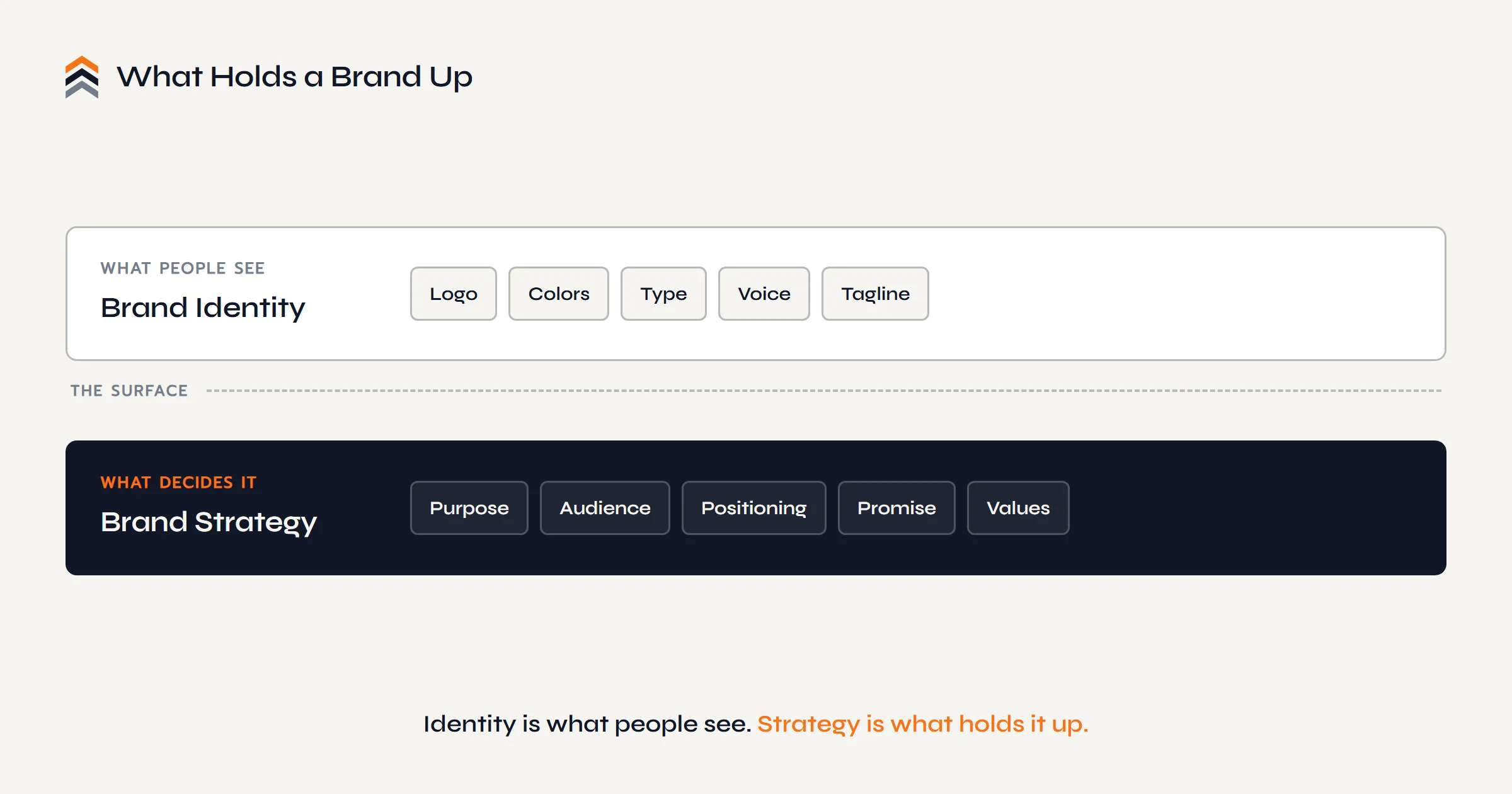
Read in order, the relationship is simple. Strategy is the plan. Positioning is one sharp component of that plan. Identity is how the plan looks and sounds, and it should be decided after the strategy, not before. Branding is the ongoing work of applying it, and marketing strategy is what happens downstream once you know who you are. The most common expensive mistake is to start with identity, a new logo, a fresh palette, and call it a rebrand, while the strategy underneath is still blank. That is also where what your brand actually stands for gets decided, and it cannot be back-filled by design.
Strategy decides what people feel. Identity decides what they see. Confuse the two and you polish the surface while the foundation stays empty.
Where Amazon Caps Your Brand Strategy
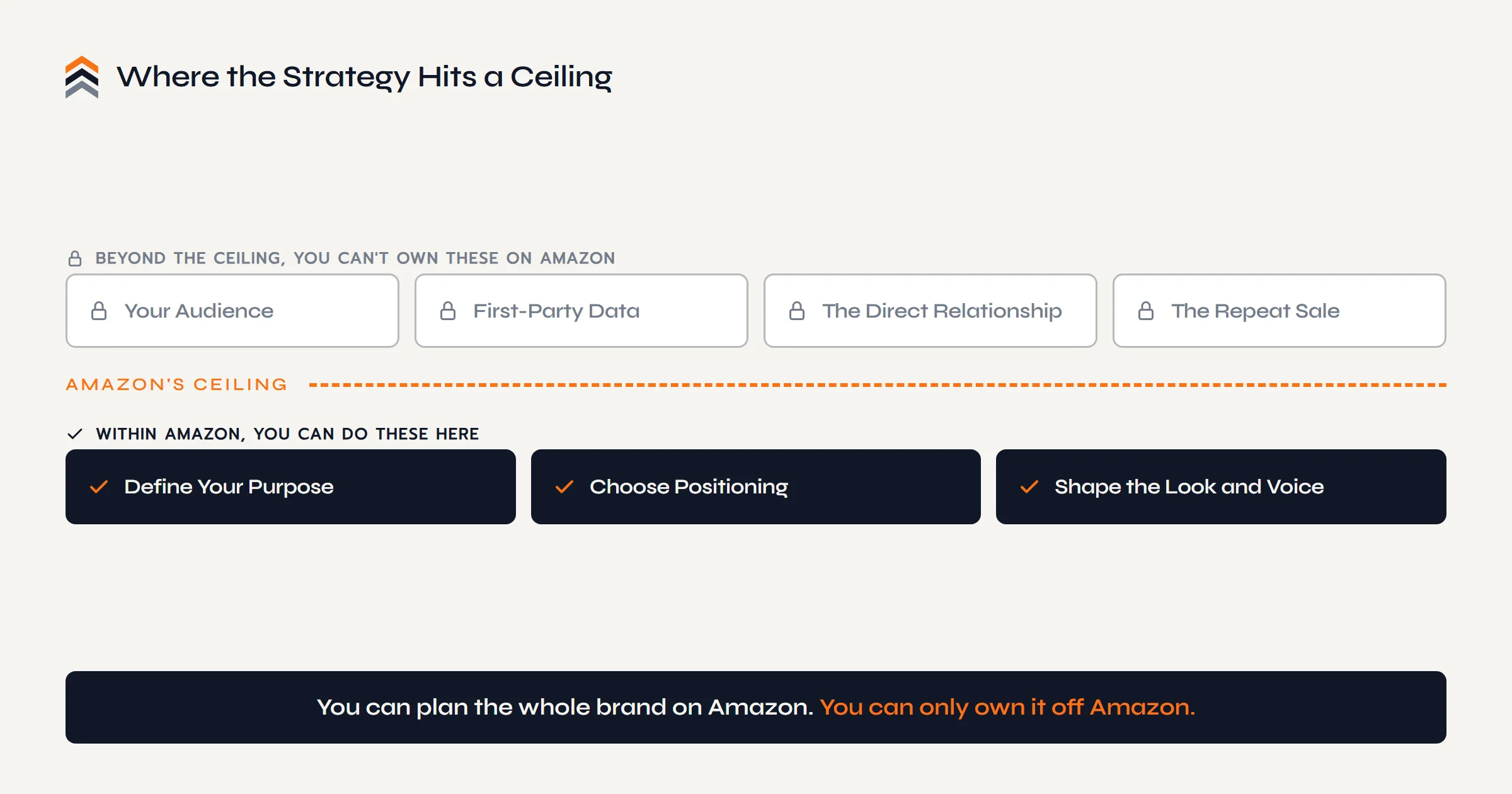
Here is where nearly all brand strategy advice quietly assumes something you may not have: a channel you own. Almost every guide tells you to define your purpose, sharpen your positioning, and then apply it consistently across your touchpoints. That advice is sound, and it was written for people who control their touchpoints. For an Amazon seller, the most valuable ones are not yours. You can define the whole strategy. You hit a ceiling the moment you try to execute the parts that pay it back.
- Positioning gets flattened. Amazon's grid stacks you beside cheaper look-alikes in an identical template. You cannot stage the comparison on your own terms, so the difference you worked to build is reduced to a thumbnail and a price.
- The relationship never reaches you. You cannot email or message the people who bought, because Amazon owns the inbox. Every instinct to reward the customers who come back runs into a wall you do not control.
- The data stays a crowd. You get aggregate Brand Metrics, not people. Owning the data to actually know your buyers is what makes a strategy sharpen over time, and it is exactly what the platform keeps.
- The experience routes through Amazon. The unboxing, the follow-up, the reason to buy the next thing, all of it happens on their rails, in their frame, under their logo, not yours.
The most-cited proof is Nike. In 2019 it pulled its products from selling directly on Amazon to go all in on its own channels, explicitly to own the customer relationship, the data, and the margin. The instructive part is the sequel: Nike returned to Amazon in 2025, but from a position of strength, as one channel among many it already controlled. That is the honest lesson, and it is not leave Amazon. It is own your own ground first, then treat Amazon as one channel whose grip on you you get to decide.
A Strategy Is Only As Real As What You Own.
The Push Roadmap is a free 12 page PDF with the Ownership Scorecard. Put a number on how much of your brand you actually own today, and see the whole move mapped in order.
Sent straight to your inbox.
How to Build a Brand Strategy That Holds
You do not need a rebrand or an agency retainer to begin. A working brand strategy fits on a single page, and most of it you can draft this week:
- Name the customer precisely. Not everyone. One real person, specific enough that you know what they fear, want, and already tried.
- Write the one promise. The single thing you will deliver every time, stated plainly enough that a customer could hold you to it.
- Find the true difference. The reason to choose you over the cheaper look-alike, in language a buyer would actually use, not a slogan.
- Give it a voice and a look. Only now does identity get drawn, so the design expresses a decision instead of standing in for one.
- Give it ground you own. The strategy needs somewhere to live that you control, which is the whole case for a website of your own alongside the marketplace.
The first four you can finish on a page. The fifth is the one Amazon cannot hand you, and it is the one that turns a strategy on paper into equity you keep. If you are weighing where the two channels fit together, the honest comparison of Amazon and your own website lays out what each does best.
An Honest Note
Two things can be true at the same time:
- Sell on Amazon. It is the best demand engine in retail. Using it is not the mistake, and no strategy here asks you to walk away from real sales.
- Don't let it be the only place your brand exists. A strategy you cannot own is a strategy you rent. The plan can be brilliant and still build someone else's asset.
Define the brand fully. Own it somewhere the platform can't cap.
Questions Brand Owners Ask
What Is Brand Strategy?
Brand strategy is the long-term plan for how a company wants to be perceived and chosen. It defines who the brand is for, what it stands for, how it is different, and what it promises. Everything visible, from the logo to the voice, is the expression of that plan, not the plan itself.
What Are the Key Elements of a Brand Strategy?
The core elements are purpose, target audience, positioning, and a brand promise, expressed through a personality, voice, and visual identity, and held together by consistency. Purpose and positioning are the strategic core; the logo and colors are the expression. A complete strategy answers who you serve, why you win, and what you reliably deliver.
What Is the Difference Between Brand Strategy and Brand Identity?
Brand strategy is the plan; brand identity is how that plan looks and sounds. Strategy decides who you are for, what you stand for, and how you compete. Identity, the logo, colors, type, and voice, makes that strategy recognizable. Strategy is what people feel; identity is what they see. Identity executes strategy, never the reverse.
What Is the Difference Between Brand Strategy and Brand Positioning?
Positioning is one component of a brand strategy, not a synonym for it. Positioning is the specific space you own in the customer mind relative to alternatives. Strategy is the wider plan that includes positioning along with your purpose, audience, promise, personality, and identity. Positioning is the sharp point; strategy is the whole spear.
How Do You Create a Brand Strategy?
Name your customer precisely, define the one promise you keep every time, find the true difference that separates you from cheaper alternatives, then give it a consistent voice and look. Write it on a single page first. The final step is giving the brand a channel you own, so the strategy compounds instead of renting space.
Why Is Brand Strategy Important?
Without a strategy, a brand is assembled by accident from whatever the market decides in your absence. A clear strategy attracts the right customers, repels the wrong ones, justifies a higher price, and earns repeat purchases. It turns scattered tactics into one recognizable thing people choose on purpose and remember the next time they buy.
What Makes a Good Brand Strategy?
A good brand strategy is specific, honest, and ownable. It names a real audience instead of everyone, stands for something a competitor cannot copy, and makes a promise the business actually keeps. Just as important, it lives somewhere the brand controls, so the audience, data, and loyalty it builds belong to the brand and not a platform.
The Conclusion
Brand strategy is not the logo, and it is not a mission statement framed on a wall. It is the set of choices that make a customer choose you, trust you, and keep choosing you. On Amazon you can make every one of those choices well. What you cannot do there is keep what they produce, the audience, the data, the repeat sale, because those live on the platform's side of the ceiling.
So build the strategy in full. Name your customer, make your promise, sharpen your difference, dress it in an identity that fits. Then give it ground where all of that compounds into something that is yours, not the platform's. A strategy is only worth as much as what it is allowed to keep.
Your sales can live on Amazon. Your brand should not.
The Next Move
You Have the Plan.
Now Give It Ground You Own.
Ready to Build
A free call, no pitch script. Walk us through your Amazon business and get a straight answer on what your own brand site would take.
Book a Free CallStill Weighing It
The Push Roadmap is a free PDF with the Ownership Scorecard. Put a number on how much of your brand you actually own today.