
Brand positioning is the distinct place your brand occupies in a customer's mind relative to the alternatives. It is a deliberate choice about how you want to be perceived and which associations you want to own, so that when a buyer feels a need, they reach for you instead of a cheaper look-alike. As the marketing classic by Al Ries and Jack Trout put it, positioning is not something you do to the product; it is what you do to the mind of the prospect. It is also the first thing building a brand you actually own has to get right, because the story, the design, and the price are all just expressions of the position you chose.
Here is the tension for an Amazon seller. Positioning is a choice, but the marketplace quietly makes that choice for you. In a grid engineered to make every product look comparable, the platform decides where you sit, not you. You can define a razor sharp position and still watch it flatten into a thumbnail and a price. So this article does two things: it makes positioning genuinely clear, and it shows you where you can finally control it.
What Is Brand Positioning?
Positioning is comparative and it is mental. Comparative, because it only means something against competitors: "the safe car" is only useful because other cars are not primarily about safety. Mental, because it lives in the customer's head, not in your product spec. Your job is to decide the one idea you want to own in that head, and then earn it.
The reason it matters is leverage. A brand with a clear position competes on that idea. A brand without one competes on price, because price is the only thing left to compare when nothing else stands out. Positioning is what lets a customer justify choosing you when a cheaper option sits right next to you, and it is what turns scattered marketing into one idea repeated until it sticks. It is the difference between being an option and being the obvious answer.
Positioning vs the Words Near It
Positioning gets tangled up with four terms that sit close to it. Keeping them straight is most of the battle, because teams waste months polishing a tagline when the position underneath it was never decided:
| Term | What It Actually Is |
|---|---|
| Brand positioning | The place you own in the customer's mind versus the alternatives |
| Positioning statement | The internal formula that captures that place, to align your team |
| Value proposition | Why a customer should buy: the value delivered and the problem solved |
| Tagline | The short public phrase that signals the positioning ("Just Do It") |
| Brand strategy | The whole system; positioning is one component inside it |
Read in one line: your value proposition is the value you promise, your positioning is the place that promise occupies against rivals, the statement is the internal formula that captures it, the tagline is the public phrase that signals it, and your brand strategy is the whole house that positioning is one room of. Get the room right first. The decor comes after.
The Positioning Statement Formula
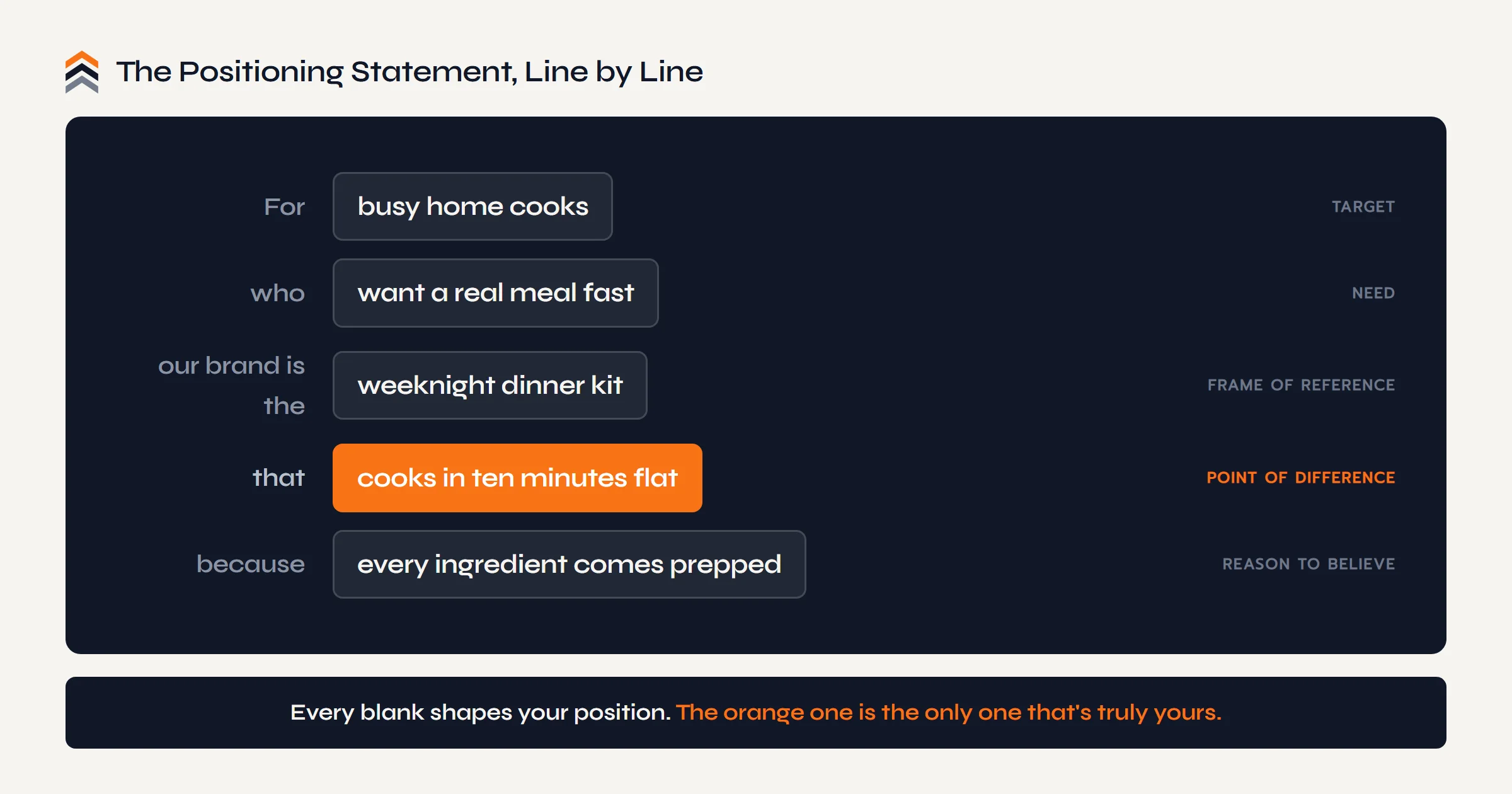
The most useful tool here is the positioning statement, a single internal sentence popularized by Geoffrey Moore in Crossing the Chasm. It is not customer facing copy. It is the alignment document that keeps your whole team pointed at the same idea. The classic template reads:
For [target customer] who [need], our brand is the [category, or frame of reference] that [key benefit, the point of difference], because [reason to believe].
Each blank is a decision. The target narrows who you are for. The frame of reference sets the category you want to be judged inside, which quietly decides who you are compared against. The reason to believe is the proof that makes your claim credible instead of a boast. And the one blank that carries your whole brand is the point of difference: the single thing only you can honestly claim. Fill in someone else's differences and you have described a competitor.
Common Ways Brands Position
There is no single correct base to position on. There is only the one that is true for you and hard for others to copy. Most brands anchor to one of these, and the discipline is choosing one, not hedging across several:
- By benefit or outcome. Own one result the product delivers. Volvo has held "safety" for decades, which is the textbook example of a single attribute owned so completely that rivals stopped trying to take it.
- By price. Premium at the top, value at the bottom. Both are positions, as long as you commit; the trap is landing in the muddled middle where you are neither.
- Against a competitor. Define yourself as the opposite of a leader. Dollar Shave Club built a brand as the convenient, affordable answer to expensive drugstore razors, and the contrast did the positioning work.
- By use case or occasion. Tie the brand to a specific moment, the post workout snack, the Sunday reset, so you come to mind exactly when that moment arrives.
- By customer niche. Position around a specific audience rather than everyone. A product visibly made for one kind of person beats a product made for anyone.
- By problem solved. Anchor to the one pain you remove better than anything else, and let that pain become your category.
How Amazon Flattens Your Positioning
Now the hard part for a marketplace seller. Every lever positioning depends on, the frame of reference, the comparison, the visual hierarchy, the story, is a lever Amazon holds, not you. The search results render your product in the exact same template as everyone else: thumbnail, title, price, star rating. A point of difference is nearly invisible in a layout engineered to make everything look interchangeable, and the algorithm stacks you beside cheaper look-alikes you never chose to be compared against.
This is not a flaw you can optimize away; it is the design. As Amazon seller strategist Liran Hirschkorn has put it, on Amazon distribution without differentiation just accelerates commoditization and margin loss. The platform's structure rewards price and logistics, and the whole environment nudges the shopper toward the cheapest acceptable option, because that is the comparison the grid makes easiest. You can write a brilliant positioning statement and the marketplace will still reduce it to a number next to four rivals.
A grid is built to make products comparable. Positioning is built to make you incomparable. The two work against each other by design.
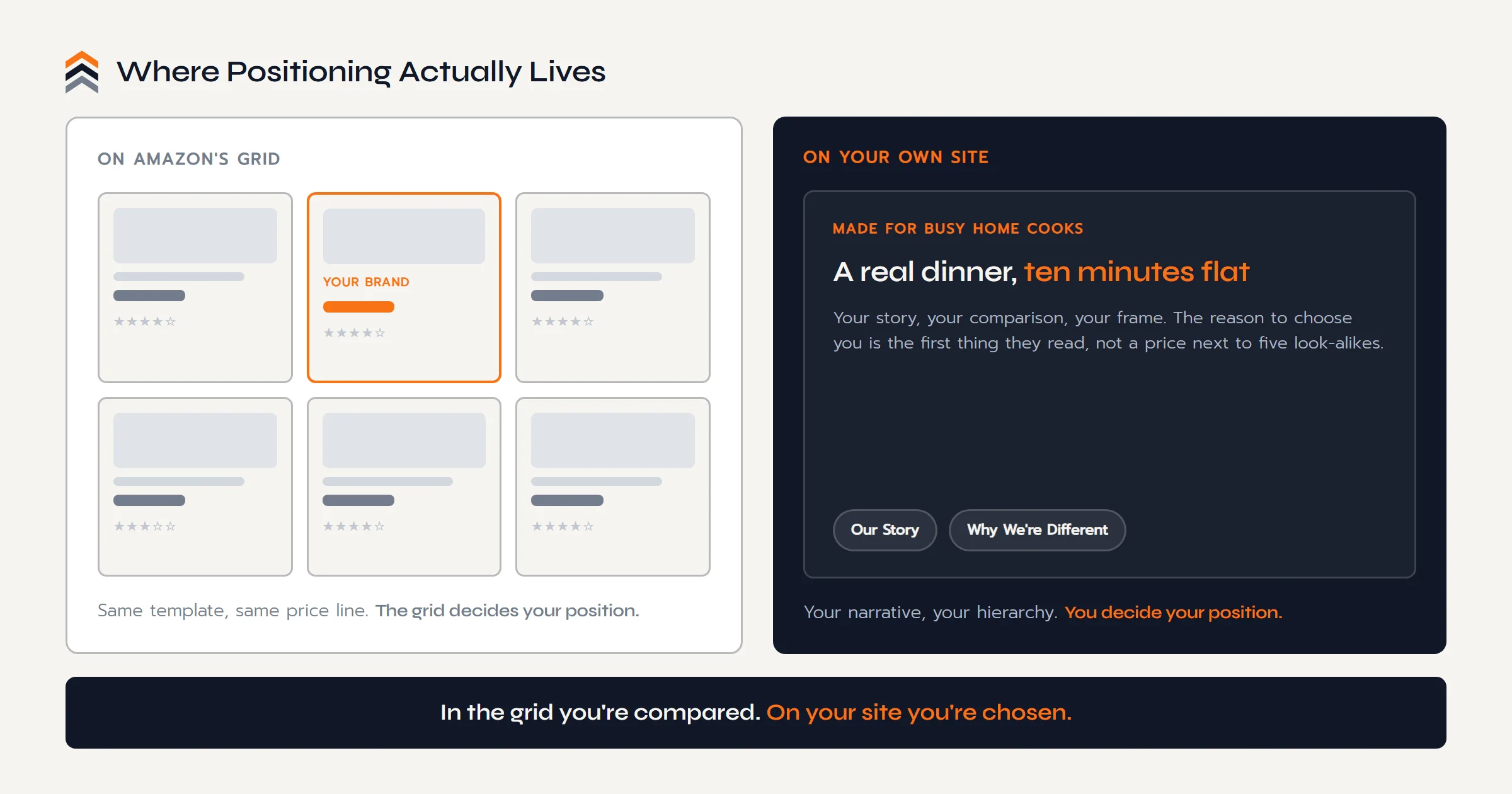
This is the honest wedge, and it is not "abandon Amazon." It is that positioning needs a surface you control, and a listing is not one. The place where you decide the frame, stage the comparison on your terms, and lead with the reason to choose you is a website of your own. That is also where the difference between renting a shelf and owning a room shows up most clearly, which is the core of the honest comparison between Amazon and your own site.
A Position Is Only Real Where You Control the Frame.
The Push Roadmap is a free 12 page PDF with the Ownership Scorecard. Put a number on how much of your brand you actually own today, and see the whole move mapped in order.
Sent straight to your inbox.
How to Position a Brand You Own
You do not need a rebrand or an agency retainer to position well. You need honest answers to a short set of questions, in order:
- Name the target precisely. Not everyone. The specific customer whose need you understand better than a generalist competitor does.
- Map who you are really compared against. Not the whole category, the two or three options your customer actually weighs you against at the moment of choice.
- Find the point of difference. The one true, defensible thing only you can claim. If a competitor could say it too, it is not your difference yet.
- Set the frame of reference. Choose the category you want to be judged inside, because that choice decides which comparison the customer makes.
- Write the statement, then express it everywhere. Put it in one sentence, then make sure the story, the design, and what people recognize and recall about you all say the same thing.
The last step is where marketplaces quietly break the chain. Consistency is how a position sinks in, and you cannot be consistent on a surface you do not control. To express a position, you need to own the touchpoints: the page, the story, the frame. That is the whole reason telling your brand's story on ground you own matters, and it is what keeps the position you chose from dissolving back into the grid.
An Honest Note
Both of these are true:
- Amazon is a great place to sell. The demand is real, and positioning your brand does not mean turning the marketplace off. Keep the sales.
- Amazon is a poor place to be positioned. A grid built for comparison will always work against a brand built to be incomparable. You need a frame you control too.
Sell where the demand is. Position where you own the frame.
Questions Brand Owners Ask
What Is Brand Positioning?
Brand positioning is the distinct place a brand deliberately occupies in customers' minds relative to competitors. It is the strategic choice of how you want to be perceived and which associations you want to own, so that when buyers feel a need, they think of you first instead of a cheaper look-alike.
What Is a Brand Positioning Statement?
A brand positioning statement is a short internal formula that captures your positioning to align your team. The classic template: "For [target] who [need], [brand] is the [category] that [key benefit], because [reason to believe]." It guides marketing and product decisions but is rarely shown to customers word for word.
What Are the Types of Brand Positioning?
Common bases include price (value or premium), quality, benefit or outcome, use case or occasion, competitor based (against a rival), attribute or feature, customer niche, and problem solved. Brands usually anchor to one primary base so a single clear idea sticks, rather than a muddled mix that says nothing.
How Do You Create a Brand Positioning Strategy?
Define your target customer, map the competitors you are really judged against, audit how you are perceived now, then identify a defensible point of difference and the category you want to compete in. Write it into a positioning statement, and express it consistently across messaging, visuals, and product so perception matches intent.
What Is the Difference Between Brand Positioning and a Value Proposition?
A value proposition states why a customer should buy, the specific value delivered and the problem solved. Brand positioning is comparative: where you sit in the customer's mind relative to competitors. The value proposition can stand alone; positioning is inherently relative. Positioning frames the market, and the value proposition sells the benefit inside that frame.
Why Is Brand Positioning Important?
Positioning drives differentiation, higher perceived value, and pricing power, and it gives your marketing one clear idea to repeat. Without it you compete mainly on price and blend into the category. Clear positioning gives customers a reason to choose you over cheaper look-alikes, and gives your team a filter for every decision.
What Are the Elements of a Positioning Statement?
Four core parts: the target customer (who it is for), the frame of reference (the category you compete in), the point of difference (what makes you distinct), and the reason to believe (proof that makes the difference credible). Geoffrey Moore's fuller version also names the primary competitor you are defined against.
The Conclusion
Brand positioning is the one idea you want to own in a customer's mind, made concrete in a statement and proven by everything you do. It is what gives a buyer a reason to choose you over a cheaper look-alike, and it is what frees you from competing on price alone. Get it right and every other decision gets easier, because you finally have a filter for what is you and what is not.
The catch is that a position only holds where you control the frame. On Amazon's grid, the frame belongs to Amazon, and a brand built to stand out gets rendered to look the same as everyone else. So choose your position with real discipline, then give it a home where the comparison, the story, and the reason to choose you are yours to set. A position you cannot control is a position you are only renting.
Your sales can live on Amazon. Your brand should not.
The Next Move
You Chose a Position.
Now Own the Frame It Lives In.
Ready to Build
A free call, no pitch script. Walk us through your Amazon business and get a straight answer on what your own brand site would take.
Book a Free CallStill Weighing It
The Push Roadmap is a free PDF with the Ownership Scorecard. Put a number on how much of your brand you actually own today.