
Private label and private brand sound like they must name two precise, different things. Here is the honest answer most comparisons will not lead with: in retail and consumer goods, the two terms are used almost interchangeably, and there is no strict dictionary line dividing them. The distinction actually worth your attention is not the words at all. It is how much real brand equity, and how much of the customer relationship, sits behind the name. For an Amazon seller that is the whole game, because it is the line between running an Amazon private label and building a brand beyond Amazon that outlasts the platform.
The Honest Answer on the Terms
Start with what is verifiable, because a lot of articles will sell you a tidy taxonomy that the industry itself does not use. Reference sources define a private label as a product made by one company and sold under another company's brand name, and in the same breath note that it is "also called a private brand." Trade bodies and retail analysts use private label, private brand, own brand, and store brand as synonyms. So if a guide hands you a strict, dictionary-style split between "private label" and "private brand," it is overselling a distinction that does not formally exist.
Where the industry does draw a real line is somewhere else: between a private brand and a national, or manufacturer, brand. A national brand like Coca-Cola or Duracell is owned by the producer and sold across many retailers. A private brand, whatever you call it, is owned and controlled by the seller or retailer and sold mainly through them. The axis that matters, in other words, is not label versus brand. It is who owns the name. Hold on to that, because it is the same axis this whole site is built on.
The Difference That Actually Matters
Now we move from what is documented to how we would put it to use, and we will flag it plainly as our reading rather than a textbook fact. Because the terms blur, the useful question is not which word to use. It is how much of a brand actually stands behind the name. Seen that way, two very different things hide under the same label.
On one end is the tactic most people mean by private label: you take an existing, largely generic product, put your logo and packaging on it, and sell it as yours. It is fast, the barrier is low, and the product is often the same one your factory sells to three other sellers. On the other end is what we would call a genuine private brand: the same starting point, but with real differentiation, a story, quality people notice, and enough loyalty that shoppers ask for it by name. Kirkland Signature is the textbook journey. It began as a plain store label and became a brand people actively seek out and trust, to the point that some of its products are openly made by the national brands it sits beside. The label was the starting line. The brand is what it grew into.
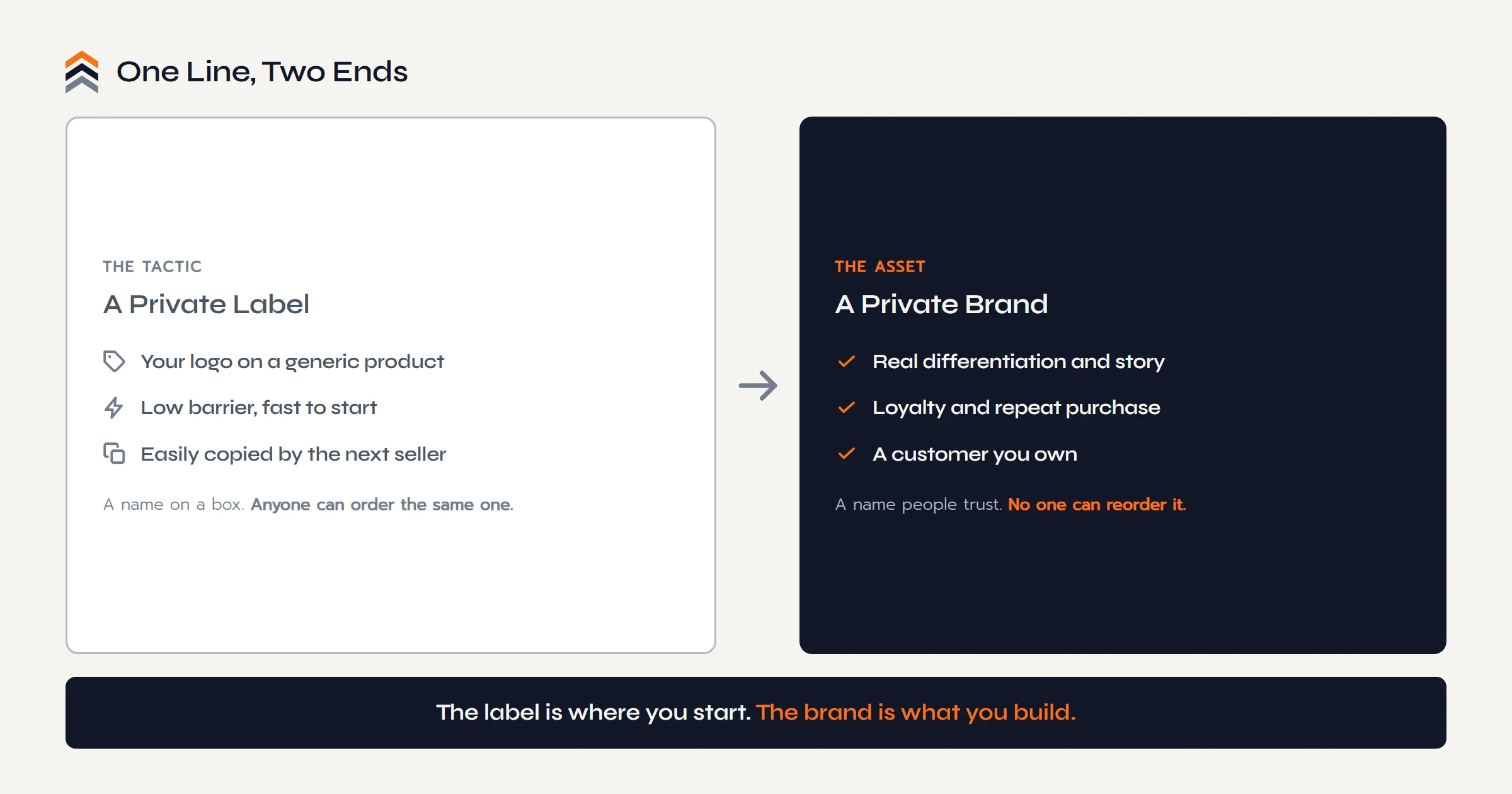
Anyone can order the same product. No one can reorder your brand.
Where Amazon Sellers Actually Sit
For most Amazon sellers this is not abstract, because private label is the default model. Jungle Scout's 2023 State of the Amazon Seller report found that over half of sellers use it, more than any other approach. The playbook is well worn: find a proven product, source it from a manufacturer, often through Alibaba, apply your own branding, create a listing, and fulfill through FBA. Done well it can be a real business, and we covered how the model works in detail in the piece on Amazon private label.
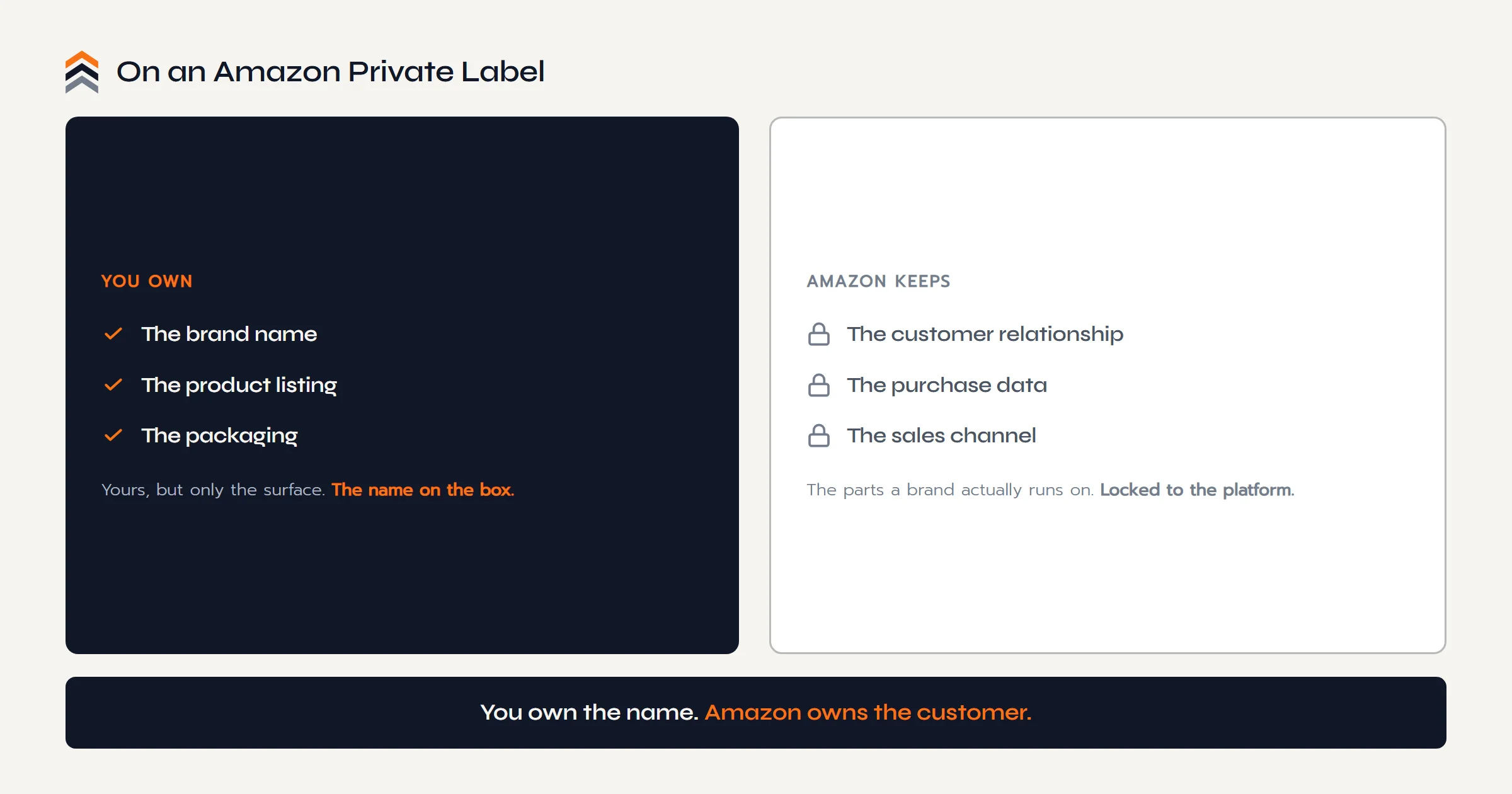
But here is the limitation that the word "brand" quietly hides on Amazon. On a private label listing you own the name, the packaging, and the listing itself. You do not own the customer. Amazon controls the marketplace, the checkout, and the relationship, and it keeps the purchase data that would let you sell to that buyer again. That is exactly the first-party data a real brand runs on, and on Amazon it stays with Amazon. It is not a small gap. Amazon has been reported to use aggregate marketplace data to develop its own competing products, and its Amazon Basics line can undercut third-party sellers on price and placement. A private label built on Amazon alone is a brand you own standing on ground you rent.
Own the Label, or Own the Brand?
The Push Roadmap is a free 12 page PDF with the Ownership Scorecard. Put a number on how much of your brand and your customer you actually own today, and see the move mapped in order.
Sent straight to your inbox.
Why the Brand Is the Asset
Chasing the brand end of that line is not sentiment. It is where the durable value lives. A genuine private brand carries differentiation, pricing power, and repeat purchase, the ingredients of customer loyalty that a bare logo cannot manufacture. And private brands are no longer the cheap also-rans they once were. Industry figures from the PLMA put US store-brand sales at a record level in 2025, with store brands taking roughly a fifth of retail dollars, close to one in four units sold, and growing several times faster than national brands. Shoppers increasingly rate them as equal or better in quality. The category people once dismissed as generic is now where a lot of the growth is.
For a seller, the reason to care is defensibility. The label is the easy part to copy; the next competitor can order the same unit from the same factory next week. What they cannot reorder is a brand customers trust and a customer list you own. That is the part that survives when the marketplace raises fees, changes the rules, or launches something that competes with you. Reducing how much of your business depends on one channel, the whole point of reducing your dependence on Amazon, starts with owning the brand rather than just labeling the box.
How a Label Becomes a Brand
So how does a private label cross the line into a private brand? Three things, roughly in order. First, real differentiation, a product or a promise that is not identical to the ten listings beside it, which is the work of brand positioning. Second, the trust layer: a story, packaging, and consistency that make the name mean something. Third, and this is the one a marketplace structurally denies you, a channel and an audience you own, so the relationship with the buyer is yours to keep and build on.
That last piece is why so many private label sellers eventually build a website of their own. Not to leave Amazon, which can keep doing what it does well, but to give the brand one place where the customer, the data, and the story finally belong to them. That is the step where a label you own quietly becomes a brand you own.
An Honest Note
Turning a label into a brand is genuinely hard, and worth saying so plainly:
- Even Amazon found it hard. It expanded to dozens of private brands, then pruned the lineup back to a fraction of that, and its private label is a tiny share of its own sales. Scaling many brands that people love is difficult even with every advantage.
- A label is easy to start; a brand is not. That is exactly why the brand is the asset. If it were easy, it would not be defensible. The work is the moat.
Starting a label is quick. Building a brand is the point.
Questions Sellers Ask
What Is the Difference Between a Private Brand and a Private Label?
In practice, very little. Retail and consumer-goods sources use private label, private brand, own brand, and store brand to mean the same thing: a product sold under a name the seller owns rather than the manufacturer. The distinction worth caring about is not the term. It is how much genuine brand equity and customer ownership sits behind the name.
What Is a Private Brand?
A private brand is a product sold under a brand owned by the retailer or seller rather than by the manufacturer that makes it. Kirkland Signature, Amazon Basics, Great Value, and Good and Gather are private brands. It is the opposite of a national or manufacturer brand like Coca-Cola, which is sold across many retailers.
Is Private Label the Same as White Label?
No. Private label means a product is customized and branded exclusively for one seller who sets the specifications. White label means one generic product is sold to many sellers, who each add their own label to the identical item. Private label gives more control and differentiation; white label is faster but interchangeable.
What Are Some Examples of Private Brands?
Costco's Kirkland Signature, Amazon Basics, Walmart's Great Value, Target's Good and Gather, and Kroger's Simple Truth are all private brands. Each is owned by the retailer and sold mainly in its stores. Kirkland is the standout example of a store label that grew into a brand shoppers actively seek out and trust.
Are Private Label Products the Same Quality as Name Brands?
Often yes. Private label goods are frequently made in the same factories as national brands, and industry surveys report that most shoppers now see store brands as equal or better in quality. Quality varies by seller, but the old assumption that private label means cheap and inferior no longer holds across most categories.
Who Owns the Customer on a Private Label Amazon Business?
Amazon does. On a private label Amazon listing you own the brand name, the listing, and the packaging, but Amazon controls the marketplace, the checkout, the customer relationship, and the purchase data. That is the core limitation of building a private label on Amazon alone, and the reason a brand needs a channel of its own.
The Conclusion
So, private label versus private brand. On the words themselves, there is less daylight than the question implies; the terms are used interchangeably, and no formal definition separates them. But underneath the words sits the distinction that decides everything: how much of a real brand, and how much of the customer, you actually own. A private label is a name on a product. A private brand is a name people trust and a customer you can reach again.
Most sellers start with the label, because it is the fast way in. The ones who build something lasting turn it into a brand, with differentiation people notice and a channel they own. The label gets you selling. The brand is what you keep.
Your sales can live on Amazon. Your brand should not.
The Next Move
You Have the Label.
Let's Build the Brand.
Ready to Build
A free call, no pitch script. Walk us through your private label and get a straight answer on the brand you could actually own.
Book a Free CallStill Weighing It
The Push Roadmap is a free PDF with the Ownership Scorecard. Put a number on how much of your brand you actually own today.