
Amazon private label is when you source a generic or manufactured product, brand it as your own with a name, logo, and packaging, and sell it exclusively under that brand on Amazon, usually after enrolling in Brand Registry. You own the listing and you are the only seller of it. In plain terms, it is the model where you stop reselling other people's products and start building one of your own, which is the first real step toward a brand you actually own.
That is worth saying plainly, because private label is the hard, good version of selling on Amazon. You did the part most sellers never do: you made a product and put a real brand on it. So this article covers what private label is, how it works, and whether it is still worth it in 2026, and then it gets honest about the one thing the model quietly leaves out. The brand is yours. The ground underneath it is not.
What Is Amazon Private Label?
The defining trait of private label is control. You are not competing with a dozen other sellers to win the Buy Box on a shared listing, because the listing is yours and the product carries your brand. You decide the packaging, the price, the positioning, and the story. To lock that in, most private label sellers enroll in Brand Registry, which requires a registered or pending trademark and unlocks A+ Content, a Brand Store, and protection against listing hijackers. That is exactly what Brand Registry protects and what it does not, and it is the legal spine of a private label brand.
It helps to name what private label is not. It is not reselling, where you buy other companies' branded goods and resell them for thin margins. It is not Amazon's own private brands like AmazonBasics, which the platform runs against third party sellers in the same categories. And it is not a business model that, on its own, gives you a customer. It gives you a product with your name on it, sold on someone else's marketplace.
Private Label vs the Alternatives
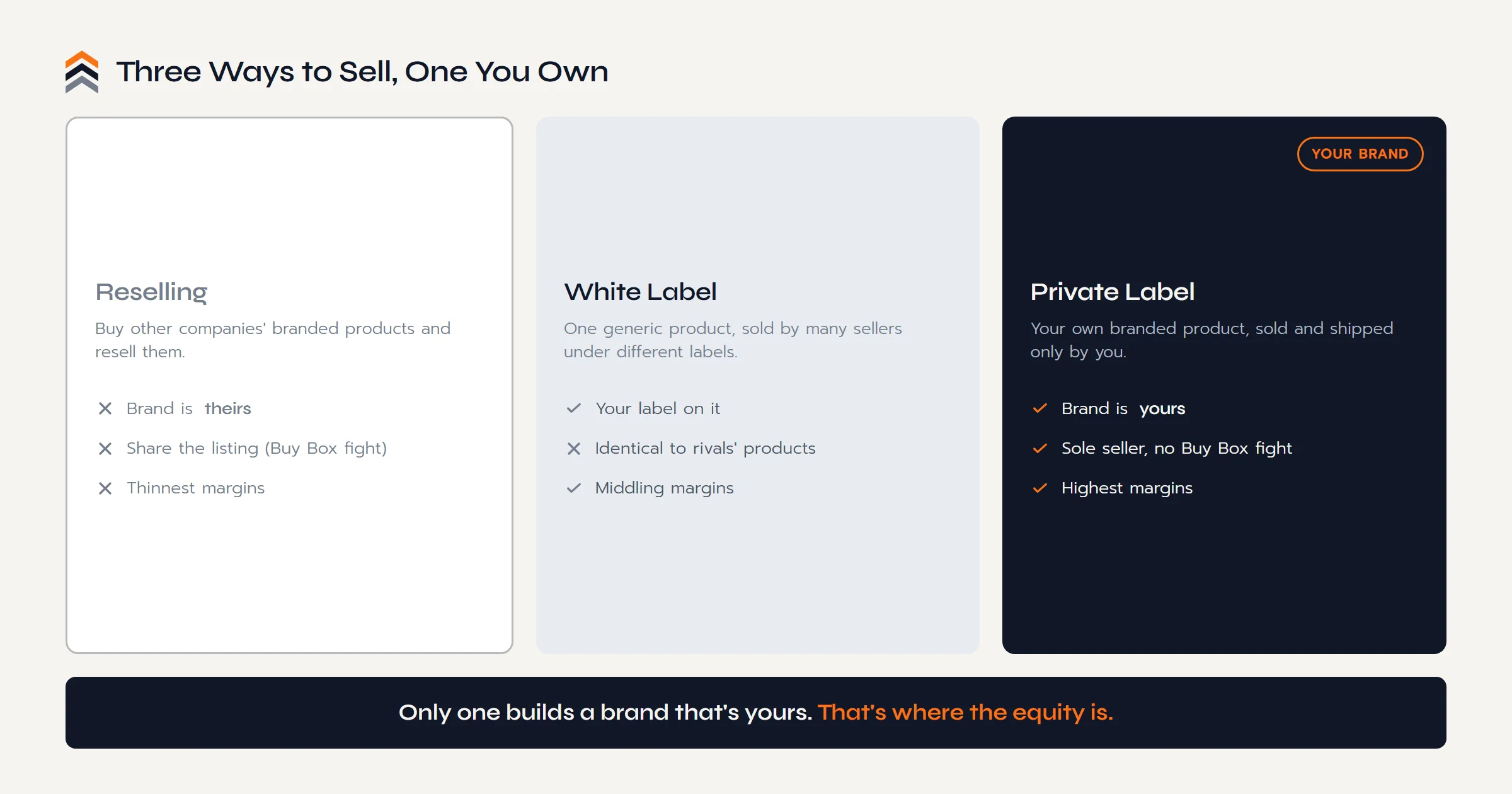
Three terms get mixed up constantly, and the difference is really about how much of the brand is yours:
- Reselling and wholesale. You buy existing branded products and resell them. The brand is someone else's, you share the listing, and you compete on price for the Buy Box. No equity accrues to you.
- White label. A generic product is sold to many sellers who each slap their own label on the identical item. You get a label, but the product underneath is the same as your competitors', so differentiation is thin.
- Private label. The product is branded and often customized exclusively for you. You are the sole seller, you control the product and packaging, and the margins are the highest of the three, commonly 25% to 40% according to figures drawn from Jungle Scout's seller data.
And even private label is only the starting point. There is a further step, from a label you own to a brand customers ask for by name, which is the real story of private label versus private brand.
How Amazon Private Label Works
The path is well worn, and the discipline is in the order. Validate before you spend:
- Find and validate a product. Look for real demand against beatable competition. A commonly cited sweet spot is a selling price around $18 to $70, high enough for margin, low enough for impulse.
- Model the margins first. Before you order a single sample, work out product cost, freight, Amazon fees, and advertising. If it does not pencil out on paper, it will not pencil out in reality. Our free Amazon margin calculator does the fee side of that math in a minute.
- Source and sample. Find a manufacturer, often through Alibaba, request samples, vet several suppliers, and negotiate the minimum order.
- Brand it. Your logo, your packaging, your inserts, and any customization that separates you from the generic base everyone else is selling.
- List, register, and launch. Build the listing, enroll in Brand Registry with your trademark, then drive early reviews and advertising to get traction.
Is Amazon Private Label Still Worth It?
The honest answer is yes, but it is no longer the passive money machine the 2017 gurus sold. The upside is real: you own the ASIN, you avoid the Buy Box fight, margins run higher than any resale model, and you end up with a genuine asset, a brand, rather than an arbitrage stream that dies when a supplier changes terms. Owning the listing outright also means you set the price and control the product roadmap, so you are never one supplier decision or one competing reseller away from watching your margin collapse.
The costs are just as real. Getting started takes capital: Jungle Scout has found most new sellers spend roughly $2,500 to $5,000 to launch, and a comfortable private label run with inventory and advertising often needs more. Competition has intensified, pay per click costs keep rising, and a launch lives or dies on reviews. The pattern across the data is clear: differentiated brands in lower competition niches still do well, while undifferentiated me-too products struggle. Private label rewards the seller who builds something distinct, which, not coincidentally, is the same seller who has the most to gain from owning their brand outright.
There is one more reason to do it well, and it is the one that ties back to ownership. A private label brand is a sellable asset in a way a reseller account never is. The entire aggregator boom, where companies raised billions to buy up Amazon brands, existed precisely because a differentiated brand with a registered trademark and loyal buyers is worth a multiple of its annual profit. But here is the quiet condition on that number: a brand is worth far more when the buyer is also acquiring the customer relationship and a sales channel, not just a listing that lives or dies at Amazon's discretion. The more of the brand you actually own, the more it is worth, both to you and to anyone who might buy it.
The Brand You Own, the Channel You Don't
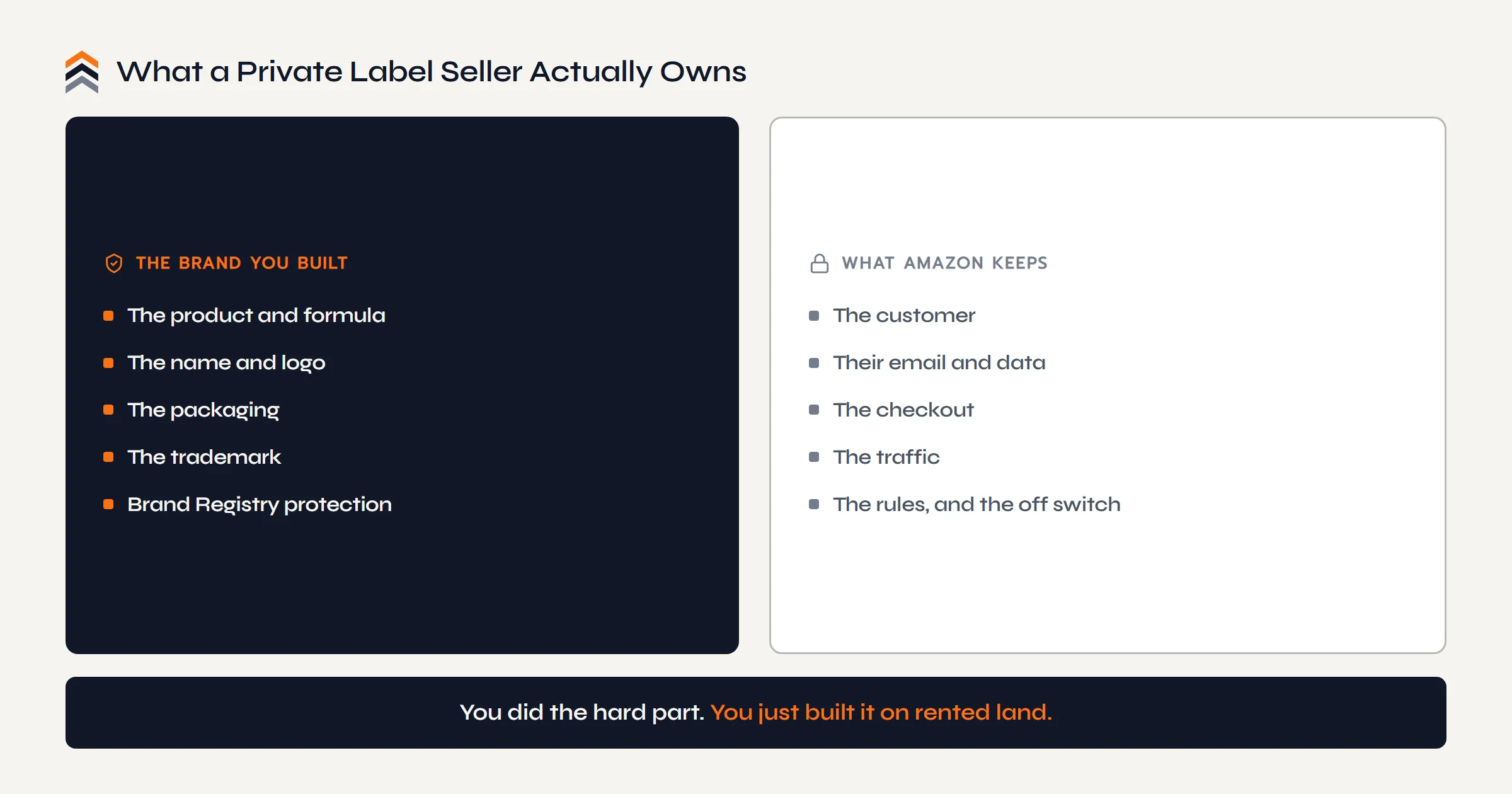
Here is the part most private label content skips. You can do everything right, register the trademark, nail the packaging, win the category, and still own only half of what you built. You own the brand. Amazon owns the channel it lives on. The customer, their email and purchase data, the checkout, the traffic, and the rules all belong to the platform, and the platform can change any of them.
This is not a hypothetical risk. In 2020, the Wall Street Journal reported that Amazon had used data from its own third party sellers to develop competing private label products, a practice that later drew antitrust charges from EU regulators. Third party sellers now account for more than 60% of the units sold on Amazon, per Marketplace Pulse, yet none of them own the customer relationship that volume creates. And an account can be deactivated with little warning and slow recourse, which means a brand you spent years building can be switched off by a landlord overnight. Owning the customer data the platform keeps and reducing how much of your business depends on Amazon are not paranoia. They are the obvious response to a channel you do not control.
The same tension shows up whenever Amazon steps further into your side of the counter, which is exactly the calculation behind a program like Buy with Prime. The pattern is always the platform reaching for more of the relationship, and the answer is always the same: the brand needs a home you control.
You Built the Brand. See How Much of It You Own.
The Push Roadmap is a free 12 page PDF with the Ownership Scorecard. Put a number on how much of your private label brand you actually control today, and see the whole move mapped in order.
Sent straight to your inbox.
The good news is the direction this points. You already did the expensive, difficult work of building a brand people buy. The next step is not to start over; it is to give that brand a channel you own, a website where the customer, the data, and the repeat sale are finally yours. That is the entire case for a private label brand having its own website alongside the marketplace, and it is a smaller leap than the one you already made.
An Honest Note
Both of these are true at once:
- Keep selling private label on Amazon. It is a real business and the demand is enormous. Nothing here says walk away from sales that work.
- Don't let Amazon be the only place your brand exists. A brand with no channel of its own is equity you rent. The product is yours; make sure the customer can be too.
Sell on the marketplace. Own the brand somewhere it can't be switched off.
Questions Sellers Ask
What Is Amazon Private Label?
Amazon private label is when a seller sources a generic or manufactured product, brands it with their own name, logo, and packaging, and sells it exclusively on Amazon, usually after enrolling in Brand Registry. The seller owns the listing and is typically the only seller of that product, unlike reselling someone else's brand.
What Is the Difference Between Private Label and White Label?
White label means one identical generic product is sold to many sellers who each add their own label. Private label means the product is customized and branded exclusively for one seller, who controls the product, packaging, and branding. Private label gives far more differentiation and control; white label is faster but interchangeable.
Is Amazon Private Label Still Profitable in 2026?
Yes, but it is harder and no longer passive. Private label margins commonly run 25% to 40%, and most FBA sellers earn a few thousand dollars a month. Success now depends on choosing differentiated, lower competition products and running tight advertising. Undifferentiated me-too products struggle against saturation and rising ad costs.
How Much Does It Cost to Start an Amazon Private Label?
It varies widely. Jungle Scout has found most new sellers spend roughly $2,500 to $5,000 to start, covering product, inventory, and tools. A comfortable private label launch with advertising and a cushion often runs higher. Budget conservatively for product cost, freight, Amazon fees, and pay per click ads before you order.
How Do I Start a Private Label on Amazon?
Find and validate a product, confirm your margins, then source and sample from a manufacturer, often via Alibaba. Brand it with your logo and packaging, create the listing, enroll in Brand Registry with a trademark, and launch with early reviews and advertising. Validate demand and cost before you commit to inventory.
Do You Need a Trademark for Amazon Private Label?
You can start selling a branded product without one, but Amazon Brand Registry requires a registered or pending trademark filed with a government office such as the USPTO. Brand Registry unlocks A+ Content, a Brand Store, and brand protection tools, so most serious private label sellers register a trademark early.
Is Amazon Private Label Legal?
Yes. Sourcing a generic product and selling it under your own brand is legal and standard practice. You must own the brand rights, so you cannot relabel another company's trademarked product as your own. Brand Registry requires a registered or pending trademark, which also protects your listing from hijackers.
The Conclusion
Amazon private label is the smart way to sell on Amazon, and it deserves the respect it rarely gets in a listicle. You built a product, a name, and a brand people choose. You avoided the race to the bottom that reselling becomes. That is real, and it is hard, and most sellers never get there. None of this is an argument against private label.
It is an argument about where the brand you built is allowed to live. On Amazon alone, you own the label and rent the land, and the landlord can raise the rent, study your numbers, or close the door. So keep the sales, and give the brand a second home where the customer, the data, and the equity are yours to keep. You already did the hard part. Owning the channel is the smaller step that makes the first one pay off. If you want the full comparison, Amazon and your own website side by side lays out what each does best.
Your sales can live on Amazon. Your brand should not.
The Next Move
You Built the Brand.
Now Own the Ground It Stands On.
Ready to Build
A free call, no pitch script. Walk us through your private label business and get a straight answer on what your own brand site would take.
Book a Free CallStill Weighing It
The Push Roadmap is a free PDF with the Ownership Scorecard. Put a number on how much of your brand you actually own today.