
Amazon Brand Registry is a free program that verifies you as the owner of your brand and unlocks a set of tools to protect your intellectual property and manage your listings. It is genuinely useful, and almost every serious seller should enroll. But registering a brand on Amazon is not the same as building one you truly own, and what it protects is narrower than the name suggests.
The registry guards your trademark and your product pages inside Amazon's store. It does not hand you the one thing a brand is actually built on: a direct relationship with the customer who bought. Both halves are true at once, and this article covers them plainly, so you can enroll with clear eyes about what the program does and does not give you.
What Is Amazon Brand Registry?
Amazon Brand Registry is a program that lets a verified brand owner protect their intellectual property and get more control over how their brand appears in the Amazon store. Enrollment is free. Once Amazon verifies your trademark, it applies predictive, machine-learning protections that catch bad listings before they publish, and it opens up a suite of brand-only tools. You can be a seller without it, but you cannot access the brand features, or the strongest protections, until you are registered.
What Amazon Brand Registry Protects
Give Amazon its due: the benefits are real, and for a brand owner they are worth having. Grouped honestly, this is what Brand Registry protects and provides:
- Your intellectual property. Automated protections stop many counterfeit and hijacked listings before they go live, and Report a Violation lets you search the catalog and flag trademark, copyright, and patent infringements for takedown. In practice, that means fewer hijackers riding your reviews and undercutting your price on the listing you worked to build.
- Your listing content. A+ Content, the Amazon Brand Store, Virtual Bundles, and split testing through Manage Your Experiments let you control how the product page looks and reads, instead of leaving it to a bare template. For most sellers, this is where conversion is won or lost, because the shopper finally sees the brand behind the product, not just a spec sheet.
- Your reach. Amazon Vine, Sponsored Brands, and Amazon Live are gated behind the registry, so enrolling is what turns on most of the brand-level ways to be discovered. Vine, in particular, is often how a new product earns its first honest reviews, the social proof that later ad clicks convert against.
- Your read on the market. Brand Analytics, Brand Metrics, and the Brand Referral Bonus give you aggregated insight into search terms, repeat rates, and the traffic you drive in from outside. For many sellers, Brand Analytics becomes the easiest way to see which search terms actually bring buyers to their products, and how often those buyers come back.
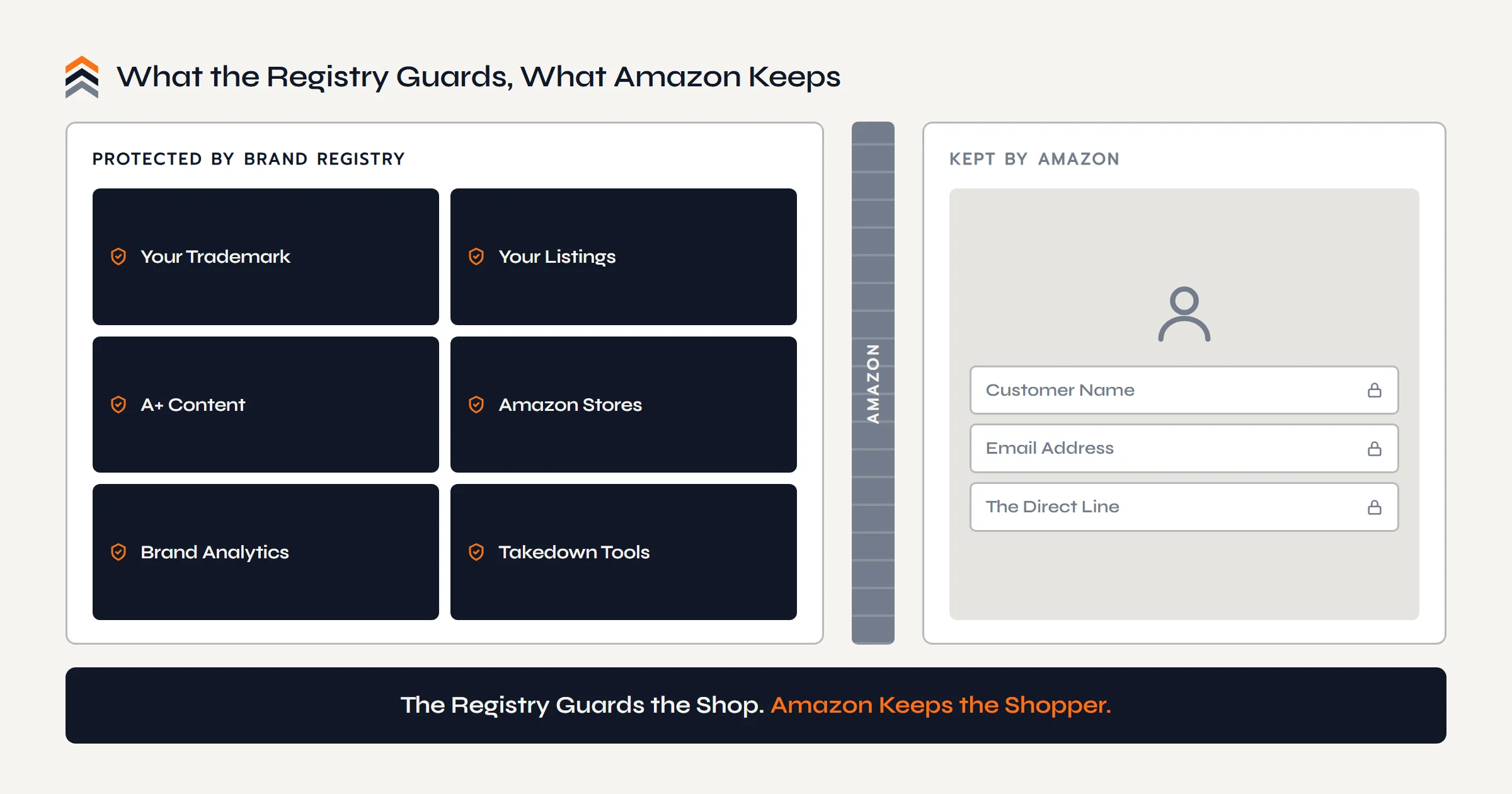
Brand Registry protects the brand you built on Amazon. It does not make that brand yours.
What Amazon Brand Registry Doesn't Protect
Here is the part the name quietly oversells. Every protection above lives inside Amazon's walls, and it ends exactly where those walls do. Three limits matter for a seller trying to build something they own:
- It protects the listing, not the customer. Brand Analytics reports crowds, not people: search terms, repeat-purchase rates, demographic bands. Useful, and worth reading. But it never introduces you to a single buyer by name, email, or address.
- Even the email tool stays on Amazon rails. Manage Customer Engagement and Brand Follow let you message followers and repeat customers, which sounds like owning an email list. It is not. Amazon holds the addresses. Turn off the store and the audience stays behind with it.
- It deepens dependence, it does not reduce it. Every tool the registry unlocks makes your brand work better on the one property you do not control. That is a fine trade, until it is the only place your brand exists, which is the whole case for reducing your Amazon dependence.
| What Brand Registry Protects | What It Leaves With Amazon |
|---|---|
| Your trademark and product listings | The identity of the customer who bought |
| Your page content (A+, Stores) | Their email address and contact details |
| Aggregated analytics about buyers | A direct channel you can keep and message |
| Your brand inside the marketplace | Your brand anywhere you control it |
None of this is a reason to skip Brand Registry. It is a reason to see it for what it is: excellent protection for the storefront you rent, and no substitute for ground you own. That distinction is the whole argument behind building your own store and first-party data, where the customer relationship finally belongs to you.
How Much of Your Business Do You Actually Own?
Brand Registry protects your listing. The Push Roadmap shows you the rest: a free 12 page PDF with the Ownership Scorecard. Score where your brand stands today and see the whole move mapped in order.
Sent straight to your inbox.
Do You Need a Trademark for Amazon Brand Registry?
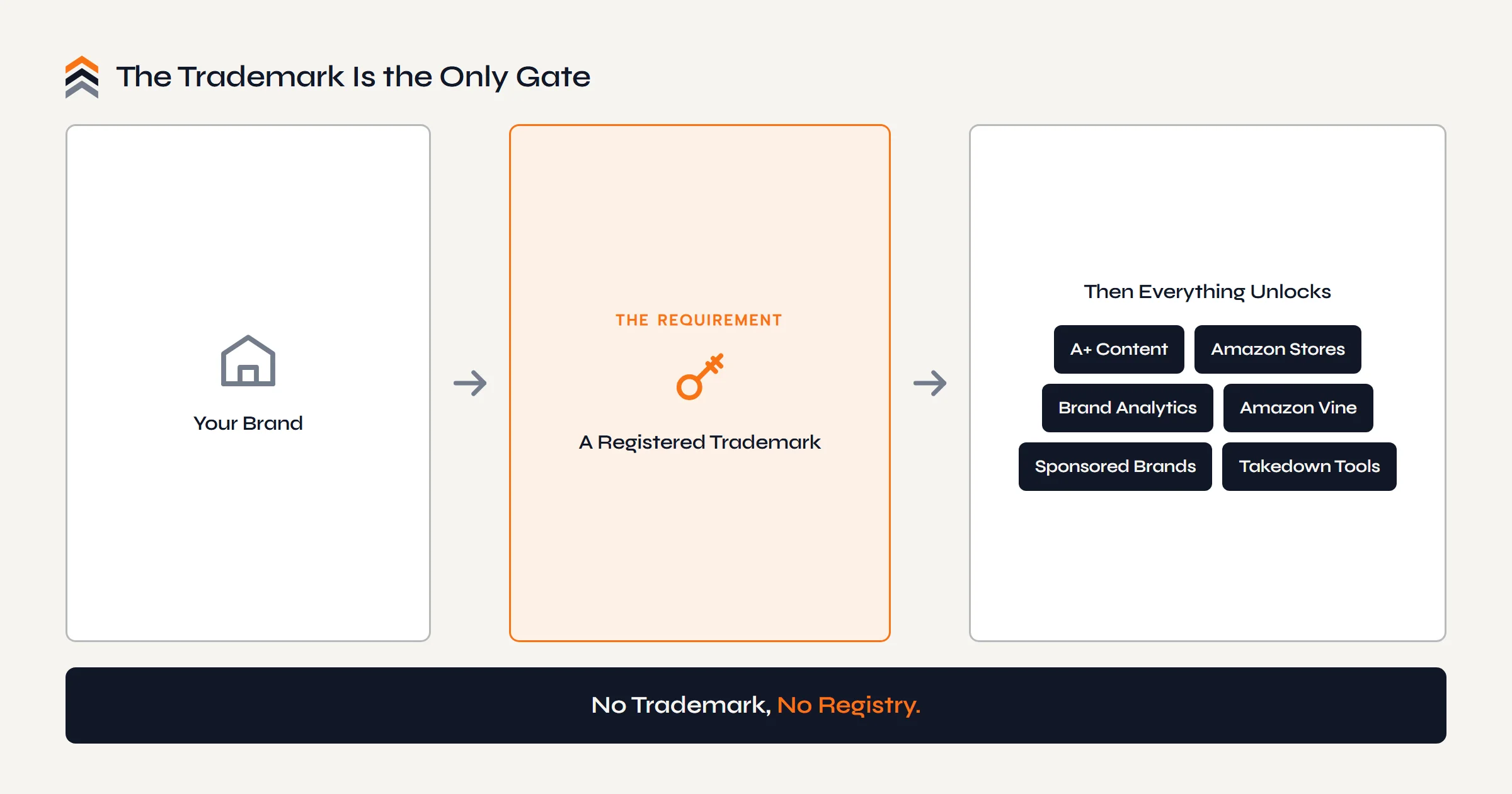
Yes, and this is the one real barrier to entry. To meet the Amazon Brand Registry requirements you need an active registered trademark, or a pending application, for your brand name or logo. It can be a text-based or an image-based mark. If you do not have one yet, you can file through any trademark office or through Amazon IP Accelerator, which connects you with vetted IP law firms and can grant faster access to registry benefits while your application is pending. The trademark, not the registry, is where the cost and the waiting live.
What You Need to Enroll in Amazon Brand Registry
Once your trademark is registered or pending, enrolling is straightforward. Amazon asks for your brand details, your trademark office and registration or serial number, a high-resolution image of your logo, and at least one photo showing your brand name or logo permanently affixed to your product or packaging. You confirm whether you are a seller, a vendor, or both, choose your product categories, and submit. Amazon then sends a verification code to complete the process. With a registered trademark in hand, approval usually lands within a couple of weeks.
An Honest Note
Two things can be true at the same time:
- Enroll anyway. Free protection for your trademark and listings is a clear yes. Leaving it off the table only helps the hijackers.
- Don't stop there. The registry is the floor of protecting a brand on Amazon, not the ceiling of owning one. The ceiling is a place customers reach you directly.
Protect the listing with the registry. Build the relationship somewhere you own.
Questions Sellers Ask
Do You Need a Trademark for Amazon Brand Registry?
Yes. To enroll in Amazon Brand Registry you need an active registered trademark, or a pending application filed through a trademark office or Amazon IP Accelerator. It can be a text-based or image-based mark. Without a registered or pending trademark, you cannot complete enrollment.
Is Amazon Brand Registry Free?
Yes. There is no cost to enroll in Amazon Brand Registry and no recurring fee. The trademark it requires is the real expense, since filing carries government and legal costs. Some tools the registry unlocks, like advertising, have their own separate costs once you choose to use them.
How Long Does It Take to Get Approved for Amazon Brand Registry?
If your trademark is already registered, approval usually takes a couple of weeks, though Amazon notes it can be several weeks or longer. If your trademark is still pending, expect longer, because the wait is tied to your trademark office timeline rather than to Amazon review.
Can You Sell on Amazon Without Brand Registry?
Yes. You can sell on Amazon with a standard seller account and no Brand Registry. It is optional. Without it, though, you lose the brand protections and brand-only tools, and your listings are more exposed to hijackers and unauthorized sellers competing on your own product pages.
Is Amazon Brand Registry Worth It?
For almost every brand owner, yes. It is free, it protects your trademark and listings, and it unlocks A+ Content, Brand Analytics, and Stores. Just be clear on the limit: it protects your brand inside Amazon. It does not give you the customer relationship that makes the brand truly yours.
What Are the Limitations of Amazon Brand Registry?
Its protection stops at Amazon edge. Brand Analytics reports aggregates, not customer identities, and even Brand Follow emails run on Amazon rails, so you never keep the addresses. It guards the listing you rent. It does not reduce your dependence on the platform or hand you your customer list.
Does Amazon Brand Registry Give Me My Customer Data?
No. Brand Registry gives you aggregated insight through Brand Analytics, such as search terms, repeat-purchase rates, and demographics, but not the names, emails, or contact details of individual buyers. To own a customer list you can keep and message directly, you need a channel of your own off Amazon.
The Conclusion
Amazon Brand Registry is one of the few genuinely free, genuinely good things Amazon offers a brand owner. Enroll. Protect your trademark, control your pages, turn on the tools, and read the analytics. Nothing here argues against any of that.
Just hold the honest line the name blurs. The registry protects the brand you have built inside Amazon. It does not make that brand yours, because the customer, the memory, and the way to reach them stay on the platform's side of the wall. That is the piece you build somewhere else, on a website of your own.
Your sales can live on Amazon. Your brand should not.
The Next Move
The Registry Guards the Listing.
Now Guard the Relationship.
Ready to Build
A free call, no pitch script. Walk us through your Amazon business and get a straight answer on what your own brand site would take.
Book a Free CallStill Weighing It
The Push Roadmap is a free PDF with the Ownership Scorecard. Put a number on how much of your brand you actually own today.