
An Amazon Brand Store is the closest thing Amazon offers to a website of your own: a free, multi-page, branded storefront that lives on Amazon, with its own amazon.com/yourbrand address. It is genuinely good, and every eligible seller should build one. But the name does a lot of quiet work, because a store you build on Amazon is still a store Amazon owns, and understanding exactly where that line falls is one of the clearest ways to see why building a brand beyond Amazon matters. Let us give the Brand Store full credit, then draw the line honestly.
What an Amazon Brand Store Is
In Amazon's own words, a Brand Store is a storefront where your brand can engage shoppers, tell its story, and showcase its full range of products with rich content like lifestyle imagery and video. In plain terms, it is a mini-website inside Amazon. Instead of a shopper landing on one product listing, they land on a branded destination with multiple pages, organized the way you choose, showing everything you sell under one roof.
It has a custom, short URL, amazon.com followed by your brand name, that you can put on packaging, ads, and social posts. It is free to build and maintain, and it needs no coding, because Amazon provides a drag-and-drop Store Builder with templates and tiles. For a brand that has only ever existed as a scatter of individual listings, it is a real step up: a single, coherent, branded place on Amazon.
What You Need to Build One
There is one gate. To create a Brand Store, you must be enrolled in Amazon Brand Registry, and Brand Registry requires a registered or pending trademark. So while the Store itself costs nothing, getting through the door does. A US trademark filing commonly runs a few hundred dollars or more per class, more if you use a lawyer, and those are third-party figures rather than an Amazon fee. Once you are in Brand Registry, you open Store Builder, pick a template, arrange your pages, submit for Amazon's review, and it goes live.
One point of confusion worth clearing up first, because it sends people down the wrong path. A Brand Store is not the same as an Amazon Influencer storefront. The Brand Store is for brand owners and shows only your own products. The Influencer storefront is for creators, curates products from many brands, and earns affiliate commissions. They share the word storefront and nothing else. This article is about the brand-owned kind.
What It Does Genuinely Well
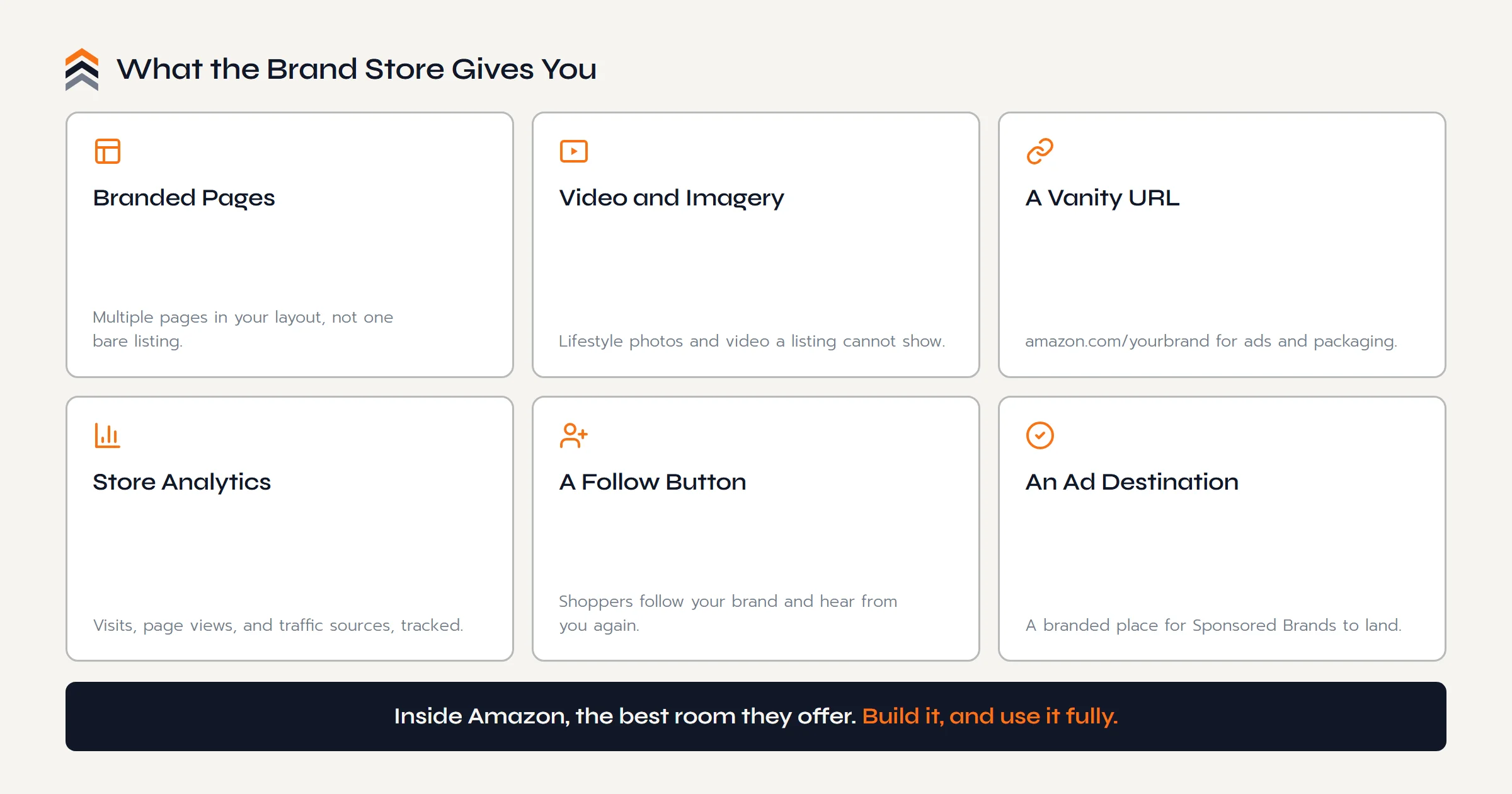
Give the Brand Store its due, because it earns it. Inside Amazon, it is the richest branded surface you get, and it does several things a bare listing cannot:
- A branded experience. Multiple pages, your layout, your imagery, video, and shoppable content, instead of one product in Amazon's standard template.
- Cross-sell and discovery. A shopper who came for one product can browse your whole range in one place, which lifts basket size.
- A destination for traffic. The vanity URL gives your Sponsored Brands ads and any external traffic a branded place to land, rather than a single listing.
- Store analytics. Amazon's Store Insights reports visits, page views, sales, and traffic sources, so you can see what is working.
- A Follow button. Shoppers can follow your brand, giving you a way to reach them again through Amazon's own channels.
Amazon also reports meaningful sales lifts for Store visitors. By its own published figures, shoppers who visit a Brand Store purchase more frequently, add to cart more often, and spend more per order than those who do not. Treat those as Amazon's own numbers, since the methodology is not disclosed, but the direction is believable: a branded, organized experience does tend to sell better than a lone listing. On Amazon's turf, the Brand Store is the best tool it hands you, and you should use it fully.
The Catch: It Is Still on Amazon
Here is the part the word store quietly hides. Everything above happens on Amazon's platform, under Amazon's rules, and that shapes what the Brand Store can never be. The limits are not bugs. They are the nature of building on rented ground:
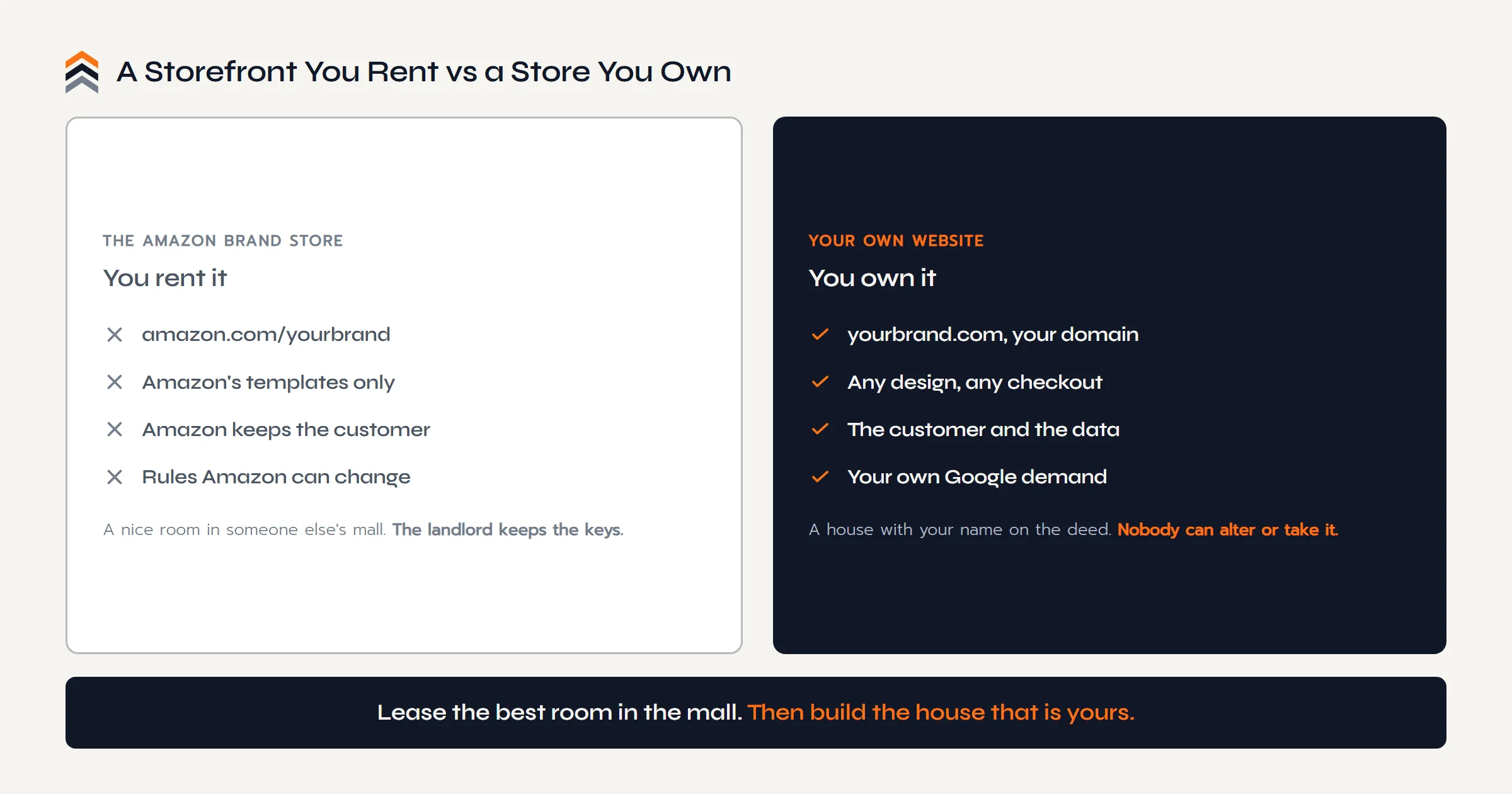
- You do not own the address. It is amazon.com/yourbrand, not yourbrand.com. You cannot host it on your own domain, so the web address itself, and all its authority, belongs to Amazon.
- You do not get the customer. A sale through your Brand Store is still an Amazon sale. You do not receive the buyer's email or the first-party data, and Amazon keeps the relationship, exactly as it does on any listing.
- You do not control the design. You are confined to Amazon's tiles and templates. No custom code, no custom checkout, no email capture of your own, no retargeting pixel.
- You do not own the demand. A Brand Store sits under amazon.com, so it earns none of the independent Google visibility an owned site can build. And Amazon can still show competitor ads and products elsewhere in the same shopper's journey.
There is a subtler cost hiding in that vanity URL. When you print amazon.com/yourbrand on your packaging, your ads, and your social posts, every shopper you send there is external traffic you earned, poured straight into Amazon. You do the work of building an audience and hand the destination to the platform. The same effort pointed at a domain of your own would compound into search authority, an email list, and a customer record that stayed yours. The Brand Store makes it easy, and completely natural, to feed your own hard-won demand back to the marketplace.
None of this makes the Brand Store bad. It makes it what it is: a well-appointed space you lease inside someone else's mall. The fixtures are nice, the foot traffic is enormous, and the landlord keeps the keys, the mailing list, and the right to change the terms.
A Storefront You Rent, or a Store You Own?
The Push Roadmap is a free 12 page PDF with the Ownership Scorecard. See where the Brand Store fits, and what a store of your own adds, mapped in order.
Sent straight to your inbox.
The Store You Actually Own
Set the Brand Store beside a website of your own and the difference is not polish; both can look excellent. The difference is who holds what. On your own site, the domain is yours, the checkout is yours, the design is unlimited, the customer's email and data are yours to keep, and the pages can earn their own demand from Google. Those are precisely the five things the Brand Store cannot give you, because they are the things a platform keeps for itself. It is the same divide that runs through selling on Amazon versus your own website, applied to the storefront specifically.
The honest conclusion is not either-or, and it is worth being clear about that. The smart move is both. Build the Brand Store and use it fully, because it is free and it works where your sales already happen. Then build the store you own beside it, the one with your name on the domain, so the brand finally has a home that a landlord cannot alter or take back. Knowing what a brand website actually needs makes that second step far less daunting than most sellers expect.
An Honest Note
Two things are true about the Brand Store at once:
- You should absolutely build one. It is free, it is better than bare listings, and it is the right way to present your brand to the shoppers already on Amazon. Skipping it is leaving value on the table.
- But do not mistake it for the finish line. It is the best room in a house you rent. The brand still needs a house with your name on the deed, and that is a different build.
Build the Brand Store. Then build the store that is actually yours.
Questions Sellers Ask
Is an Amazon Brand Store Free?
Yes. Building and maintaining a Brand Store on Amazon is free, with no coding required, using Amazon's drag-and-drop Store Builder. The real cost is indirect: you must be in Brand Registry first, which requires a registered or pending trademark, and a US trademark filing commonly runs a few hundred dollars or more.
Do You Need a Trademark for an Amazon Brand Store?
Yes. Only brands enrolled in Amazon Brand Registry can build a Brand Store, and Brand Registry requires an active registered or pending trademark. Without a trademark and Brand Registry, you cannot create the multi-page branded storefront, though you can still sell through standard product listings.
How Do You Create an Amazon Brand Store?
First enroll in Amazon Brand Registry with your trademark. Then open Store Builder in Seller Central or Amazon Ads, choose a template, and arrange pages with drag-and-drop tiles for images, video, and products. Once published, Amazon reviews it, and it goes live at a custom amazon.com/yourbrand URL.
Can Anyone Make an Amazon Storefront?
Not a Brand Store. That requires a trademark and Brand Registry, so it is limited to brand owners. The version anyone can apply for is the Amazon Influencer storefront, which is for creators who curate other brands' products for affiliate commissions, and it is gated on social following rather than a trademark.
What Is the Difference Between a Brand Store and an Influencer Storefront?
A Brand Store belongs to a brand, shows only that brand's own products, and requires a trademark through Brand Registry. An Amazon Influencer storefront belongs to a creator, curates products from many brands, and earns affiliate commissions. They share the word storefront but are built for completely different people.
Does an Amazon Brand Store Replace a Website?
No. A Brand Store is a branded presence inside Amazon, but it lives on Amazon's domain, uses Amazon's templates, and gives you none of the customer data. A website you own controls the domain, the checkout, the customer relationship, and the data. The Store complements an owned site; it does not replace one.
The Conclusion
So, an Amazon Brand Store is a free, multi-page branded storefront on Amazon, gated behind a trademark and Brand Registry, and genuinely worth building. It gives your brand a real home inside the marketplace, richer than any single listing, with a custom URL and analytics to match. Within the walls of Amazon, it is the best you can do, and you should do it.
Just be clear-eyed about the walls. The Brand Store is a storefront you rent, not a store you own. The domain, the customer, the data, and the rules stay with Amazon. Build it, use it, and then build the one thing it can never be: a store with your name on the door, on ground you no longer only rent.
Your sales can live on Amazon. Your brand should not.
The Next Move
The Brand Store Is a Great Room.
Let's Build the House.
Ready to Build
A free call, no pitch script. Walk us through your Amazon business and get a straight answer on the owned store that would sit beside your Brand Store.
Book a Free CallStill Weighing It
The Push Roadmap is a free PDF with the Ownership Scorecard. Put a number on how much of your brand you actually own today.