
First party data is the information a business collects directly from its own customers, with consent, through channels it owns, its website, its emails, its checkout, its surveys. That is the whole definition, and it sounds simple until you ask an Amazon seller a harder question: where is yours? Because the thing that makes first party data so valuable, that it comes straight from the customer, is exactly the thing a marketplace quietly keeps for itself. Understanding what it is, and why you do not have it, is one of the clearest arguments for building a brand beyond Amazon, and it is worth going deeper than the usual definition to see why.
What First Party Data Is
Marketing sources define it consistently. Salesforce calls first party data the information you collect directly from customers on your own channels. The common thread across every definition is two words: directly and owned. It is data that comes to you from the source, the customer, gathered on property you control, rather than data you buy, borrow, or infer about people you have never met.
That directness is the entire value. Data collected straight from your customers is more accurate, more current, and more relevant than anything an outside broker can sell you, because it describes real people who really bought from you, not a modeled guess about a lookalike. It is also yours to keep and use, with their permission, without asking anyone's platform for access. Owning it is the difference between renting an audience and having one.
The Four Kinds of Data
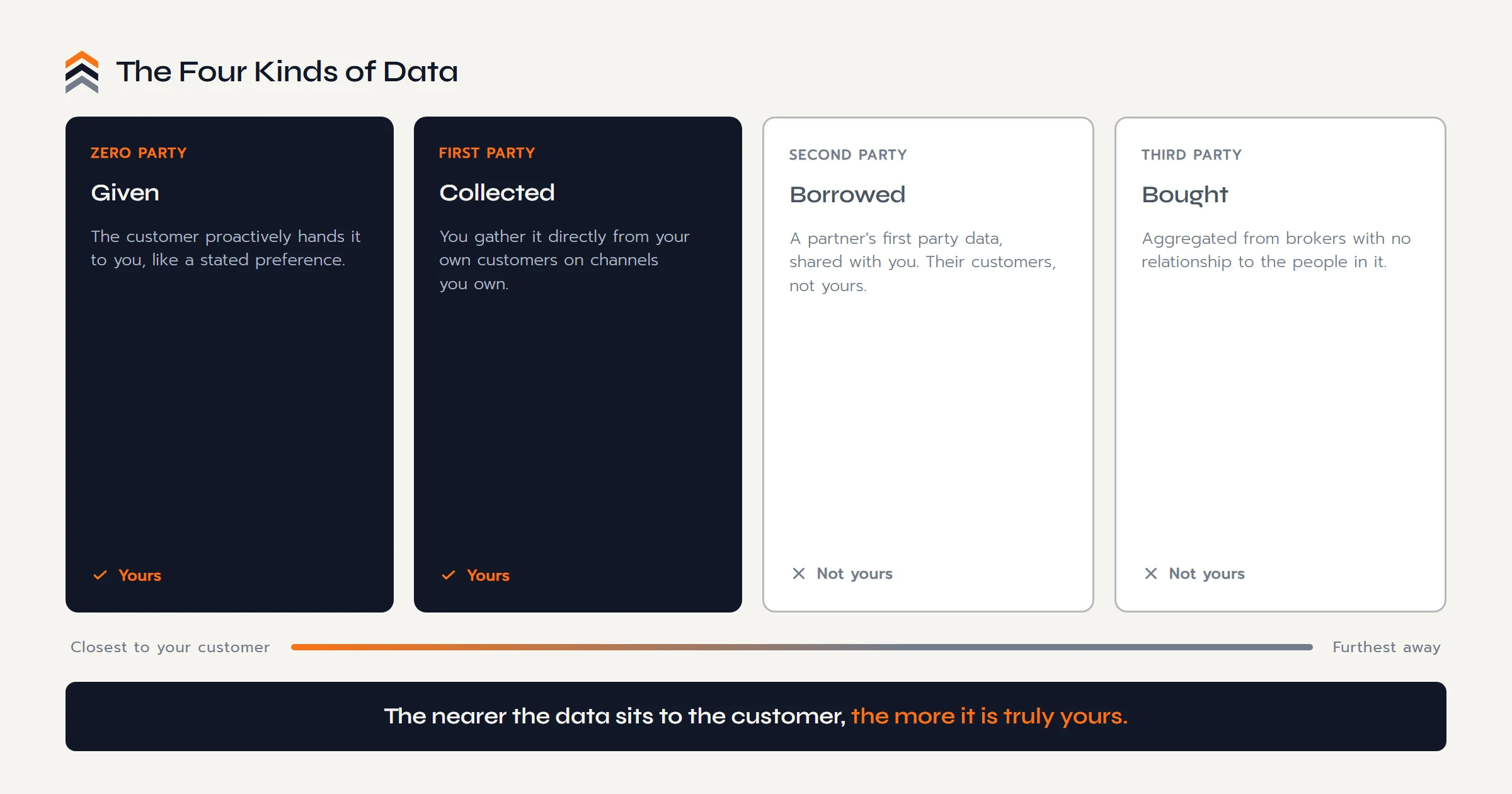
First party data is easiest to understand next to its neighbors, because the four types really describe one thing: how close the data sits to the customer. The closer it is, the more accurate and the more durable it tends to be.
- Zero party data. What a customer proactively and intentionally gives you, like a stated preference or a quiz answer. The term was coined by Forrester. It is the most willing data there is, because the customer chose to hand it over.
- First party data. What you collect directly from your own customers through your owned channels: purchases, email signups, site behavior, account details. Given or observed, it is yours and it is direct.
- Second party data. Simply someone else's first party data, shared with you through a direct partnership. Useful, but it describes their customers, not yours.
- Third party data. Aggregated and bought from outside brokers who have no relationship with the people in it, historically powered by tracking cookies. It is the most distant, the least reliable, and the most exposed to privacy changes.
Why It Matters More Every Year
First party data has always been useful. What changed is that the alternatives got shakier. For years, brands leaned heavily on third party data, the bought, cookie-tracked kind, to find and target customers. That foundation is quietly cracking. Privacy laws like the GDPR in Europe and CCPA in California push brands toward data that is collected with clear consent. Browsers moved on their own: Safari and Firefox already block third party tracking cookies by default.
It is worth being accurate here, because the headlines overshot. Google spent years promising to remove third party cookies from Chrome, then reversed course in 2025 and decided to leave them under user control instead. So cookies are not being switched off overnight. But the direction of travel has not changed. Every year, data you do not own directly becomes harder to rely on, and data you collect yourself becomes more valuable by comparison. And the value is not just defensive. Research by Google and Boston Consulting Group found that marketing built on first party data drove a 2.9 times increase in revenue and a 1.5 times decrease in cost compared with campaigns that did not use it. Data you own does not just protect you. It performs.
You can borrow an audience for a while. You can only build one on ground you own.
What Counts, and How You Collect It
First party data is less abstract than it sounds. You have seen all of it as a shopper. It includes purchase and order history, email and SMS subscribers, website behavior and analytics, account and profile details, survey and quiz responses, loyalty program activity, and customer service conversations. Any signal a customer gives you directly, or that you observe on a channel you own, counts.
Collecting it is not complicated either. It comes from your own website analytics, your email and SMS signup forms, account creation and loyalty programs, surveys, and post-purchase touchpoints like reviews and reorders. Notice the common requirement in every one of those: a channel of your own to collect it on. An email list is the workhorse here, which is why building an email list is the first move so many sellers make. And the place all of it lives is a site you control, which is one of the quiet reasons a brand website earns its keep. Without an owned channel, there is nowhere for first party data to land.
Who Owns Your Customer Right Now?
The Push Roadmap is a free 12 page PDF with the Ownership Scorecard. Put a number on how much of your customer and your data you actually hold today, and see the move mapped in order.
Sent straight to your inbox.
On Amazon, You Are the Third Party
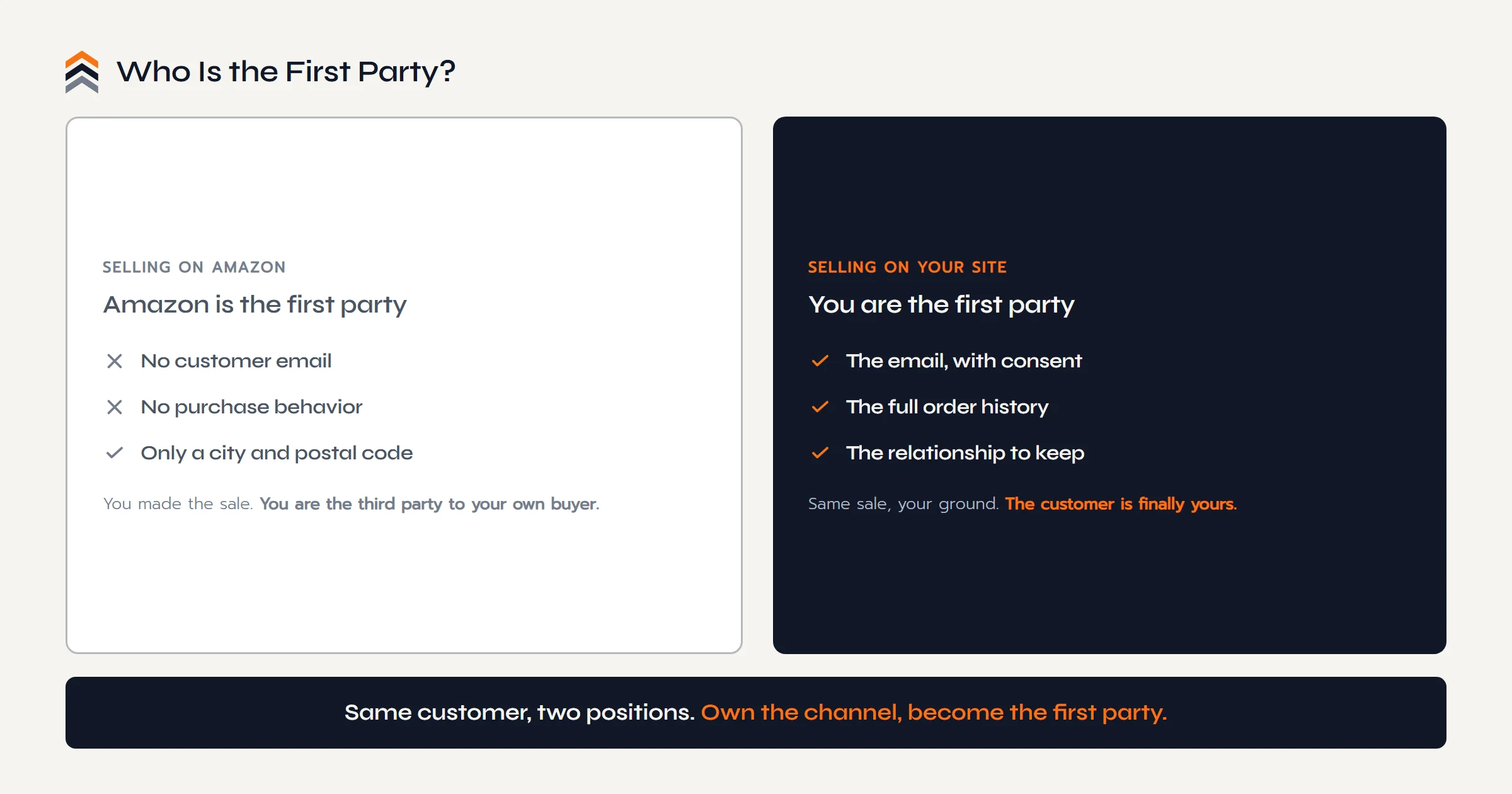
Here is where the definition turns personal for a seller. First party data belongs to whoever the customer buys from directly. On Amazon, that is Amazon. The marketplace is the first party to the buyer. It holds the identity, the email, and the full record of what that person browses and buys. As Modern Retail put it plainly, there has never been an agreement by Amazon that the marketplace seller owns the customer. You make the sale, and Amazon keeps the relationship.
What reaches you is a shadow of the real thing. Sellers have historically seen only limited details, a shipping city, a state, a postal code, and never the customer's email, with even that limited window narrowing over the years. So on the single most important asset in your business, the customer, you are not the first party at all. You are the third party to your own buyer, dependent on the platform for a scrap of the data it collects in full. That is not a flaw you can optimize away with better listings. It is built into selling on someone else's marketplace, and it is the heart of first party data for Amazon sellers. The moment the sale happens on a site you own, that inverts. You become the first party. The email, the history, the relationship, and the right to reach that customer again all become yours, which is a large part of what it means to actually sell direct to consumer.
An Honest Note
First party data is not a magic button, and it is fair to say so:
- Owning the data is the start, not the finish. A list you never email or a history you never use is just storage. The value comes from putting it to work with real, welcome communication.
- But you cannot use what you never receive. On Amazon the question is moot, because the data never reaches you. Owning a channel is what puts the choice back in your hands.
Collecting it is step one. You just cannot take step one on rented ground.
Questions Sellers Ask
What Is First Party Data?
First party data is information a business collects directly from its own audience, with consent, through channels it owns. That includes purchase history, email and SMS subscribers, website behavior, account details, and survey answers. Because it comes straight from your customers rather than a third party, it is the most accurate and reliable data you can hold.
What Is the Difference Between First, Second, Third, and Zero Party Data?
Zero party data is what a customer proactively gives you, like a stated preference. First party data is what you collect directly from your own customers. Second party data is another company's first party data shared through a partnership. Third party data is bought from outside brokers you have no relationship with. The closer the source, the more accurate and durable the data.
Why Is First Party Data So Important Now?
Because the data you do not own is getting harder to rely on. Privacy laws like GDPR and CCPA favor consented data, and browsers such as Safari and Firefox block third party tracking cookies by default. First party data, collected directly and with permission, is the durable foundation that these shifts do not erode. Research by Google and BCG links it to significantly higher revenue.
What Are Examples of First Party Data?
Common examples include purchase and order history, email and SMS subscribers, website behavior and analytics, account and profile information, survey and quiz responses, loyalty program data, and customer service interactions. Anything a customer shares with you directly, or that you observe on channels you own, is first party data.
How Do You Collect First Party Data?
You collect it through channels you own: website analytics, email and SMS signup forms, account creation and loyalty programs, surveys and quizzes, on-site behavior, and post-purchase data like reviews and order history. The one requirement is a channel of your own to collect it on, which a marketplace listing does not give you.
Do Amazon Sellers Get Their Customers' First Party Data?
No. On Amazon the marketplace is the first party to the buyer and keeps the identity, email, and purchase behavior. Sellers have historically seen only limited information such as a shipping city and postal code, and even that has narrowed over time. On a marketplace, you are effectively a third party to your own customer.
The Conclusion
So, first party data is the information you gather directly from your own customers, on channels you own, with their consent. It sits closest to the customer, which is why it is the most accurate, the most durable, and the most valuable data you can hold, and why it keeps gaining ground as the borrowed alternatives lose it. It is, in a real sense, the raw material of a relationship.
For an Amazon seller the lesson is sharp. You are generating first party data with every order, and someone else is keeping it. The way to change that is not a better listing. It is a channel of your own, where the customer buys from you directly and the data finally has somewhere to land, on a foundation you actually own rather than rent. If you want to know where you stand today, the free Amazon Ownership Score measures it in ten questions, the data pillar included.
Your sales can live on Amazon. Your brand should not.
The Next Move
The Data Is Already Yours to Earn.
Let's Build the Place It Lands.
Ready to Build
A free call, no pitch script. Walk us through your Amazon business and get a straight answer on the owned channel that would finally capture your customer.
Book a Free CallStill Weighing It
The Push Roadmap is a free PDF with the Ownership Scorecard. Put a number on how much of your customer you actually own today.