
A third-party seller is an independent business that sells its own products on Amazon's marketplace, and if you sell on Amazon, it is almost certainly you. It is the standard way to sell there, it is a genuinely good business, and the term is so routine that most sellers never stop to hear what it actually says. But the name is worth pausing on, because it quietly describes a relationship you may not have chosen, and seeing that clearly is one of the plainest arguments for eventually building a brand beyond Amazon. Start with the definition, then listen to the words.
What a Third Party Seller Is
A third-party, or 3P, seller lists and sells its own products directly to shoppers on Amazon, using Amazon's Seller Central platform. You own the inventory, you set the price, you manage the listing and the account, and Amazon provides the marketplace and, if you choose, the fulfillment. On a product page, it is the difference you have seen a hundred times without noticing: a listing that says "Sold by" a store name is a third-party seller, while one that says "Ships from and sold by Amazon.com" is Amazon selling directly.
The mechanics are straightforward. Amazon takes a referral fee on each sale, commonly around 15 percent though it varies by category, and you choose how to fulfill orders. With Fulfilled by Amazon, you send stock to Amazon and it handles storage, shipping, and returns, and the item earns Prime. With Fulfilled by Merchant, you ship orders yourself and pay no fulfillment fees, though the referral fee still applies. That is the whole model: your product, your price, Amazon's marketplace. What the model costs per order, next to the same sale on a site you own, is exactly what our free Amazon margin calculator shows.
Third Party vs First Party
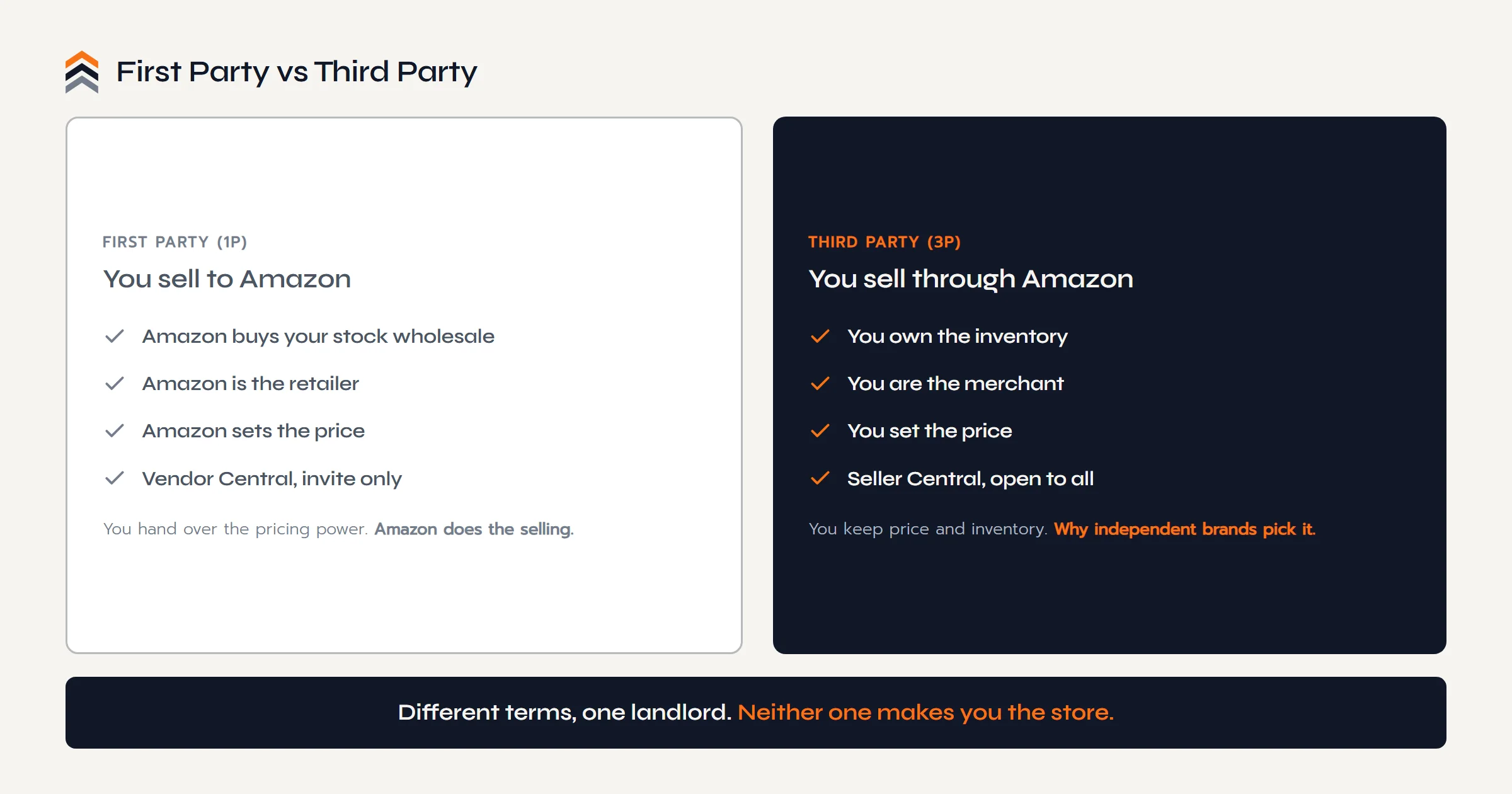
The term only makes full sense next to its opposite. A first-party, or 1P, seller does not sell to shoppers at all. They sell wholesale to Amazon, and Amazon becomes the retailer, reselling the goods and setting the price. That arrangement runs through Vendor Central, which is invite-only, and it is why some listings read "sold by Amazon.com." The trade is simple: you hand Amazon the inventory and the pricing power, and in return Amazon handles the selling.
Third party is the other path, and the one open to everyone. No invitation is required, you keep control of your price and your listing, and you own your inventory rather than selling it away. For an independent brand, 3P is almost always the right model, because it keeps the things a brand should hold. Just notice what the label is measuring. Both models are defined by their relationship to Amazon, not to the customer. One sells to Amazon; the other sells through Amazon. In neither case is the seller the store.
Why Almost Everyone Is 3P
If being a third-party seller feels like a lesser status, the numbers say otherwise. Third-party sellers are not a fringe of Amazon; they are the majority of it. By Marketplace Pulse's tracking, roughly 60 percent of the units Amazon sells come from third-party sellers, a level that has held steady for years. The marketplace, not Amazon's own retail, is where most of the selling happens.
Amazon has said as much itself, and in blunt terms. In his 2018 letter to shareholders, Jeff Bezos wrote that third-party sellers were "kicking our first-party butt. Badly," noting that their share of physical sales had grown from 3 percent in 1999 to 58 percent by 2018. Being 3P is not the junior version of selling on Amazon. It is the main event. Which makes the name it carries all the more worth examining, because it applies to the majority of a trillion-dollar marketplace.
Within that majority, the most common approach is private label, where a seller sources a product, brands it as its own, and sells it exclusively on Amazon. If that describes you, the name applies twice over: you did the work of building a brand, and you are still the third party to the people who buy it. It is the same quiet catch we traced through the model of Amazon private label, now visible in the label the marketplace pins on you.
What You Gain, and What You Give Up
The third-party model earns its popularity honestly. It gives an independent seller real advantages, and it is worth naming them before the catch:
- A low barrier to entry. Anyone can open a Seller Central account and start, with none of the invitation or wholesale terms a 1P vendor deals with.
- Instant access to demand. You reach Amazon's enormous base of Prime shoppers from day one, without building traffic yourself.
- Control of your listing and price. Unlike a 1P vendor, you decide how the product is priced and presented, and you keep ownership of your brand and stock.
- Logistics handled, if you want. FBA can take storage, shipping, and returns off your plate entirely.
Now the other side of the ledger, told just as plainly. The fees stack: a referral fee, then FBA fulfillment and storage, then advertising to stay visible, until industry estimates put Amazon's blended take at as much as a quarter to two-fifths of the sale price before you count product cost. Competition is fierce, and it includes Amazon's own private-label lines undercutting you in your category. Everything runs at Amazon's discretion, so fees can rise and rules can change with little warning. And there is a documented history of the platform using aggregate seller data to build competing products, as a 2020 Wall Street Journal investigation reported. These are not reasons to quit Amazon. They are reasons to understand exactly what you are, and are not, building there.
You own the product and the risk. Amazon owns the storefront and the shopper.
Tired of Being the Third Party to Your Own Sales?
The Push Roadmap is a free 12 page PDF with the Ownership Scorecard. See how a third-party seller becomes a first-party brand, mapped in order.
Sent straight to your inbox.
The Catch Hiding in the Name
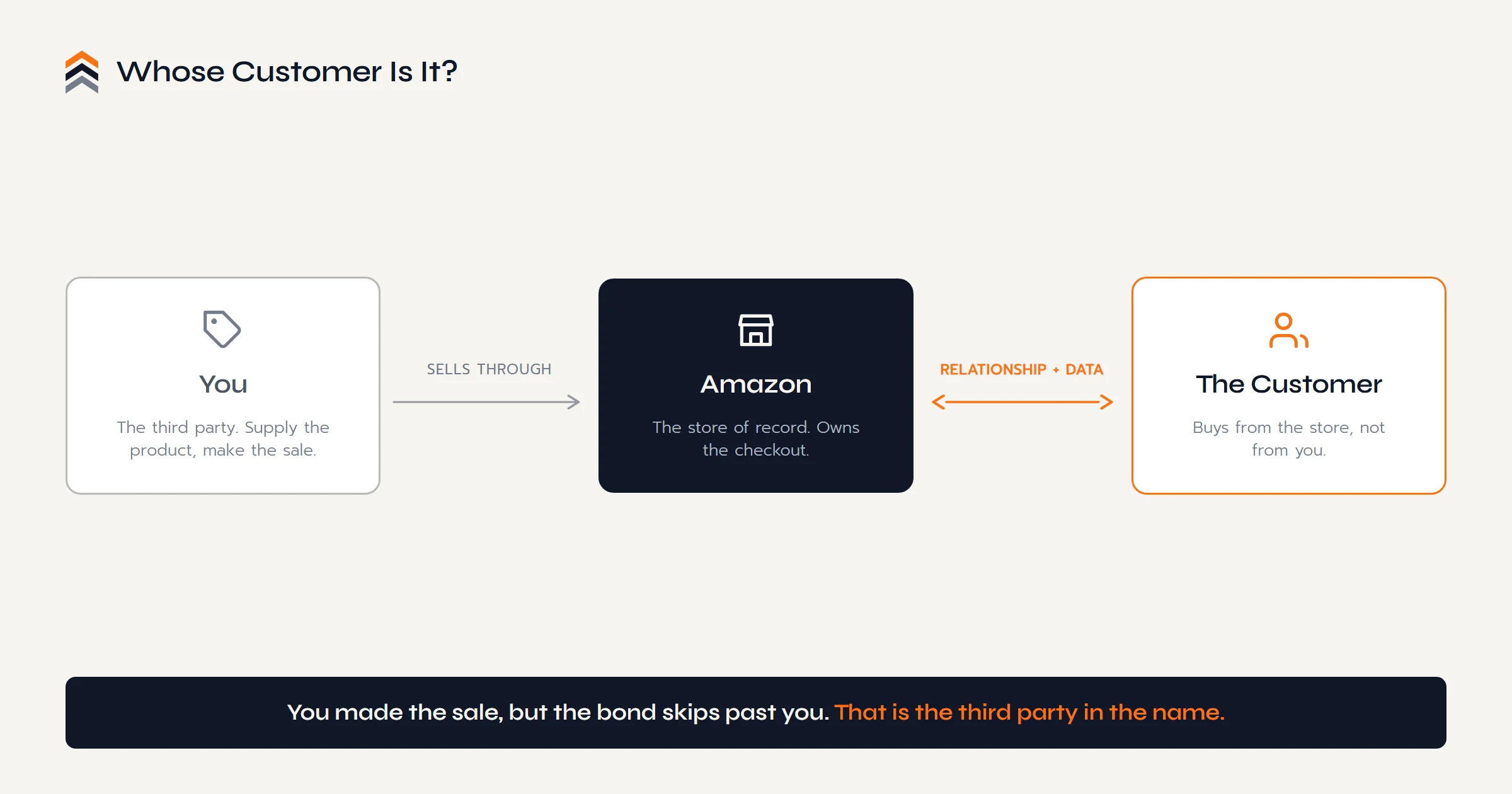
Now the words. Why third party, and not simply seller? The labels come from Amazon's own structure: a first-party seller sells to Amazon, and a third-party seller sells through Amazon. But there is a second, more revealing way to read the term, and while it is interpretive rather than an official definition, it is worth sitting with. In any sale there are a few parties: the platform that hosts it, the customer who buys, and you. The customer's relationship, and their data, is with the store they bought from, and on Amazon that store is Amazon. You supplied the product and made the sale, yet you stand a step outside the relationship it created. That is the logic behind the name. You are the third party to your own customer, which is the heart of the larger question of who owns your customers.
This is not wordplay. It is the same gap that shows up everywhere else in the model, named right on the label. The buyer's email, their purchase history, the permission to reach them again, all of it is the first-party data that stays with Amazon. You can run a large, profitable third-party business for years and never once own the customer at the center of it. The only way the arithmetic changes is to become the first party somewhere, on a channel where the sale happens with you, which is exactly what it means to sell direct to consumer. Do that, and the same buyer who was Amazon's on the marketplace becomes yours on your own site.
An Honest Note
Being a third-party seller is not a problem to escape. It is a position to understand:
- The marketplace is a great place to sell. The traffic is real, the model works, and most successful product brands start exactly here. Keep doing it.
- Just do not mistake selling for owning. A third-party business, however big, rests on a customer relationship that is not yours. Add a channel where it is, and you stop being only the third party.
Sell as the third party. Build somewhere you are the first.
Questions Sellers Ask
What Is a Third Party Seller on Amazon?
A third-party seller is an independent business or person that lists and sells its own products on Amazon's marketplace through Seller Central. The seller owns the inventory, sets the price, and runs the account, while Amazon provides the platform and, optionally, fulfillment. On a listing it shows as "Sold by" the seller's store name.
What Is the Difference Between Amazon and a Third Party Seller?
When Amazon is the seller, the listing reads "Ships from and sold by Amazon.com," and Amazon owns that inventory. When a third-party seller is behind it, the listing reads "Sold by" their store name. The product may still be fulfilled by Amazon through FBA, but the seller, not Amazon, owns and prices the goods.
What Is the Difference Between 1P and 3P on Amazon?
A first-party (1P) seller sells wholesale to Amazon through Vendor Central, which is invite-only, and Amazon then resells the goods and sets the price. A third-party (3P) seller sells directly to shoppers through Seller Central, which is open to all, and keeps control of pricing and inventory. Most independent sellers are 3P.
What Percentage of Amazon Sellers Are Third Party?
Third-party sellers account for the majority of what Amazon sells. Per Marketplace Pulse, they made up roughly 60 percent of Amazon's paid units in early 2026, a level that has held for years. Amazon has reported that 3P share of its physical sales grew from about 3 percent in 1999 to well over half today.
Is It Safe to Buy From Third Party Sellers on Amazon?
Generally yes. Most third-party sellers are legitimate businesses, and eligible orders are covered by Amazon's A-to-z Guarantee, which can refund buyers if an item does not arrive or is not as described. Checking the seller's ratings and reviews is still wise, as quality and service vary between sellers.
Do Third Party Sellers Own Their Customers?
No. On Amazon, the marketplace owns the customer relationship and the data. A third-party seller makes the sale but does not receive the buyer's email or the right to market to them, and the shopper generally sees the purchase as being from Amazon. That gap is the reason many sellers build a channel of their own.
The Conclusion
So, a third-party seller is an independent business selling its own products on Amazon's marketplace, in control of its price, its listing, and its inventory, and it is the model behind the majority of everything Amazon sells. It is a real business and a smart place to start. There is nothing lesser about it, whatever the name may imply.
But the name is honest about one thing, and it is the thing that matters most. You are the third party to a customer who belongs to the platform. Keep selling there, by all means, and then build the one place that makes you the first party to a buyer of your own, on ground you no longer only rent. That is the whole difference between selling on Amazon and selling on your own website.
Your sales can live on Amazon. Your brand should not.
The Next Move
You Know the Position.
Let's Change It.
Ready to Build
A free call, no pitch script. Walk us through your Amazon business and get a straight answer on the owned channel that would make you the first party.
Book a Free CallStill Weighing It
The Push Roadmap is a free PDF with the Ownership Scorecard. Put a number on how much of your customer you actually own today.