
Ask most Amazon sellers who owns their customers, and the honest answer is that it depends on where the sale happened, and many will not like the result. You can do six or seven figures a year on Amazon and still not own a single one of the people who bought from you, because owning a customer is a different thing from selling to one. It is one of the quietest facts about selling on a marketplace, and one of the clearest reasons to think seriously about building a brand beyond Amazon. The reassuring part is that the answer flips the moment the channel changes, and it is worth walking through exactly where and why. Most of it comes down to who ends up holding your first party data.
What Owning a Customer Means
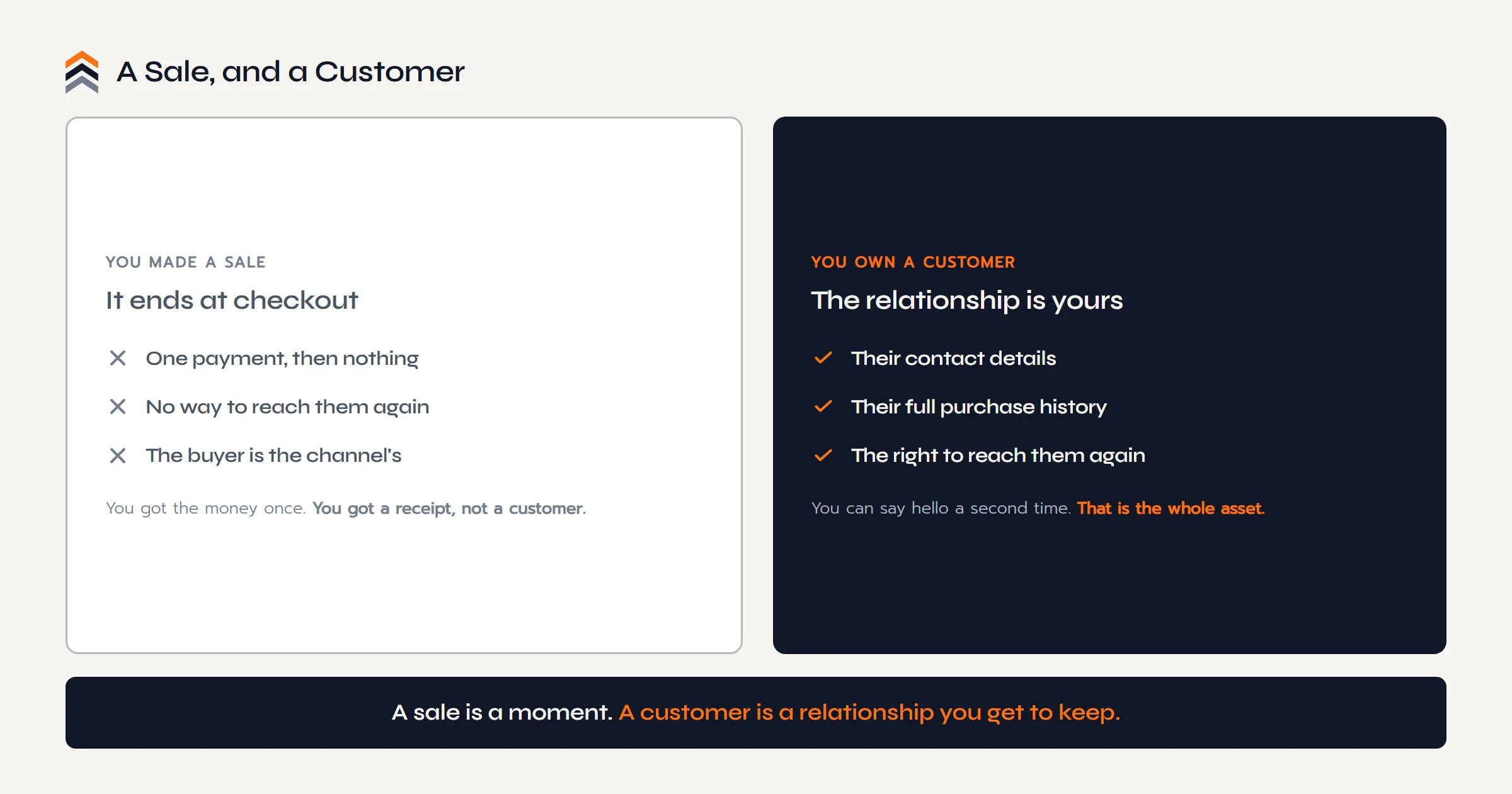
Owning a customer is not a mystical idea. It comes down to three concrete things. You hold their contact details, an email address or a phone number you are permitted to use. You hold a record of what they bought and when. And you keep the right to reach them again, directly, without asking a platform for permission each time. When all three are yours, you have a relationship. When they are not, you have a receipt.
That is the whole distinction, and it is worth saying plainly because the word owning gets thrown around loosely. To be clear, no business literally owns a person. What you own is the relationship and the data around it: the ability to say hello again, on a channel where nobody stands between you and the customer. That direct line is the asset. Everything else in this article is just a question of which channels give it to you and which quietly keep it.
A Sale Is Not a Customer
Here is the trap that catches good sellers. A sale feels like proof you have a customer. Someone paid you money, so surely they are yours. But a one-time transaction and an owned customer are two different assets, and the gap between them is exactly the contact details and the permission to use them. If you cannot reach a buyer again on your own terms, you did not gain a customer. You completed a sale and handed the relationship to whoever ran the checkout. Two minutes with the free Amazon Ownership Score will tell you how much of the relationship, and the rest of the brand, is actually yours.
This is the difference between renting demand and owning an audience. It is also the practical heart of what it means to sell direct to consumer. In our view, the cleanest test is a simple question you can ask about any channel: if you launched a new product tomorrow, could you tell your past buyers about it without paying someone for access to them? If the answer is no, you are selling to that channel's customers, not your own.
On Amazon, the Customer Is Amazon's
On the Amazon marketplace, the answer to who owns the customer is settled, and it is not the seller. The buyer is Amazon's customer. Amazon holds the identity, the email, and the full history of what that person browses and buys. What reaches the seller is only what is needed to ship the order, a name and a shipping address, delivered through Amazon's own system. As of 2026, sellers do not receive the buyer's real email address or phone number, and there is no button anywhere in Seller Central that exports a customer list.
The communication rules make the boundary concrete. Sellers can message a buyer about an order through Amazon's Buyer-Seller Messaging system, generally within thirty days, but Amazon's guidelines prohibit marketing or promotional messages, external links, and any attempt to collect further contact information. You are allowed to service the order and nothing more. This is not new, and it is not an oversight. Trade press was reporting years ago that Amazon owns the customer relationship and will not give brands the email addresses, and the policy has only tightened since. It is the same structural position a third party seller occupies on any part of the platform: you supply the product, Amazon keeps the shopper.
What Amazon Does Hand You
It would be unfair to say Amazon gives brands nothing, and pretending so would only make the case weaker. Sellers enrolled in Amazon Brand Registry can use a tool called Brand Tailored Promotions to send discounts to defined audience segments, groups like repeat customers, brand followers, cart abandoners, and lapsed buyers. It is a genuinely useful lever, and worth using if you have it.
But read the fine print through the ownership lens and the point holds. Those segments are anonymized and aggregated, delivered on Amazon's terms with a minimum size, and you never see a name, an email, or a phone number. Amazon controls the sending. You are targeting an audience the platform describes to you, not a list you hold, and you cannot take a single contact with you if you leave. The one real exception is Buy with Prime, where Amazon does pass the merchant the shopper's name, email, and address, and it is telling that this only happens when the sale runs on the merchant's own website rather than the marketplace. We looked hard at Buy with Prime and chose not to install it on client builds yet, for reasons we cover in our piece on what Buy with Prime really trades. The pattern is consistent: the data flows to you only when the checkout is yours.
How Much of Your Customer Do You Actually Own?
The Push Roadmap is a free 12 page PDF with the Ownership Scorecard. Put a number on how much of your customer and your data you hold today, and see the move to change it mapped in order.
Sent straight to your inbox.
The Answer Changes by Channel
This is the part that turns a complaint into a decision. The answer to who owns your customers is not fixed. It is set by the channel the sale runs through, and there are really three positions a brand can be in.
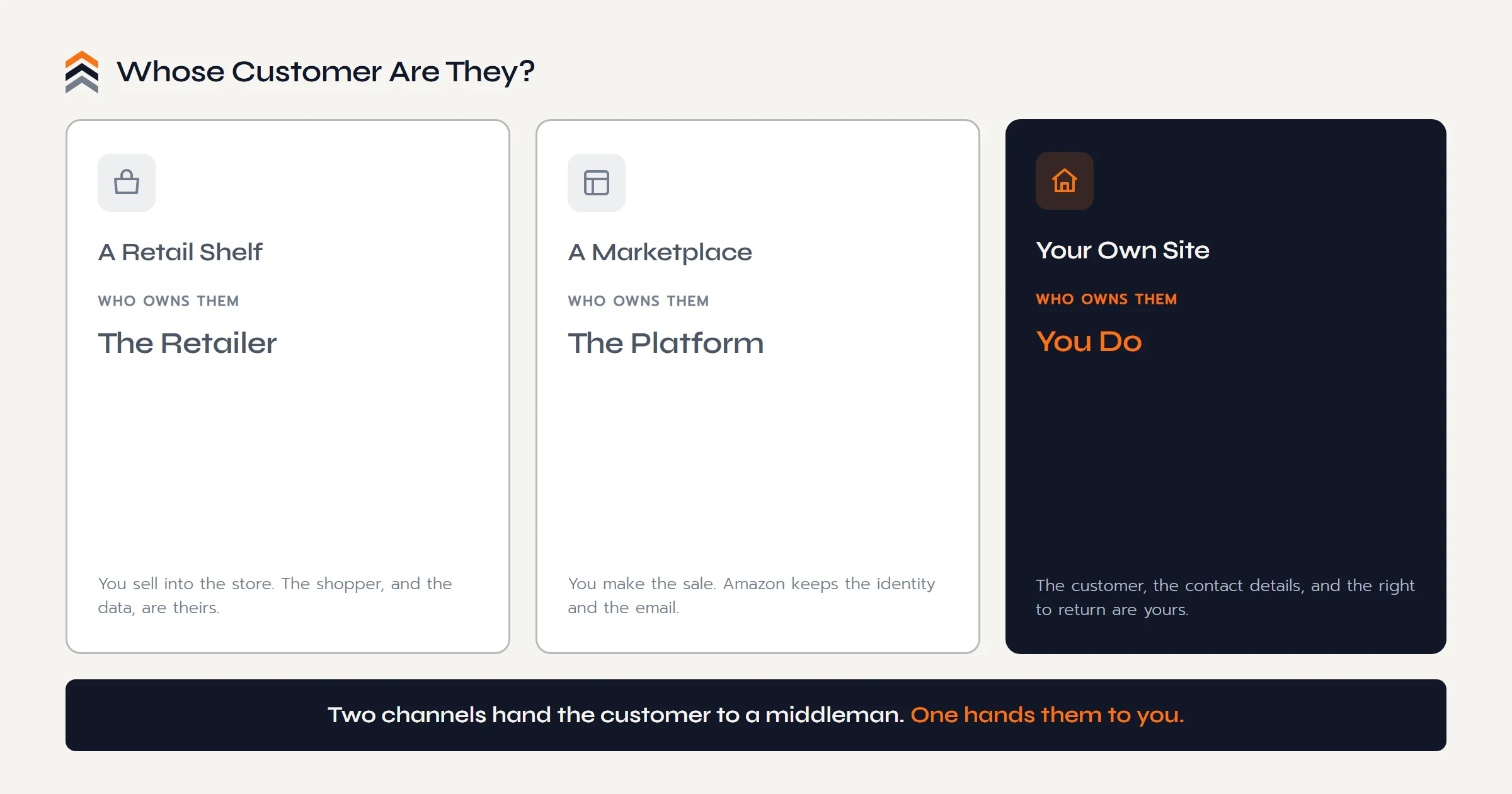
On a retail shelf, the retailer owns the end customer. You sell into the store, the shopper is theirs, and you get no direct relationship and no data. On a marketplace like Amazon, the position is almost identical: the platform owns the shopper and gatekeeps the data, as we just walked through. Both are middleman channels, and in both the customer is somebody else's. On your own website, the arrangement inverts completely. The customer buys from you directly, so the contact details, the purchase history, and the right to reach them again are all yours to keep. Nobody stands in the middle. That is the same reason first party data finally becomes yours the instant the checkout is on ground you control.
Seen this way, a website is not a competitor to your Amazon channel. It is the one channel on the list where the answer to who owns the customer comes back you. Most established brands run all three at once, using the marketplaces for reach and their own site to actually own the relationships those sales create.
Why It Is Worth Real Money
Customer ownership is not just a matter of principle. It shows up in what your business can do and what it is worth. When you own the relationship, a new product launch starts with a warm audience you can email instead of a cold ad spend. Repeat purchases run through a channel you control rather than one you rent by the click. And there is a harder edge to it: if your Amazon account is ever suspended, the damage is not that Amazon deletes customers you owned, it is that you lose access to buyers you never had a direct line to in the first place. A brand with its own list still has somewhere to send them. A brand without one goes quiet overnight.
There is a valuation angle too, and it is worth stating carefully because it is an area where estimates vary. Mergers and acquisitions brokers who value ecommerce businesses generally report that brands with an owned customer list and direct traffic command higher multiples than purely platform-dependent ones, because a documented, contactable customer base is a transferable asset that lowers the risk a buyer takes on. The specific numbers move with the market and should be treated as directional rather than precise. But the logic is not controversial: a business that owns its customers is, in our experience and in the brokers' framing, a more valuable and more resilient asset than one that rents them. That is the reward at the end of doing the work of reducing your dependence on a single platform.
Questions Sellers Ask
Does Amazon Give Sellers Customer Information?
Only what is needed to ship an order. As of 2026, third party sellers see a buyer name and shipping address, and communicate through Amazon's Buyer-Seller Messaging system. Amazon does not share the customer's real email address or phone number, and there is no way to export a customer list from the platform.
Who Owns the Customer Data on Amazon, the Seller or Amazon?
Amazon does. On the marketplace the buyer is Amazon's customer, and Amazon holds the identity, the contact details, and the full record of what that person browses and buys. A seller makes the sale but never receives the underlying relationship, so the customer data stays with the platform, not the brand.
Can Amazon Sellers Contact Their Buyers?
Only inside limits. Sellers can message a buyer about an order through Amazon's Buyer-Seller Messaging system, usually within 30 days of the order. Amazon's guidelines prohibit marketing or promotional messages, sharing external contact details or links, and collecting further contact information from the buyer.
Can I Export My Amazon Customer List?
No. Amazon does not let sellers export a list of customer emails, because on the platform those customers belong to Amazon rather than to the individual seller. You can see order and shipping details needed for fulfillment, but not a portable, contactable customer list you could market to elsewhere.
Can Amazon Sellers Email Customers for Marketing?
Not through Amazon. The Buyer-Seller Messaging system is for order-related communication only, and promotional messaging through it is against Amazon's rules. To email customers for marketing, a seller needs its own channel, such as a website with an email signup, where shoppers opt in directly and the list belongs to the brand.
Does Owning Your Customers Increase Your Business Value?
It can. Mergers and acquisitions brokers report that ecommerce businesses with an owned customer list and direct traffic tend to command higher valuation multiples than platform-dependent ones, because a documented, contactable customer base is a transferable asset that lowers risk for a buyer. These are estimates that move with the market.
The Conclusion
So who owns your customers? Whoever runs the checkout they bought through. On a retail shelf it is the retailer. On Amazon it is Amazon, which keeps the identity, the contact details, and the data, and hands you back only what you need to ship. Those are the plain facts, and they are not a scandal. They are simply how a marketplace works, and Amazon is under no obligation to change them.
What is in your hands is the channel you build alongside it. The moment a customer buys on a site you own, the answer changes: the relationship, the data, and the right to reach that person again all come back to you. You do not have to leave Amazon to make that true. You just have to stop letting it be the only place your customers exist.
Your sales can live on Amazon. Your brand should not.
The Next Move
Make the Channel Where the Answer
Finally Comes Back You.
Ready to Build
A free call, no pitch script. Walk us through your Amazon business and get a straight answer on the owned channel that would finally make the customers yours.
Book a Free CallStill Weighing It
The Push Roadmap is a free PDF with the Ownership Scorecard. Put a number on how much of your customer you actually own today.