
D2C means direct-to-consumer: a brand sells its own products straight to the people who use them, with no wholesaler, retailer, or marketplace in the middle. The whole point is ownership. The brand keeps the customer relationship, the data, and the margin that a middleman would otherwise take.
That definition raises the question most Amazon sellers eventually ask, and the one nearly every article on the subject skips: if you sell straight to shoppers on Amazon, are you already direct-to-consumer? The honest answer is no, and the reason comes down to the single word the whole model is built on. Here is what D2C really means, why selling on a marketplace is not it, and what going direct actually involves for a brand that already sells.
What D2C (Direct-to-Consumer) Actually Means
Direct-to-consumer is a business model where the company that makes a product also sells it, straight to the end customer, skipping every intermediary in between: the distributor, the wholesaler, the retail shelf, the marketplace. You will see it written D2C, DTC, or direct-to-customer. They mean the same thing.
It helps to set it beside the term it gets confused with. D2C is a subset of B2C. Both sell to consumers rather than to businesses. The difference is the path. A B2C brand might reach shoppers through a big-box retailer, a distributor, or Amazon. A D2C brand reaches them itself, on a channel it controls, and keeps everything that comes with that direct line.
And that is the part the textbook definition undersells. Cutting out the middleman is the mechanism, not the prize. The prize is what the direct line lets you keep: the identity of the customer, the record of what they bought and when, the margin no reseller skims, and a brand that people recognize and choose on purpose. D2C is less about how the product ships and more about who owns the relationship after it does.
Is Selling on Amazon D2C?
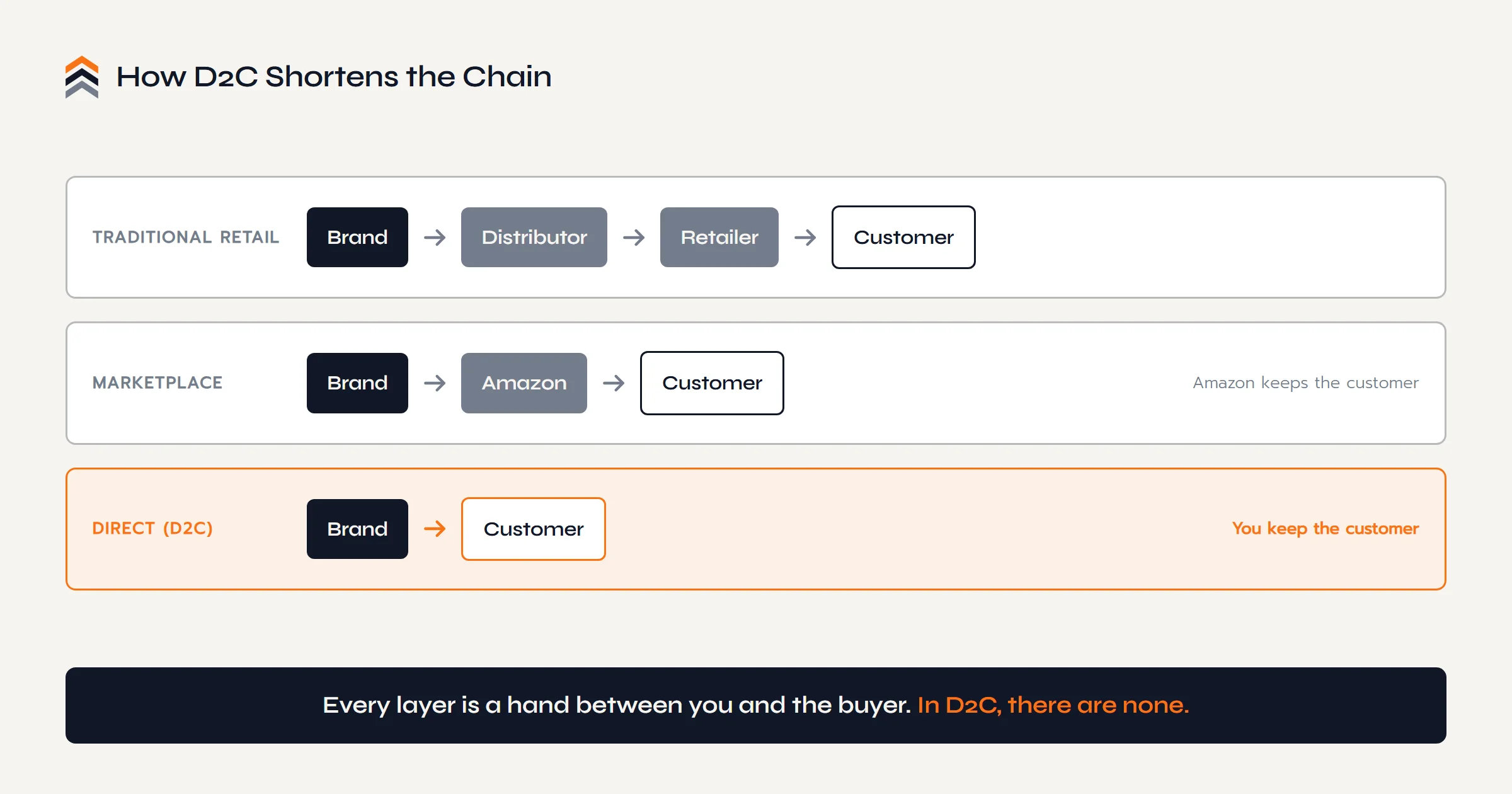
Here is the uncomfortable answer for a seller doing real numbers: no, selling on Amazon is not direct-to-consumer. It feels direct, because there is no other brand's name on the box and the shopper buys your product from you. But a marketplace sits in the middle of that sale, and it is the exact kind of intermediary the D2C model is defined by removing.
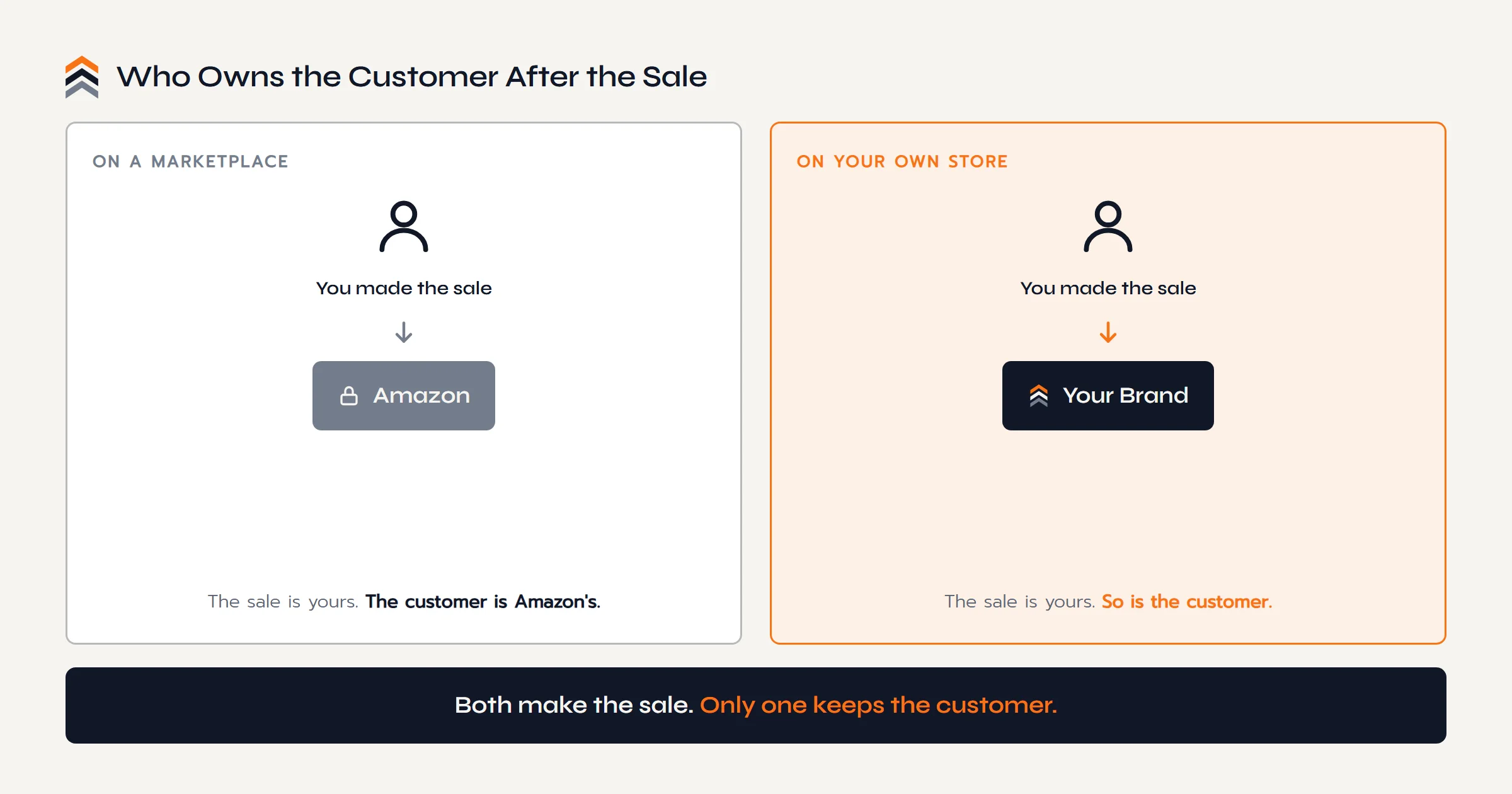
The tell is ownership. When someone buys your product on Amazon, Amazon owns that customer, not you. You get an order to fulfill and a payout, plus aggregate reports: repeat rates, search terms, demographic bands. What you never get is the person, by name, by email, or by any way to reach them again without paying Amazon to do it. That is not a direct relationship. It is a rented one, and selling on Amazon versus selling on your own site is the whole difference between a revenue stream and a brand you own.
So the accurate label for a marketplace seller is B2C, not D2C. You sell to consumers, through a channel that keeps the consumer. Nike made this distinction impossible to ignore: it pulled its products from Amazon in 2019 to sell direct and own its customers, ran that way for years, and only returned in 2025 on its own terms. A company that size does not walk away from Amazon's traffic for nothing. It walked away to own the relationship.
On Amazon you sell direct to a shopper. You just do not get to keep them.
D2C vs B2C vs Marketplace Selling
The words blur together, so here is the clean version. Every brand selling to shoppers is B2C. Some do it directly (D2C), some do it through a marketplace or a retailer. The line that matters is not how the product reaches the buyer. It is who walks away owning the buyer.
| Selling on a Marketplace | Selling Direct (D2C) |
|---|---|
| Amazon owns the customer | You own the customer |
| You get aggregates and summaries | You keep names, emails, real behavior |
| The marketplace sets the rules | Your brand sets the relationship |
| Margin after fees and commissions | The margin is yours to keep |
| At exit, a seller account | At exit, a brand asset |
Read down the right column and you are reading the reason direct-to-consumer exists. Not the shipping route. The ownership.
What Going D2C Gets You, and What It Costs
Owning the relationship is not a slogan. It cashes out as four specific things, the same four a marketplace seller currently hands to the platform:
- The customer, so you can sell again for free. An owned list of buyers, the first-party data Amazon never hands you, is repeat revenue you do not re-purchase every time. On the marketplace, every reorder is demand you pay to reach again.
- The margin. Selling direct, the referral fee and much of the ad tax stay in your pocket. Same product, more of the price.
- New demand. Your own site can be found on Google, linked, recommended, and remembered, pulling in buyers a marketplace never sends.
- A brand worth more than an account. A business with its own customers and provable repeat behavior is an asset you can sell. A seller account is a login. This is the whole case for building a brand beyond Amazon.
The honest other side: going direct means you own the parts Amazon currently handles. Fulfillment, returns, customer service, and the work of earning that first visit, since no marketplace is feeding you traffic. D2C is more control and more responsibility at the same time. For most established sellers the trade is worth it, but it is a trade, and pretending otherwise helps no one.
An Honest Note
Two things are true at once:
- You do not have to leave Amazon to go D2C. The smart move is rarely either or. Keep selling where the sales already are, and add a channel you own beside it.
- But direct is work you now own. Fulfillment, service, and traffic become yours to run. Go in clear-eyed, not starry-eyed.
Add the channel you own. Keep the one that already sells.
How Much of Your Business Do You Actually Own?
Direct-to-consumer starts with one question: who owns your customer today. The Push Roadmap is a free 12 page PDF with the Ownership Scorecard. Score where your brand stands now and see the move to owned ground mapped in order.
Sent straight to your inbox.
D2C Brands You Already Know
The model is easiest to see in the brands that built themselves on it. Warby Parker sold glasses straight from its own site and skipped the optical chains. Dollar Shave Club shipped razors by subscription and sold to a giant for a billion dollars, on the strength of its customer list. Glossier turned an audience into a beauty brand. Casper did it with mattresses, Allbirds with shoes.
What they share is not a product category. It is that each one owned its customer from the first sale, learned from that data, and built a name people sought out on purpose. None of them started as a listing on someone else's shelf. And the most telling example is the one that already had everything: Nike, big enough to sell anywhere, chose to pull back from Amazon and sell direct, because owning the customer was worth more than the marketplace's volume.
How an Amazon Seller Becomes D2C
For a seller with real sales, going D2C is not a leap and it is not an exit. It is adding the one thing you do not have yet: a channel you own. The marketplace keeps doing what it does well, moving units. The owned channel does the thing the marketplace never will, which is hand you the customer.
In practice that means your own website, where the sale, the email, and the data belong to you. It does not require walking away from Amazon on day one, and it should not. Reducing Amazon dependence is not about selling less on Amazon; it is about no longer having only one place your brand exists. Going direct is how you build the second place, the one with your name on the deed.
Questions Sellers Ask
What Does D2C Mean?
D2C means direct-to-consumer. A brand makes its product and sells it straight to the end customer, with no wholesaler, retailer, or marketplace in between. The defining feature is ownership: the brand keeps the customer relationship, the first-party data, and the full margin, instead of handing any of it to a middleman.
Is D2C the Same as DTC?
Yes. D2C and DTC are two spellings of the same thing, direct-to-consumer. Some brands write D2C, others write DTC, and a few use direct-to-customer. There is no difference in meaning. Use whichever your audience uses, because the business model is identical either way.
Is D2C the Same as B2C?
Not quite. D2C is a subset of B2C. Both sell to consumers, but B2C also includes brands that sell through retailers and marketplaces, while D2C means the brand sells directly and owns the customer relationship itself. Every D2C brand is B2C. Not every B2C brand is D2C.
Is Selling on Amazon D2C?
No. On Amazon you sell to a shopper, but Amazon is the marketplace in the middle, and it owns the customer relationship and the data, not you. That is the exact intermediary the D2C model bypasses. Selling on Amazon is marketplace B2C. True D2C is a channel you own, like your own store.
What Is an Example of a D2C Brand?
Warby Parker (glasses), Dollar Shave Club (razors), Glossier (beauty), and Casper (mattresses) are classic D2C brands: each sells its own products through its own site and owns the customer. Nike is a well-known case that pushed hard into D2C, even leaving Amazon for years to own the relationship directly.
Is D2C the Same as Ecommerce?
No. Ecommerce is the channel, selling online. D2C is the business model, a brand selling its own products directly and owning the customer. You can run ecommerce without being D2C, such as selling on Amazon, and a D2C brand can even sell offline. Most D2C brands use ecommerce, but the two are not the same.
The Conclusion
D2C meaning, stripped down, is not complicated: a brand selling its own products directly to the customer, and owning everything that comes with that. The confusion only shows up when a marketplace is involved, because selling on Amazon looks direct while quietly keeping the one thing that makes D2C matter, the customer.
So the useful question is not really what D2C means. It is who owns your customer right now. If the answer is Amazon, you are selling on a marketplace, not selling direct, no matter how well it is going. Direct-to-consumer is the ground where that answer finally becomes you.
Your sales can live on Amazon. Your brand should not.
The Next Move
You Know What D2C Means.
Now Own the Customer.
Ready to Build
A free call, no pitch script. Walk us through your Amazon business and get a straight answer on what your own direct channel would take.
Book a Free CallStill Weighing It
The Push Roadmap is a free PDF with the Ownership Scorecard. Put a number on how much of your brand you actually own today.