
A DTC, or direct-to-consumer, brand sells its products straight to shoppers through its own channels, its website, app, or stores, instead of through wholesalers or third-party retailers. By cutting out the middleman, the brand owns the customer relationship, the first-party data, and more of the margin. It is one of the clearest expressions of building a brand you actually own, and for an Amazon seller it is a more reachable goal than it looks. If you want the full definition and the distinctions, the companion piece on what D2C actually means goes deeper; this one is about the brands themselves, what the best of them do, and what it means for you.
Because here is the part worth saying up front. The famous DTC brands are held up as a different species from an Amazon seller, but they are not. They sell a product directly and own the people who buy it. You already sell a product. The only thing you do not yet own is the person who buys it. That gap is smaller than the DTC mythology makes it sound, and this article is about closing it honestly.
What Are DTC Brands?
The defining trait of a DTC brand is not that it sells online. It is that it sells on ground it controls. A brand that only sells through Amazon is doing ecommerce, but it is not direct-to-consumer, because the marketplace sits between it and the buyer and keeps the relationship. A DTC brand removes that middle layer so the customer, the data, and the repeat sale belong to the brand.
That is also why DTC is not the same as B2C. Every consumer brand is business-to-consumer, including the ones that sell through Target or Amazon. DTC is the narrower case where the brand owns the channel end to end. The distinction matters because owning the channel is exactly what turns a stream of sales into an asset you can build on.
What Makes a DTC Brand Work
Across categories, the brands that win share the same handful of traits. None of them is about the product being unique; they are about the relationship being owned:
- An owned channel and first-party data. Every purchase flows straight to the brand, which fuels personalization, email, and repeat marketing. Owning the customer data a marketplace keeps is the engine under everything else.
- A real brand story. Not a product spec, a point of view. Shoppers on DTC sites go looking for the brand's reason to exist, which is why telling your story well is a growth lever, not decoration.
- A direct relationship. The brand talks to buyers directly through email, SMS, and community, instead of renting that access from a platform.
- Control of the whole experience. Product, packaging, unboxing, service, and returns are one consistent journey the brand designs, not a checkout it borrows.
- Repeat revenue. Subscriptions and replenishment turn one sale into many, which is what makes the economics work over time.
- Community and digital-first marketing. They grow through content, social, and word of mouth rather than shelf space, so the audience compounds over time instead of resetting with every new campaign.
Six DTC Brands Worth Learning From
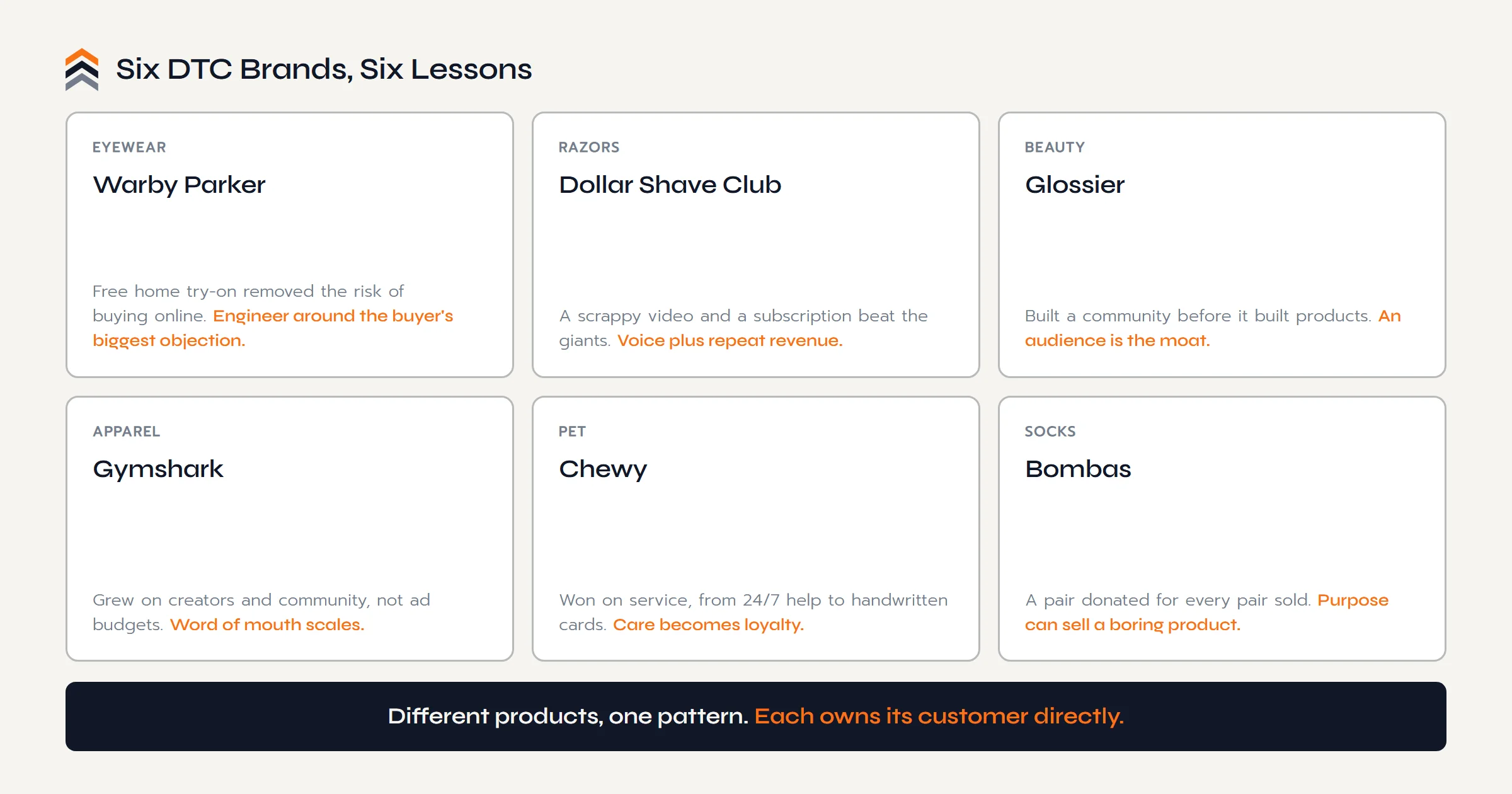
The names get repeated so often they blur, so it helps to hold onto the single lesson each one teaches:
- Warby Parker made buying glasses online safe with a free home try-on, engineering around the customer's biggest objection instead of arguing with it.
- Dollar Shave Club beat billion-dollar incumbents with a scrappy launch video and a subscription, then sold to Unilever for a reported one billion dollars in 2016. Voice plus repeat revenue.
- Glossier built a community out of a beauty blog before it built products, proving an audience is the real moat.
- Gymshark scaled to a multi-billion-dollar valuation almost entirely on creators and community, with little traditional ad spend.
- Chewy won a commodity category on service, from 24/7 support to handwritten cards, until care became loyalty.
- Bombas donated a pair of socks for every pair sold, showing that purpose can differentiate even the most boring product.
Different products, one pattern. Each brand made itself the thing customers sought out by name, and each kept the relationship that produced. None of them won because they had the only product in their category; they won by owning the demand they built, which is the one advantage a marketplace can never hand you.
The Honest Part: DTC Alone Isn't the Win
Here is where most DTC content stops and where the useful part begins. The pure-DTC boom of the 2010s ran into hard limits, and pretending otherwise would be selling you a myth. Many brands leaned entirely on cheap paid social to acquire customers, and as ad costs climbed, the math stopped working. Casper, the brand that invented the bed-in-a-box, reportedly lost 200 to 300 dollars on every mattress it sold and saw its IPO valuation cut to around 500 million dollars in 2020. Demand, it turned out, was the expensive part. Acquiring a single customer through paid channels commonly ran into the tens or even hundreds of dollars, a cost that only made sense if that customer came back many times, and for a mattress company, they rarely did.
So the winners changed the plan. Warby Parker and Allbirds opened hundreds of physical stores. Dollar Shave Club sold to a conglomerate. Most surviving DTC brands now also sell on Amazon and in retail. The lesson is not that DTC failed; the US direct-to-consumer market is enormous, projected by eMarketer to reach roughly 240 billion dollars in 2025, nearly a fifth of all US retail ecommerce. The lesson is that DTC was never meant to be your only channel. It is about owning a direct relationship as part of a mix, not betting the business on a single storefront. The data backs that up: most consumer brands now run a hybrid model, selling direct and through other channels at the same time, rather than going all in on one. Pure DTC was a phase. Owning a direct channel inside a wider mix is the durable version.
You Have the Demand. See What It Takes to Own It.
The Push Roadmap is a free 12 page PDF with the Ownership Scorecard. Put a number on how much of your brand you own today, and see the move from marketplace seller to direct brand mapped in order.
Sent straight to your inbox.
Your Head Start as an Amazon Seller
Now the part that should change how you read every DTC success story. The pure-DTC startups spent the 2010s bolting a marketplace and retail onto a direct base. As an Amazon seller, you get to make the same move in reverse, and from a stronger starting point. You are bolting a direct channel onto a marketplace base, and you already have the two things those startups burned millions trying to buy.
They had a website but had to purchase every single customer through rising ad costs, and many never found steady product-market fit before the money ran out. You have proven product-market fit, real demand, and paying customers today. The expensive, risky part of building a DTC brand, getting people to want the product, is the part you have already done on Amazon. What is left is the cheaper part: giving that demand a channel you own so you keep the customer, the data, and the margin instead of handing them to the platform. And because you are not relying on paid ads to manufacture demand from nothing, you sidestep the exact economics that sank the pure-play brands. The acquisition is effectively already paid for; the job now is keeping the customer, which is far cheaper than winning one and stays entirely in your hands once the relationship is yours.
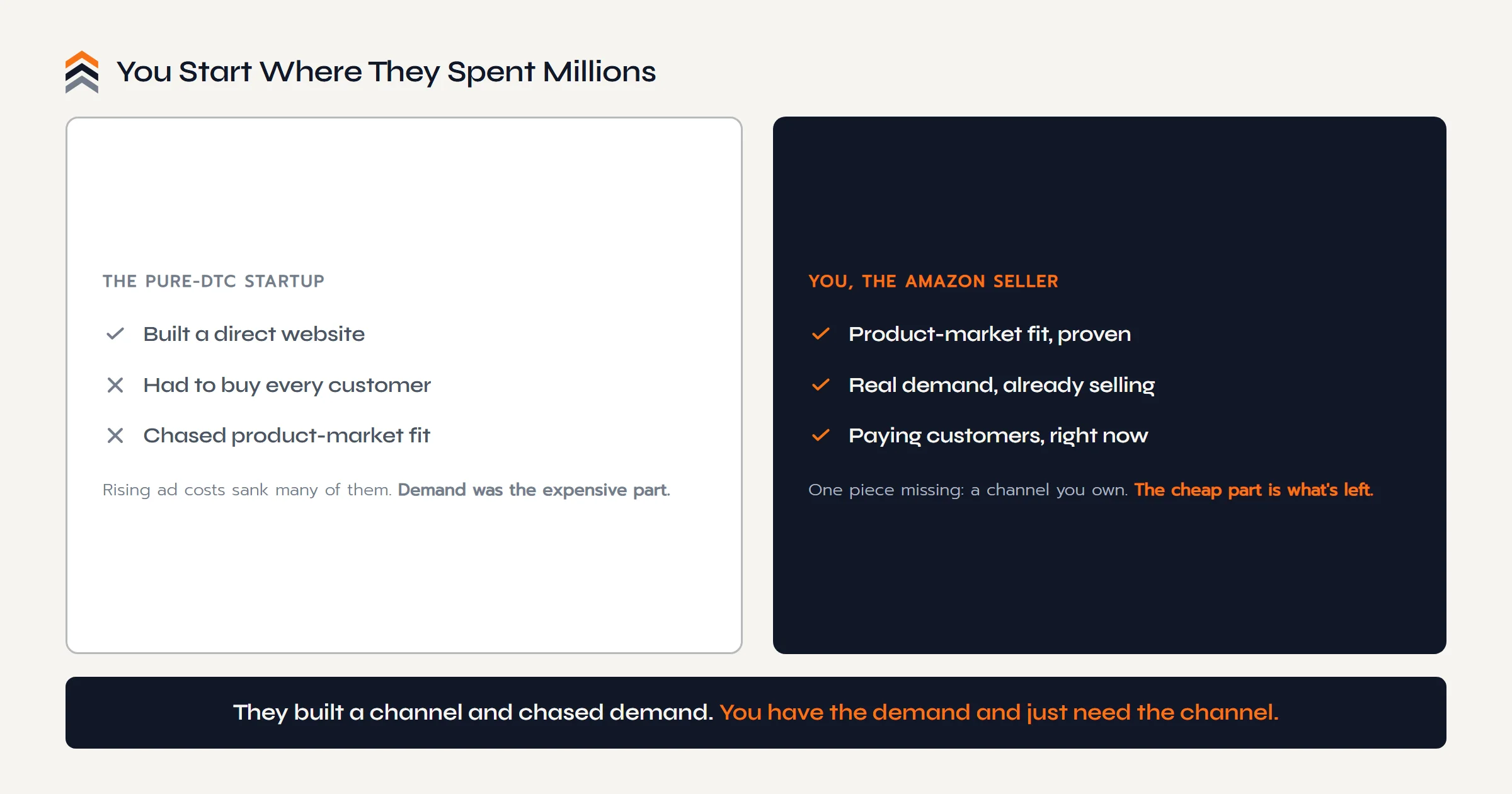
This is the honest, defensible version of going direct. It is not a bet against Amazon, and it does not ask you to walk away from the sales that work. It is omnichannel from a position of strength: keep the marketplace, and add the owned channel that turns anonymous buyers into an audience you can reach directly and a brand you keep. It is the same move a private label seller is already primed for, because they built the brand but not the channel. The website is the missing half.
An Honest Note
Both of these are true at once:
- DTC is not a magic switch. The pure-play brands proved a direct channel alone does not guarantee profit. Demand and economics still have to be real.
- You already cleared the hard part. Your demand exists and your product sells. Adding a direct channel is a smaller, safer step than the one those startups gambled on.
Keep selling on Amazon. Add the channel that finally makes the customer yours.
Questions Sellers Ask
What Are DTC Brands?
DTC (direct-to-consumer) brands sell their products straight to shoppers through their own channels, such as their website, app, or stores, instead of through wholesalers or third-party retailers. Cutting out the middleman lets them own the customer relationship, the first-party data, and more of the margin. Warby Parker and Glossier are classic examples.
What Is an Example of a DTC Brand?
Warby Parker is a flagship example: it sells prescription eyewear directly through its own website and stores, skipping the optical-chain middlemen. Other well-known DTC brands include Glossier in beauty, Gymshark in fitness apparel, Bombas in socks, Chewy in pet supplies, and Allbirds in footwear.
What Makes a Successful DTC Brand?
Successful DTC brands own a direct channel and the first-party data it produces, tell a genuine brand story, build community, and control the whole customer experience end to end. Increasingly they also sell across multiple channels, including retail and marketplaces, rather than relying on one channel alone.
Are DTC Brands Profitable?
They can be, but many pure-DTC startups struggled. Casper reportedly lost $200 to $300 on every mattress sold. Profitability depends on customer acquisition cost versus lifetime value. Brands that add repeat or subscription revenue and multiple channels, and that already have demand, are far likelier to turn a profit.
What Is the Difference Between DTC and B2C?
B2C (business-to-consumer) means any business selling to end consumers, including through retailers like Target or Amazon. DTC is a subset: the brand sells directly through its own channels with no middleman. All DTC is B2C, but not all B2C is DTC. The difference is who owns the customer relationship.
Is DTC the Same as Ecommerce?
No. Ecommerce is any online selling, including on marketplaces like Amazon. DTC specifically means a brand selling through its own channels and owning the customer relationship. You can do ecommerce without being DTC, by selling only on Amazon, and DTC can also include physical stores, not just online.
Can You Be a DTC Brand and Still Sell on Amazon?
Yes, and most successful brands are omnichannel. Warby Parker and Allbirds added stores, and countless DTC brands also sell on Amazon. Being DTC is about owning a direct channel and the customer relationship, not abandoning marketplaces. For an Amazon seller, going DTC means adding a channel, not replacing one.
The Conclusion
The best DTC brands are not a different species from you. They sell a product directly and keep the people who buy it, and they win by owning the relationship, not by owning a secret. The famous names, Warby Parker, Glossier, Gymshark, teach one lesson between them: make yourself the brand people seek out, and keep the channel that seeking produces.
The honest footnote is that a direct channel alone is not a guarantee. The pure-play brands learned that demand is expensive and single-channel bets are fragile. But that footnote is exactly why an Amazon seller is in such a strong position. You already have the demand they went broke chasing. Becoming a DTC brand, for you, is not a leap into the unknown. It is adding the one piece you are missing, a channel you own, to a business that already works. Keep the marketplace. Own the customer.
Your sales can live on Amazon. Your brand should not.
The Next Move
You Have the Demand.
Now Build the Brand That Keeps It.
Ready to Build
A free call, no pitch script. Walk us through your Amazon business and get a straight answer on what your own direct-to-consumer site would take.
Book a Free CallStill Weighing It
The Push Roadmap is a free PDF with the Ownership Scorecard. Put a number on how much of your brand you actually own today.