
DTC companies, short for direct-to-consumer, are businesses that sell their own products straight to the people who use them, through channels they own, with no wholesaler or retailer in between. The label gets attached to trendy startups, but the defining trait is plain and it is about ownership: a DTC company owns the customer relationship, the data, the margin, and the brand, instead of handing them to a middleman. If you want the term itself unpacked, that is in what D2C means; here we look at the companies, what the strong ones share, and what a seller can borrow.
It matters for one specific reader: an Amazon seller. You already have the product and the demand. The DTC playbook is largely about the piece you do not yet own, and the good news is you are closer to it than the glossy startup stories suggest.
What DTC Companies Are
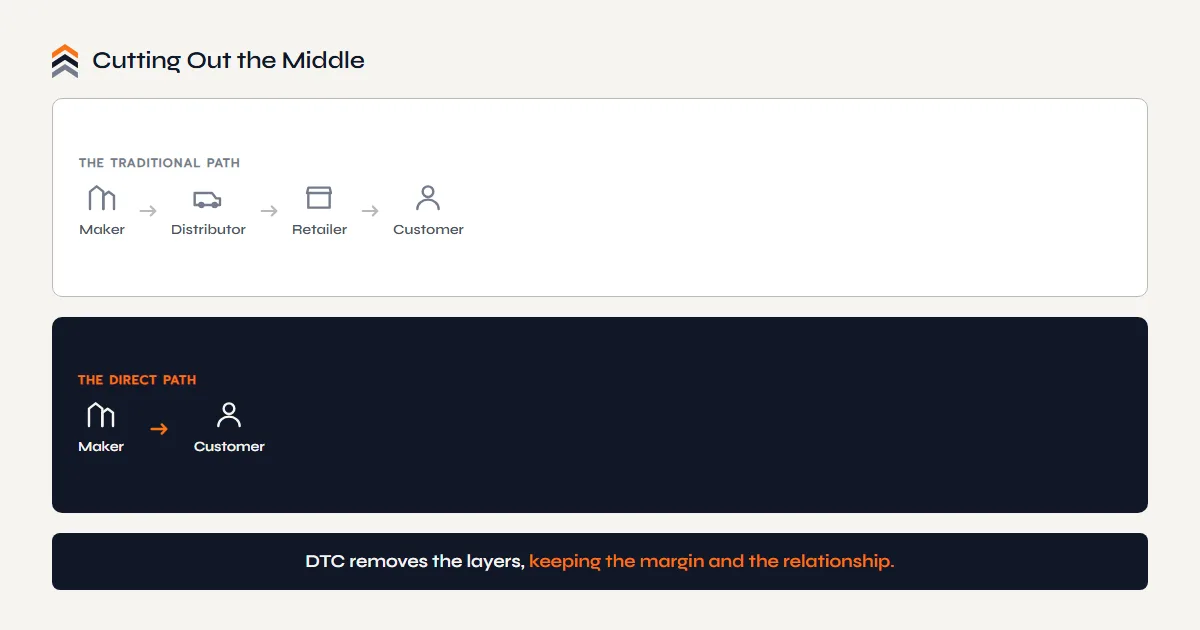
Strip away the marketing and a DTC company is defined by what it cuts out: the layers between maker and buyer. A traditional brand sells to a distributor, who sells to a retailer, who sells to the customer, and at each step the brand loses margin and, more importantly, loses contact with the person who actually buys. A DTC company removes those layers and sells directly, usually online, keeping both the margin and the relationship.
That is why DTC is a stricter idea than simply selling to consumers. A brand can reach consumers through Amazon or a big-box retailer and still not be DTC, because the channel owns the customer. DTC is specifically the direct relationship, and it is the same distinction that decides who owns your customers in the first place.
What the Best DTC Companies Have in Common
The well-known DTC names come from wildly different categories, eyewear, mattresses, razors, cosmetics, apparel, so the product is clearly not the secret. What they share is a model and a set of habits. As of 2026, the pattern holds across the ones that last:
- They own their storefront. The brand's own website is the center of gravity, not a marketplace listing. The site is the asset, and everything points to it.
- They own the customer data. Every purchase builds a first-party list of names, emails, and history they can use, the raw material covered in owning your customer data.
- They market to buyers again, for free. Email and community mean a past customer is a customer they can reach without paying a platform to reintroduce them.
- They build a brand, not just a product. A clear identity and story is why people choose them on purpose, which is the whole point of real brand strategy.
None of these depend on being a funded startup. They are habits any seller can adopt, at any size, the moment they have a channel they own.
Want to Sell Direct, Like They Do?
The Push Roadmap is a free 12 page PDF that maps the move from a marketplace to a brand you own, with the Ownership Scorecard to show where you stand.
Sent straight to your inbox.
How the DTC Model Actually Works
The economics are the appeal, and they are worth stating plainly. By cutting out the middle layers, a DTC company keeps the margin that would have gone to a distributor and retailer. By owning the customer, it can sell again to the same person for the cost of an email instead of the cost of a new acquisition. And by owning first-party data, it learns directly from buyers instead of guessing through a middleman. Stack those up and a DTC business compounds in a way a wholesale one cannot.
Now the honest other side, because the success stories rarely lead with it. Owning the customer means owning the traffic problem too. A marketplace hands a seller built-in shoppers; a DTC company has to earn its own visitors through search, content, email, and reputation. That is the real work behind the model, and it is why DTC is more demanding than the highlight reels suggest. It is also why the smartest move for most sellers is not to abandon the marketplace but to build the owned channel beside it.
Owning the customer is the prize. Owning the traffic is the price.
How DTC Companies Get Customers Without a Marketplace
If owning the traffic is the price, the fair question is how the model pays it. DTC companies build demand rather than borrow it, and in practice that comes down to a handful of channels, some rented and some owned.
The rented one is paid advertising, and it deserves an honest word because it is where most of the category started. Ads still work: you can buy attention today and see sales tomorrow, which is genuinely useful when nobody knows your name yet. What ads do not do is compound. The traffic stops the moment the spending stops, and as more brands bid for the same audiences, the cost of buying a customer has climbed with them. Paid is a good accelerator and a poor foundation.
The owned channels are slower to start and they keep paying. Search is the largest of them: content and product pages that answer what buyers are already typing bring visitors who cost nothing per click, which is the whole point of ecommerce SEO. Email is the most direct, because a list you own lets you sell to a past customer for the price of a send, with no auction in between. A loyalty program sits on top of that same list and turns a single order into a habit, which is worth more to a brand than any discount. Community and social give the brand a face, so people follow it rather than merely find it. And the quietest channel is the product itself, since something good that arrives well earns repeat orders and recommendations, the cheapest acquisition there is.
The companies that last do not pick one. They use paid to prime the pump and owned channels to carry the weight, so that a larger share of sales each year arrives without being bought. And a seller who already has a marketplace holds a fourth option those startups never had: an audience you are already selling to, which can be pointed toward a site you own. That is a real head start, and it makes the move look less like founding a DTC company and more like finishing one you have half built already.
What an Amazon Seller Can Borrow
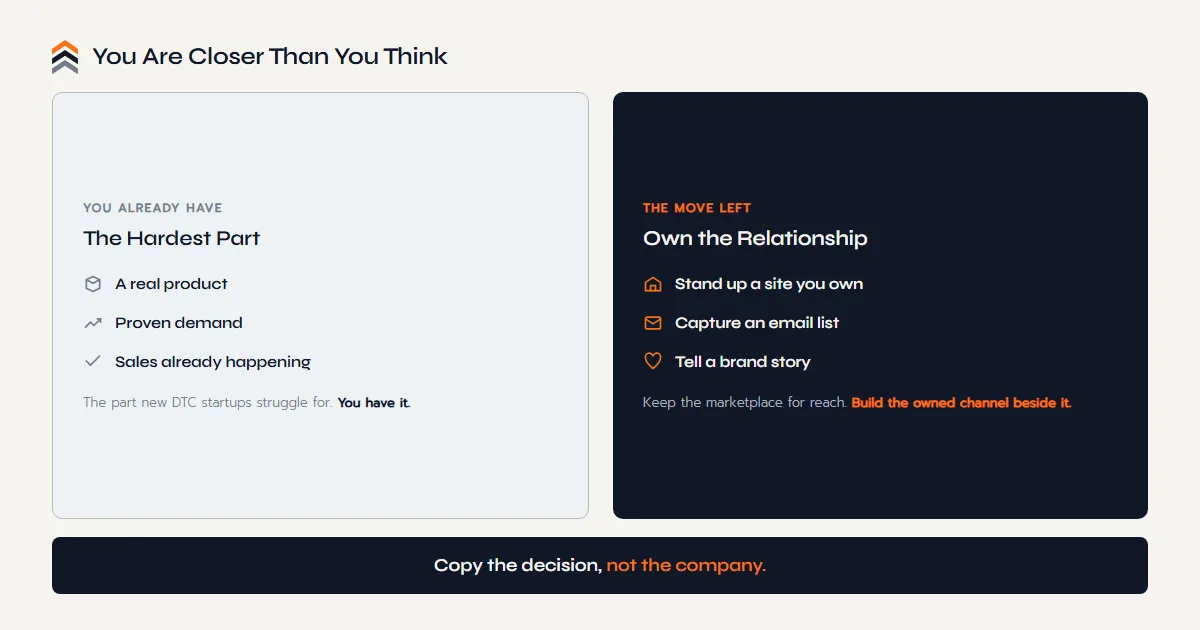
Here is where it comes home. As an Amazon seller, you have already solved the hardest thing a new DTC startup struggles with: a product with proven demand. What you have not yet done is own the relationship around it. On Amazon, the customer, the data, and the brand belong to the marketplace, which is precisely what you do not own there.
So you do not need to become a DTC company overnight or leave Amazon behind. You borrow the habits: stand up a website you own, start capturing an email list, tell a brand story that makes you a choice rather than a listing, and route some of your marketplace momentum to ground that is yours. That is the whole move in going from Amazon to your own website, and it turns the DTC model from a startup fairy tale into a practical next step. The companies you admire are not doing something you cannot; they are just doing the part you have not started yet.
Questions People Ask
What Are DTC Companies?
DTC companies, short for direct-to-consumer, are businesses that sell their own products straight to customers through their own channels, rather than through wholesalers or retailers. The defining trait is ownership: the company controls the product, the customer relationship, the data, and the brand, instead of handing those to a middleman.
What Are Examples of DTC Companies?
The best-known examples come from categories like eyewear, mattresses, razors, cosmetics, and apparel, brands that launched by selling online directly instead of through stores. The common thread is not the product but the model: they own the website, the customer list, and the brand, and they built demand rather than renting shelf space.
What Is the Difference Between DTC and B2C?
B2C means selling to consumers, through any channel, including retailers and marketplaces. DTC is a stricter subset: selling to consumers directly, with no middleman in between. Every DTC company is B2C, but a B2C brand that sells mainly through Amazon or big-box stores is not DTC, because it does not own the direct relationship.
Is Amazon a DTC Company?
For its own private-label products, Amazon can act direct-to-consumer. But for the millions of third-party sellers on its marketplace, Amazon is the middleman, not a DTC channel. A seller on Amazon is using a marketplace; they become DTC only when they sell through their own website and own the customer relationship themselves.
Why Are DTC Companies Successful?
When they succeed, it is usually because they own their customer relationship and margin. Selling direct means keeping the retailer markup, learning from first-party data, and marketing to past buyers for free instead of paying to reach them again. That ownership compounds. It is also why DTC is harder than it looks: you own the traffic problem too.
The Conclusion
DTC companies are not a product category or a startup fad. They are businesses that made one decision, to own the direct relationship with their customers, and built everything on top of it. The margin, the data, the repeat sales, and the brand all flow from that single choice, and so does the harder part, owning the job of bringing in your own traffic.
For an Amazon seller, the lesson is not to copy a company; it is to copy the decision. You already have the product. The move left is to own the customer, on a channel that is yours.
Your sales can live on Amazon. Your brand should not.
The Next Move
You Admire the Model.
Let's Build You Into It.
Ready to Build
A free call, no pitch script. Tell us about your product, and get a straight answer on the owned store that would let you sell direct.
Book a Free CallStill Weighing It
The Push Roadmap is a free PDF with the Ownership Scorecard. See how much of your brand you own today, and the move to owning more.