
A loyalty program is a structured way to reward customers for coming back, and it is one of the most reliable growth levers in ecommerce, because keeping a customer is far cheaper than finding a new one. It is also, for an Amazon seller, a quietly impossible one. You can run the best loyalty program in your category and never offer it to a single Amazon buyer, for a reason that has nothing to do with effort and everything to do with ownership. Seeing why is a sharp, specific case for building a brand beyond Amazon. Start with what a loyalty program actually is.
What a Loyalty Program Is
A customer loyalty program rewards people for buying or engaging with your brand repeatedly. In exchange for their repeat business, they earn something: points toward a discount, a members-only perk, a status tier, early access to new products. The mechanics vary, but the purpose is always the same, and it is not really about the reward. It is about retention. A loyalty program is a system for turning a one-time buyer into a repeat customer, and a repeat customer into a habit.
That is a different goal from most marketing, which is aimed at strangers. A loyalty program is aimed at the people who already bought, the warmest audience a business has, and it works by giving them a reason to choose you again instead of drifting to whoever is cheapest or most convenient next time. Done well, it is less a discount scheme than a relationship, formalized.
The Main Types
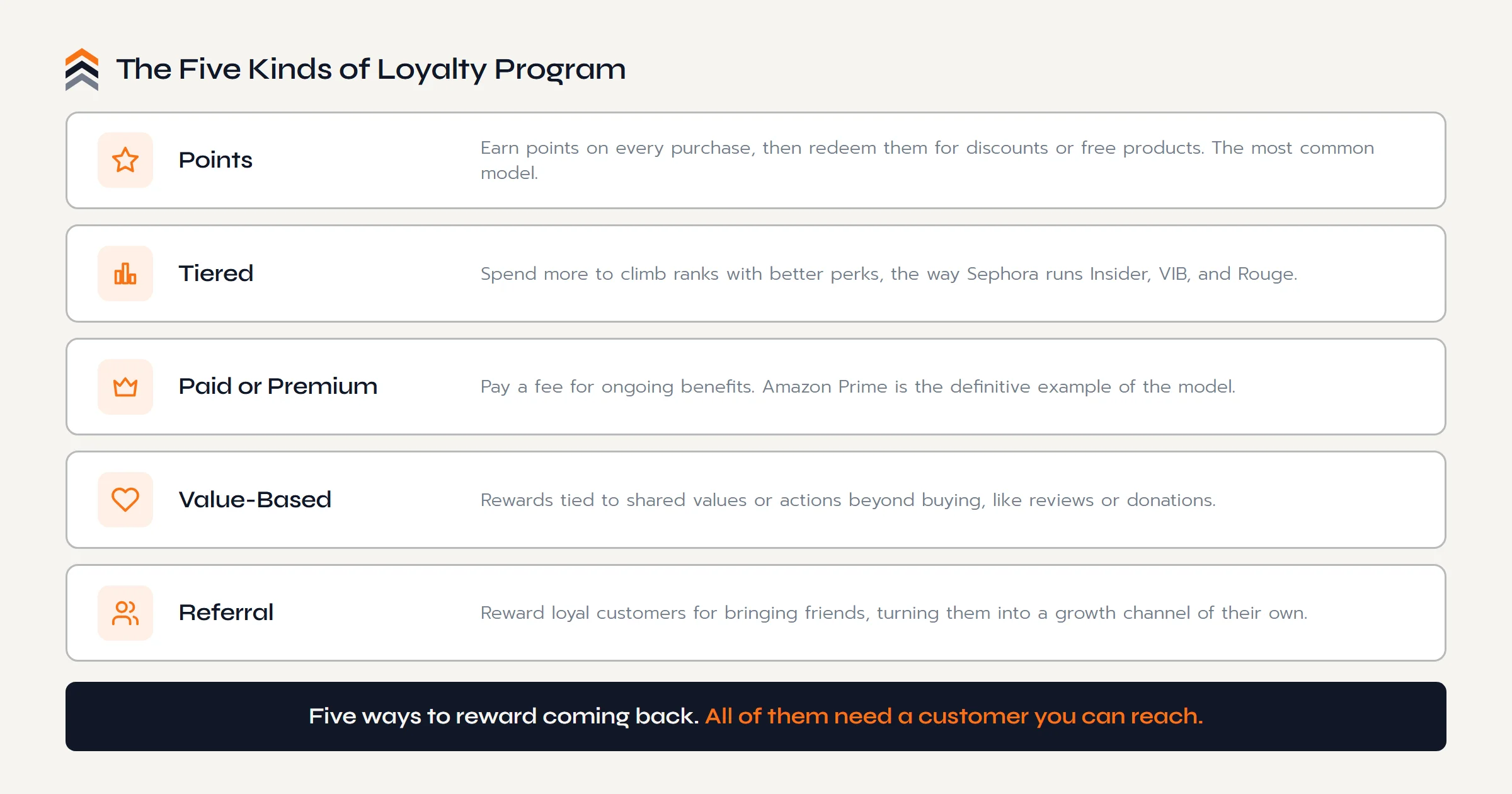
Loyalty programs come in a handful of shapes, and most brands pick one or blend two. The common models:
- Points programs. Customers earn points for purchases, and often for reviews, referrals, or signups, then redeem them for discounts or free products. The most common model, and the easiest to understand.
- Tiered programs. Spending or engagement moves customers up ranks, each with better perks, the way Sephora's Beauty Insider runs Insider, VIB, and Rouge levels. Status becomes its own motivation.
- Paid or premium programs. Customers pay a fee for immediate, ongoing benefits. Amazon Prime is the definitive example, and it shows how powerful the model is, and to whose benefit, as we will see.
- Value-based or community programs. Rewards tied to shared values or actions beyond buying, like donations or reviews, which suit brands with a strong identity.
- Referral programs. Customers are rewarded for bringing friends, turning loyal buyers into a growth channel of their own.
Why the Math Works
Loyalty programs are not sentimental. They exist because retention is where the profit hides. Winning a new customer is expensive, and every marketer feels it: Harvard Business Review has reported that acquiring a new customer can cost anywhere from five to twenty-five times more than keeping an existing one. Selling again to someone who already trusts you skips almost all of that cost.
And the upside compounds. The most-cited figure in retention, from Bain and Company research popularized by Harvard Business Review, is that increasing customer retention by just 5 percent can lift profits by 25 to 95 percent. Repeat customers also tend to spend more over time; loyalty platforms like Yotpo report that returning shoppers spend meaningfully more per order than first-timers, though those are vendor figures worth taking as directional. The precise numbers vary, but the shape does not: a business that keeps its customers is far more valuable than one that constantly replaces them, and a loyalty program is a deliberate machine for keeping them.
A new customer is a cost you pay once. A loyal one is a profit you keep earning.
The Program You Cannot Run on Amazon
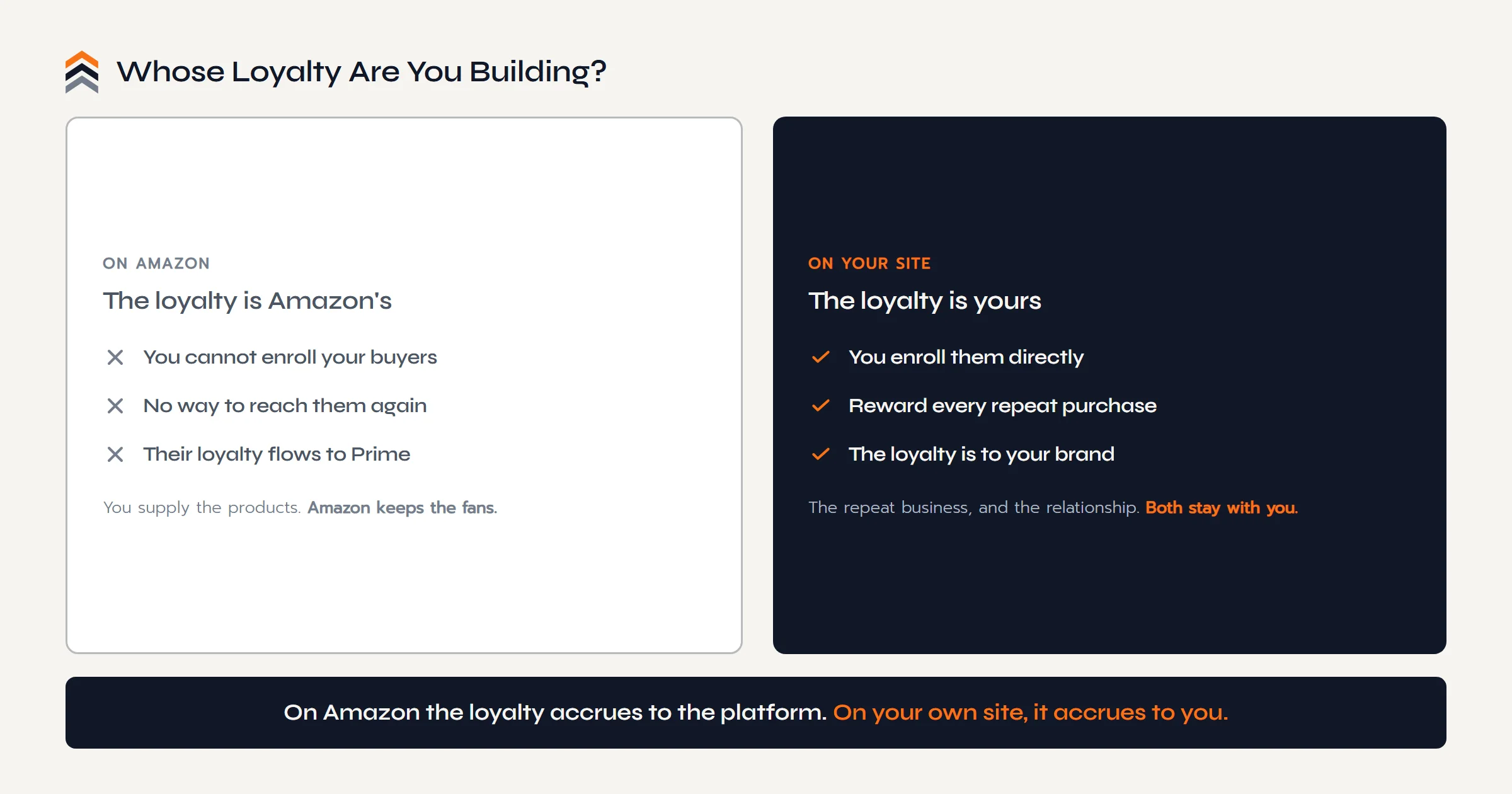
Here is where it turns personal for a marketplace seller, and it is the whole point. To run a loyalty program, you need three things: to know who your customers are, to be able to reach them, and to track and reward what they buy. On Amazon, you have none of the three. You never receive the buyer's name, email, or any way to contact them, so you cannot enroll them, cannot see their repeat purchases as a brand, and cannot reward them for coming back. The single most profitable growth lever in retail is simply switched off, because the customer it depends on is not yours to hold. It runs on the exact first-party data that Amazon keeps.
There is one loyalty program thriving on Amazon, and it is worth being honest about it, because it proves the point rather than softening it. Amazon Prime is a textbook paid loyalty program, and a brilliant one, with around 200 million members worldwide. But read who it rewards. Prime builds loyalty to Amazon, not to you. A Prime member is loyal to fast, free shipping and the ecosystem around it, and when they come back to buy your category again, they will happily pick a competitor's product if it ranks a little higher. Every ounce of loyalty the marketplace generates accrues to the platform. You supply the products; Amazon keeps the fans. That is the same pattern that runs through customer loyalty for Amazon brands as a whole: the repeat business is real, but the relationship behind it is Amazon's.
To be fair, Amazon does lend sellers a few retention tools. Subscribe and Save discounts repeat orders of consumables, and Brand Tailored Promotions let you send offers to anonymized segments like past customers or brand followers. They are worth using, and you should. But notice what they are not. You still never learn who those customers are, you can reach them only through Amazon and on Amazon's terms, and the moment they lapse the relationship stays the platform's, not yours. They are Amazon's retention levers, lent to you for use inside its walls, not a loyalty program you own and control.
Loyalty Needs a Customer You Can Reach.
The Push Roadmap is a free 12 page PDF with the Ownership Scorecard. See how owning the customer unlocks loyalty, email, and repeat revenue, mapped in order.
Sent straight to your inbox.
How to Run One, Once You Own the Customer
The moment the sale happens on a channel you own, all three missing pieces appear at once. You know who bought, you can reach them, and you can track what they do next. From there, a loyalty program is refreshingly practical to run. Choose a model that fits your margins, points for simplicity or tiers for aspiration, and pick rewards people actually want rather than token discounts. Set it up with a loyalty platform like Smile.io, Yotpo, or LoyaltyLion, which handle the points, tiers, and referrals for you and work on the kind of owned store we build. Then promote it where your customers already are: on the site, at checkout, and through email marketing, which is how most loyalty programs actually speak to their members.
None of that is exotic, and that is the point worth sitting with. The hard part of a loyalty program was never the mechanics. It was having a customer you were allowed to keep. Solve that, by owning the relationship, and the rest is a solved problem with off-the-shelf tools, quietly compounding your repeat revenue in the background. It is one of the clearest rewards of learning to sell direct to consumer.
An Honest Note
Two things are worth holding at once:
- A loyalty program is not a trick. Points bolted onto a brand nobody loves will not save it. Loyalty is earned first with a good product and a real experience; the program formalizes and rewards it.
- But the program needs a home. Even the best loyalty is wasted if you cannot enroll and reach the people who feel it. That home is a channel you own, which is the part Amazon cannot give you.
Earn the loyalty with the product. Keep it with a channel of your own.
Questions Sellers Ask
What Is a Customer Loyalty Program?
A customer loyalty program is a structured marketing program that rewards people for buying or engaging with a brand repeatedly, through points, perks, discounts, or tier status. The goal is retention: encouraging existing customers to come back and buy again, which is far cheaper and more profitable than winning new ones each time.
What Are the Types of Loyalty Programs?
The main types are points programs, where purchases earn redeemable points; tiered programs, where spending unlocks higher status and perks; paid or premium programs, where a fee buys ongoing benefits; value-based or community programs, tied to shared values; and referral programs, which reward customers for bringing friends. Many brands combine points with tiers.
Do Loyalty Programs Actually Work?
Yes, when they are designed well. The economics are strong: Harvard Business Review reports that keeping a customer costs far less than acquiring one, and Bain research found that raising retention by 5 percent can lift profits by 25 to 95 percent. A poorly designed program that only discounts can erode margin, so the design matters.
Is Amazon Prime a Loyalty Program?
Yes, Prime is the textbook example of a paid loyalty program: members pay a fee for ongoing benefits like fast shipping. But the loyalty it builds belongs to Amazon, not to any individual seller on the marketplace. Prime keeps shoppers loyal to Amazon's convenience, not to the brands whose products they buy there.
How Do You Create a Loyalty Program?
Choose a program type that fits your margins and customers, pick rewards people actually want, and set it up with a loyalty platform such as Smile.io, Yotpo, or LoyaltyLion. Promote it on your site, at checkout, and by email, then measure repeat purchase rate. The one requirement is a channel where you can identify and reach your customers.
Can Amazon Sellers Run a Loyalty Program for Their Customers?
Not on Amazon. Sellers do not receive the buyer's identity or contact details, so they cannot enroll customers, track their repeat purchases, or reward them directly. A loyalty program only becomes possible on a channel a seller owns, such as their own website, where the customer relationship finally belongs to the brand.
The Conclusion
So, a loyalty program is a structured way to reward repeat customers, built in points, tiers, or paid perks, and it works because retention is the cheapest, most profitable growth a business has. It turns the customers you already earned into the ones who quietly carry the business, buying again and again without being re-won each time.
For an Amazon seller, the lesson is not that loyalty is hard to build. It is that on the marketplace you are not allowed to keep it. The loyalty you generate is Amazon's, because the customer is. Build a channel of your own, and the same repeat business finally has somewhere to land, on ground you own rather than rent.
Your sales can live on Amazon. Your brand should not.
The Next Move
Your Best Customers Are Waiting.
Let's Build a Place to Keep Them.
Ready to Build
A free call, no pitch script. Walk us through your Amazon business and get a straight answer on the owned channel where loyalty finally becomes yours.
Book a Free CallStill Weighing It
The Push Roadmap is a free PDF with the Ownership Scorecard. Put a number on how much of your customer you actually own today.