
Ecommerce email marketing is using email to turn shoppers into buyers, and buyers into repeat customers, for a store you own. It is the oldest digital channel and still the most profitable one, and for an Amazon seller it hides a twist worth understanding: it is the single most valuable marketing channel you cannot use while you sell only on Amazon. Understanding why is a small, sharp case for building a brand beyond Amazon, and it starts with what the channel actually is and why it keeps outperforming the flashier ones.
What Ecommerce Email Marketing Is
At its simplest, it is sending the right message to the right customer at the right moment, on a list of people who asked to hear from you. It runs in two modes that work together. Broadcast campaigns are the one-time sends you decide on: a sale, a product launch, a seasonal offer, a newsletter. Automated flows are triggered sequences that fire on their own when a customer does something, like signing up or leaving items in a cart. Campaigns are you reaching out. Flows are the store reaching out for you, around the clock.
The reason it works so well is the list itself. Everyone on it gave you permission to email them, which means you are talking to people who already raised a hand for your brand. That is a fundamentally different starting point from an ad shown to a stranger, and it is why email, done with care, quietly outproduces channels that cost far more.
Why It Still Beats Rented Reach
Two things make email the channel serious ecommerce brands lean on hardest. The first is return. Long-running studies from Litmus and the DMA have put email's return on investment at roughly $36 to $42 for every dollar spent, higher than any other channel, and higher still in retail and ecommerce. Treat that as a long-standing benchmark rather than a fresh-off-the-press figure, but the direction has held for years: for well-run stores, email and SMS together often drive somewhere in the range of twenty to forty percent of total revenue, according to Klaviyo benchmark data.
The second reason is the one that matters most for this whole site. An email list is an audience you own. You hold the contact, and you can reach it directly, for free, whenever you choose. Compare that to the alternatives. Social followers are rented from a platform whose algorithm decides how many of them ever see you. Marketplace shoppers are rented from the marketplace. Ad audiences are rented by the click. Every one of those can shrink, get more expensive, or vanish with a policy change. The people on your email list cannot be taken from you, which makes email the most durable growth channel a brand has, and a natural partner to ecommerce SEO as the two demand channels you actually control.
There is a third reason, quieter but decisive for the economics. Email is how a brand sells again to someone it has already paid to win once. The first order often barely breaks even after ad costs and fees; the profit lives in the second, third, and tenth. Because reaching your own list costs next to nothing, email is the cheapest way to earn that repeat revenue, which is why it lifts customer lifetime value more than any paid channel can. It does not just win on return per send. It changes the math of the whole business, turning a string of one-time buyers into the repeat customers that make a brand worth owning. It is also the engine behind a loyalty program, the system for rewarding those repeat customers so they keep choosing you.
An algorithm decides who sees your post. Nobody stands between you and your list.
Campaigns, and the Flows That Do the Work
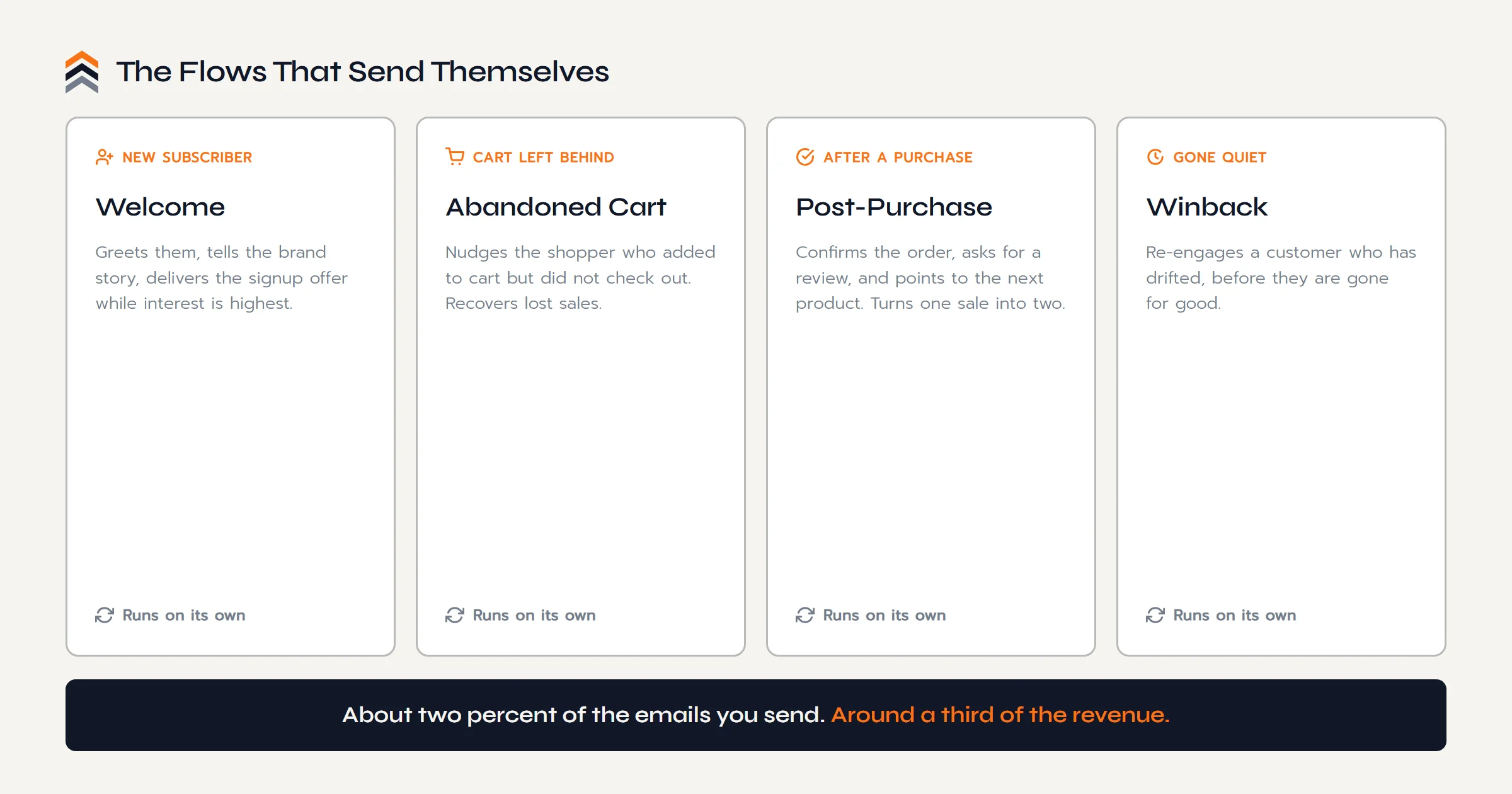
Most beginners think email marketing means blasting a promotion to the whole list. That is one half of it, and the smaller half. The quiet engine of ecommerce email is the automated flow, and the numbers are striking: Omnisend has found that automations make up only a couple of percent of the emails a store sends, yet drive around a third of all email revenue. A handful of sequences, set up once, keep selling on their own. The core flows every store should build:
- Welcome series. Greets a new subscriber, introduces the brand, and usually delivers the signup offer. It arrives when interest is highest, so it tends to earn the most per email.
- Abandoned cart. Reminds a shopper who added to cart but did not check out. It recovers a meaningful slice of sales that would otherwise be lost, which is why it is the flow most stores build first.
- Browse abandonment. Follows up when someone views products without adding anything, catching interest earlier in the journey.
- Post-purchase. Confirms the order, sets expectations, asks for a review, and gently introduces the next product. It turns a one-time buyer into a returning one.
- Winback. Re-engages customers who have gone quiet, before they drift away for good.
- Replenishment. For consumables, reminds a customer to reorder right when they are likely running low.
Campaigns bring the news; flows bring the reliability. A store with its money flows running has a salesperson working every hour without being asked.
What to Measure, and the Open-Rate Trap
It is worth being honest about metrics, because the most quoted one is now the least reliable. For years, open rate was the headline number for email. Then in 2021 Apple's Mail Privacy Protection began loading email images automatically, which marks messages as opened whether or not anyone read them. Ecommerce open rates still look healthy, around thirty percent by Klaviyo's benchmarks, but the number is inflated and no longer means what it used to.
So judge email on what reflects real behavior: click rate, conversion rate, and revenue per recipient, which is the truest measure of whether a send actually made money. Watch list growth and unsubscribe rate to keep the list healthy. Chasing opens is chasing a ghost. Chasing revenue per recipient is running a business.
The Channel You Own Starts With a Site You Own.
The Push Roadmap is a free 12 page PDF with the Ownership Scorecard. See how the owned channels, email included, fit into the whole move off Amazon, mapped in order.
Sent straight to your inbox.
The Catch for Amazon Sellers
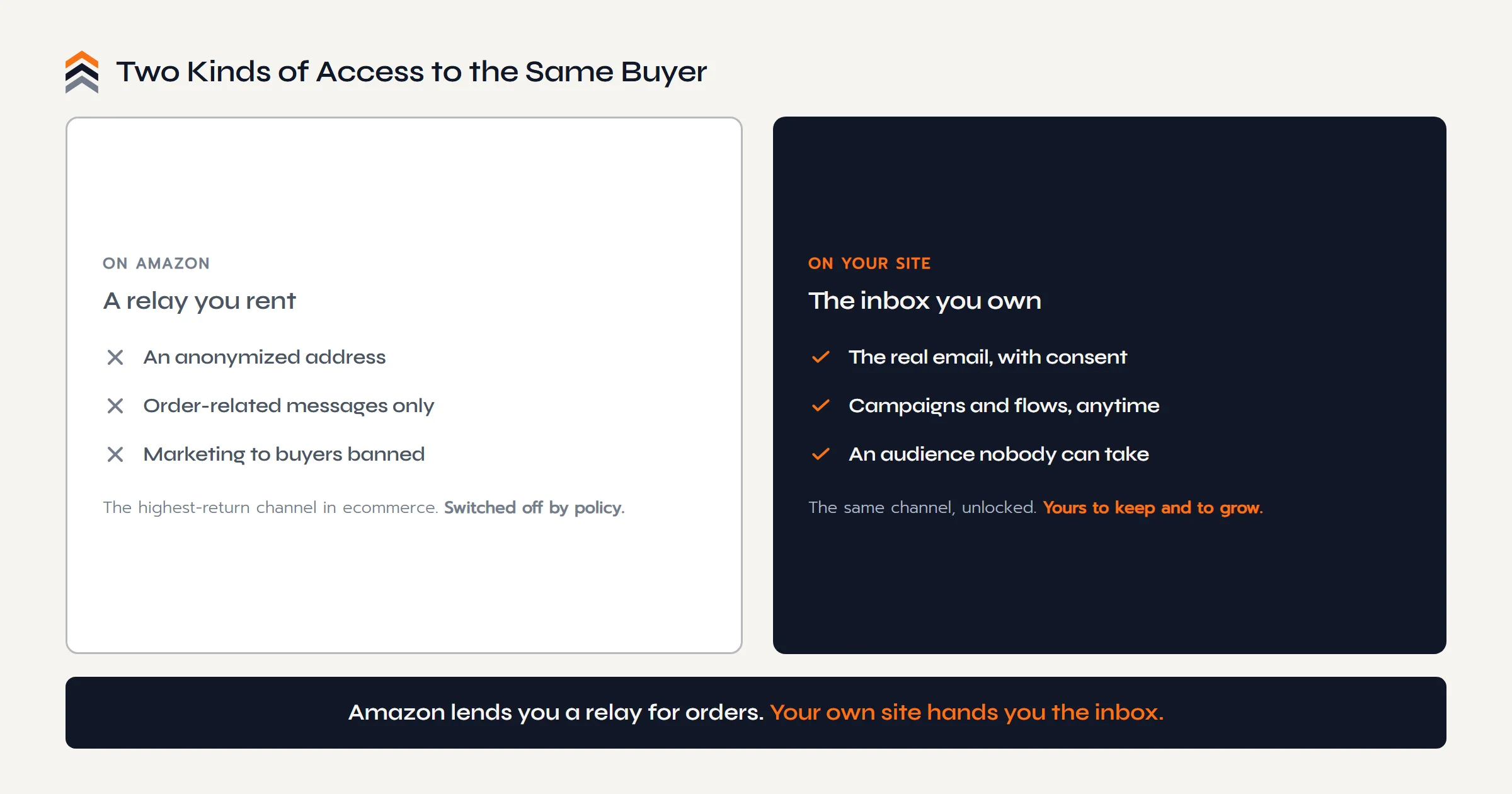
Here is where all of it lands for a seller, and it is not a matter of skill or effort. You cannot do email marketing to your Amazon customers, because Amazon does not let you. Amazon never gives the seller the buyer's real email address. All contact runs through an anonymized messaging service, permitted messages are order-related only, and Amazon's policies explicitly prohibit using buyer information to market to them or to pull shoppers off the platform. Try to work around it and you risk your selling privileges. The single highest-return channel in ecommerce is switched off for you by design.
That is not a gap you can close with a better strategy. It is structural, and it only opens when the sale happens somewhere you control. The moment a customer buys on your own site and hands you their email, with their consent, the whole channel unlocks: the welcome series, the flows, the campaigns, the repeat revenue. Every one of those emails runs on the first-party data Amazon keeps for itself, which is why building an email list of your own is one of the first things a seller does after launching a site, and part of what it means to stop depending on a single channel for everything.
An Honest Note
Email is powerful, not magic, and it is fair to be clear:
- A list only pays if you treat it well. Relevant, welcome, well-timed emails build a channel. Constant discount blasts burn it down and train people to ignore you or unsubscribe.
- But the ceiling is enormous, and it is yours. No other channel combines this return with this much control. The work is worth it precisely because no platform can take it away.
Send like a guest, not a salesman. The inbox is a privilege you keep earning.
Questions Sellers Ask
What Is Ecommerce Email Marketing?
Ecommerce email marketing is using email to drive first purchases, repeat purchases, and retention for an online store. It works in two modes: broadcast campaigns, which are one-time sends like promotions and launches, and automated flows, which are triggered sequences such as welcome and abandoned-cart emails that run on their own.
Does Email Marketing Actually Work for Ecommerce?
Yes, and it is consistently the highest-return channel. Long-running Litmus and DMA studies put email ROI at roughly $36 to $42 back for every dollar spent, higher for retail and ecommerce. For well-run stores, email and SMS can drive a large share of total revenue, often cited in the range of twenty to forty percent.
What Are the Best Types of Ecommerce Emails?
The highest-leverage emails are automated flows: a welcome series for new subscribers, an abandoned-cart flow to recover lost sales, browse abandonment, post-purchase follow-ups, winback for lapsed customers, and replenishment reminders for consumables. Welcome and abandoned-cart flows usually earn the most per send, so most stores automate those first.
What Is a Good Open Rate for Ecommerce Email?
Ecommerce open rates commonly land around thirty percent, per Klaviyo benchmarks, but open rate is no longer a reliable number. Apple Mail Privacy Protection has inflated opens since 2021 by loading images automatically. Judge performance on click rate, conversion, and revenue per recipient instead, which reflect real engagement.
How Do I Start Email Marketing for My Store?
Start by collecting emails with consent on a channel you own, usually your website, through a signup offer. Add an email platform, then build the two highest-value automated flows first: a welcome series and an abandoned-cart flow. Once those run, layer in post-purchase and winback flows, then regular campaigns.
Can Amazon Sellers Email Their Customers?
No, not for marketing. Amazon does not give sellers the buyer's real email address, routes contact through an anonymized messaging service, and prohibits using buyer information to promote anything or pull shoppers off Amazon. Email marketing only becomes possible once a seller has their own site where customers share their email directly.
The Conclusion
So, ecommerce email marketing is the highest-return channel in online retail, run through campaigns you send and flows that send themselves, on an audience that belongs to you and no one else. In a world of rented reach and rising ad costs, that combination of return and ownership is rare, and it is why email remains the backbone of serious ecommerce brands.
For an Amazon seller, the lesson is not that email is hard. It is that email is locked, and the key is a channel of your own. Build the place where customers can hand you their email, and you turn on the one growth engine no platform can ever switch off, on ground you actually own and control.
Your sales can live on Amazon. Your brand should not.
The Next Move
The Best Channel Is Waiting.
Let's Build the Place It Lives.
Ready to Build
A free call, no pitch script. Walk us through your Amazon business and get a straight answer on the owned site that would finally let you email your customers.
Book a Free CallStill Weighing It
The Push Roadmap is a free PDF with the Ownership Scorecard. Put a number on how much of your brand and your customer you actually own today.