
Brand awareness and brand recognition are not two rival ideas competing for the same job. They are a whole and one of its parts. Brand awareness is the umbrella term for how familiar people are with your brand at all. Brand recognition is one layer inside it: the aided ability to identify you when a cue appears, your logo, your name, your colors, your packaging. The distinction is worth getting right, because the deeper layers of awareness are exactly what a marketplace withholds and exactly what building a brand you actually own is designed to earn.
Here is the uncomfortable part for anyone selling on Amazon. You can post real, growing sales while your awareness of either kind sits near zero. Revenue proves the product works and the listing converts. It does not prove that a single customer knows your brand, could name it tomorrow, or would ever go looking for it. Those are different assets, and this article is about the gap between them.
Awareness, Recognition, and Recall
Three words get used interchangeably, and the confusion hides the whole point. They describe different depths of memory:
- Brand awareness. The umbrella. How familiar the market is with your brand and how readily it links your brand to a product category. Everything below is a component of it.
- Brand recognition. Aided memory. Shown a cue, the customer thinks "yes, I know them." It is the lower bar, because the prompt does the heavy lifting. They see the logo and the memory clicks into place.
- Brand recall. Unaided memory. Given only the category or the need, the customer produces your name unprompted: "I need running shoes, I will get Brand X." No cue, no list, just retrieval. This is the harder, more valuable layer.
The cleanest way to hold the two apart: recognition is "I have seen you before," and it needs the cue. Recall is "I think of you first," and it supplies the name on its own. A shopper who recognizes you will pick you off a shelf once they are already looking at you. A shopper who recalls you seeks you out before the shelf. That is the difference between being an option and being the answer, and it is why the two are never the same measurement.
The Four Levels of Brand Awareness
The most useful map of all this is the brand awareness pyramid, a framework from marketing academic David Aaker that is still the standard reference. It sorts awareness into four ascending levels, each a deeper memory than the one beneath it:
- Unaware. The base. The customer does not know the brand exists. Nothing to build on yet.
- Recognition. Aided. Prompted with your name or logo, they identify you. The first real rung above obscurity.
- Recall. Unaided. Cued only by the category, they name you from memory. Now the brand is doing work before the buying moment.
- Top of Mind. The apex. You are the first brand they name in the category, the default the others get measured against.
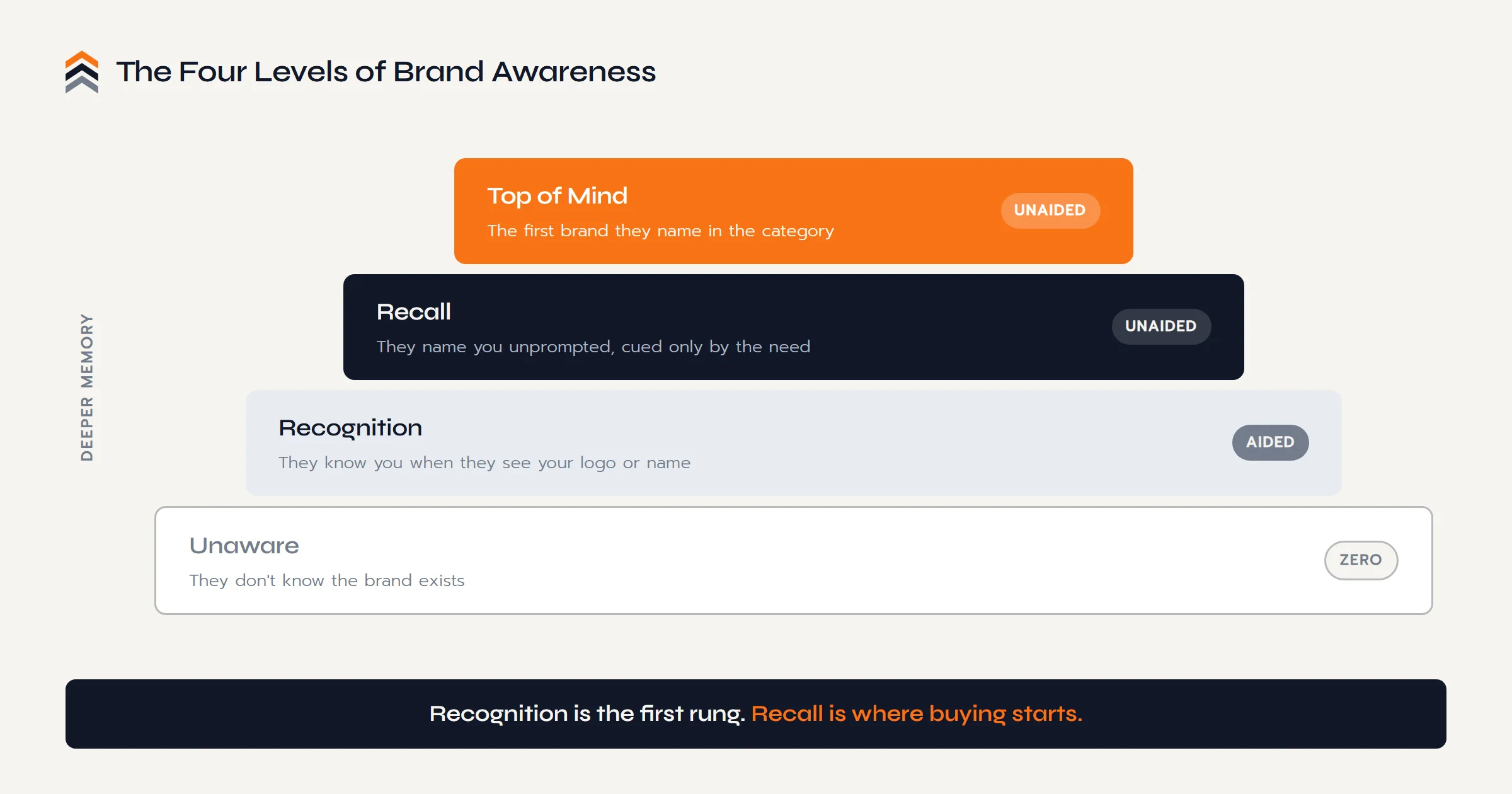
The reason the pyramid matters to a seller is direction. Recognition alone is fragile, because it only helps you when the customer is already staring at your product. That is precisely the moment Amazon controls. Recall and top of mind are the levels that pull a customer toward you on their own, through their own search, on their own initiative, and those are the levels that turn a brand into the one customers come back to on purpose. Climbing the pyramid is the whole game, and recognition is only the first step of it.
How You Measure Each
Because recognition and recall are different memories, they are measured differently, and this is where the distinction stops being academic. The formal method is survey based, and the split is exactly the aided versus unaided line:
- Recognition is measured aided. You show a list: "Which of these brands have you heard of?" Scores run high and move fast, because you are testing the easy layer.
- Recall is measured unaided. You show nothing: "Name a brand in this category." Whoever the customer produces without prompting is who genuinely owns space in their memory. This is the gold standard of awareness measurement.
Most sellers will not run formal surveys, and they do not need to. Awareness leaves behavioral fingerprints you can track directly: branded search volume (people typing your brand name into Google), direct traffic (people typing your web address), share of search against competitors, and the volume of brand mentions across the web. When those numbers climb, recall is climbing. When they are flat while sales grow, you are renting attention, not building it. The catch is that every one of those signals needs a destination you own to point at, which is where the marketplace problem starts.
Why Amazon Builds Sales, Not Awareness
Amazon is a phenomenal demand engine and a poor awareness engine, and the two facts sit side by side. The platform is built around the product and the transaction, not the brand behind them. A shopper searches a generic term, compares by price and reviews and Prime shipping, checks out through Amazon, and receives a box with Amazon's smile on it. At no point in that sequence is your brand the thing being remembered. The memory encodes the platform, not the seller.
The data backs this up bluntly. According to Marketplace Pulse, only about 22% of searches on Amazon include a brand name, meaning roughly 78% of the top search terms are generic. Shoppers look for "wireless earbuds," not for you. Amazon expert Steven Pope has observed that only a small share of shoppers can even recall the brand of their last Amazon purchase. The most telling example is Thrasio, one of the largest Amazon aggregators, which owned dozens of brands that reached millions of homes and yet remained almost entirely unknown to the people who bought them. Enormous sales, almost no awareness. The two are not the same asset.
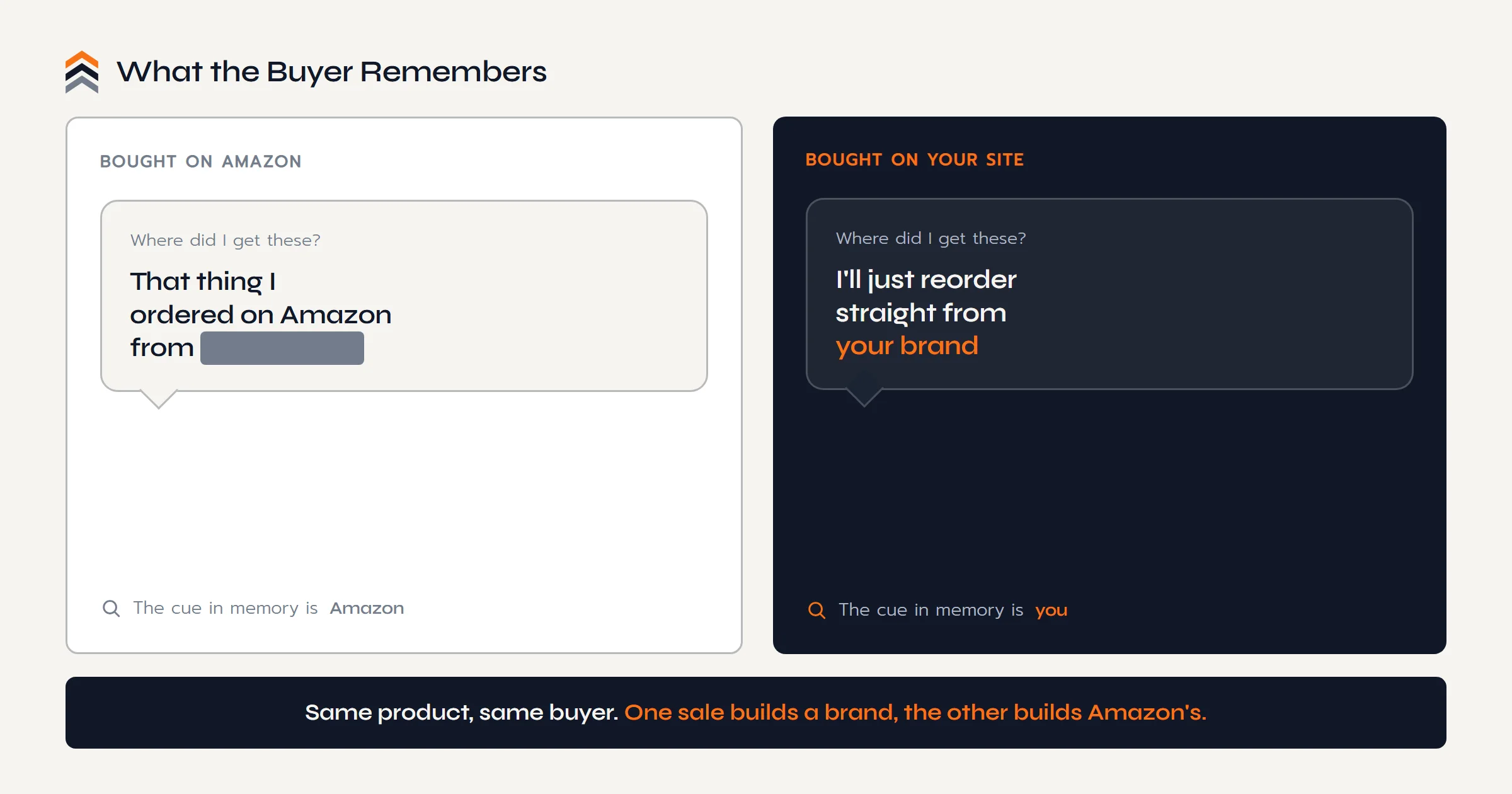
This is the honest wedge, and it is not "leave Amazon." It is that awareness and recognition are precisely the things a marketplace cannot hand you, because the marketplace keeps the customer's attention pointed at itself. To build recall, you need the pieces Amazon holds: the discovery moment, the checkout, the post purchase experience, and the customer data that tells you who actually bought. Those live on a channel you control. It is the same ceiling that caps the rest of your brand strategy, showing up again in the one metric a seller most wants to grow.
Sales You Can Count. A Brand You Can Own.
The Push Roadmap is a free 12 page PDF with the Ownership Scorecard. Put a number on how much of your brand you actually own today, and see the whole move mapped in order.
Sent straight to your inbox.
How to Turn Recognition Into Recall
Recognition and recall are built by different work, and knowing which is which keeps you from wasting effort. Recognition is a repetition game. Recall is an association game. You need the first before the second can compound.
- Build recognition with consistency. Show the same distinctive assets, logo, colors, name, type, packaging, everywhere the customer meets you, over and over. The old Rule of Seven, that someone needs to encounter a brand several times before it sticks, is a rough heuristic, not a law, but the principle holds: repetition is how the brain files you. Marketing research on brand consistency has linked keeping presentation uniform across channels to revenue lifts of up to roughly 23%, per the widely cited Marq brand consistency study. Consistency is not vanity; it is memory.
- Build recall with association. Recognition only becomes recall when your brand gets wired to a buying trigger, the moment a customer feels the need. You earn that by attaching your distinctive assets to the situations people actually buy in, and by telling a story that gives the brand something to stand for beyond the product spec. A brand tied to a clear reason and a clear moment is the one that surfaces unprompted.
- Give both a channel you own. Repetition and association need surfaces you control to happen on. A listing gives you neither. A website of your own lets you own the look, the post purchase moment, and the address customers can type from memory, so the awareness you build lands somewhere it accrues to you.
The order is the point. Repetition builds recognition, association turns recognition into recall, and a channel you own is what lets either one compound instead of evaporating into Amazon's traffic. If you are weighing how much of your brand still lives on rented ground, the case for reducing that dependence lays out what changes when the memory finally points at you.
An Honest Note
Two things are true at once:
- Amazon sales are real. The revenue is not an illusion, and building awareness does not mean turning the marketplace off. It is the best demand engine in retail.
- Sales are not awareness. Volume on a platform that keeps the attention is not the same as a brand people know, recall, and seek. One is income. The other is equity.
Keep the sales. Build the awareness somewhere it belongs to you.
Questions Brand Owners Ask
What Is the Difference Between Brand Awareness and Brand Recognition?
Brand awareness is the umbrella term for how familiar people are with your brand overall. Brand recognition is one part of it, the ability to identify your brand when shown a cue like your logo, name, or colors. Awareness is the whole ladder; recognition is the aided, "I have seen you" rung near the bottom.
What Comes First, Brand Awareness or Brand Recognition?
Recognition comes first within awareness. On the brand awareness pyramid, people move from unaware, to recognition when prompted, to recall without prompts, to top of mind. Recognition is the entry rung and awareness is the whole ladder, so building recognition is how awareness begins to compound.
Is Brand Recognition the Same as Brand Recall?
No. Brand recognition is aided, a shopper identifies your brand when they see a cue like your packaging or logo. Brand recall is unaided, they name your brand from memory with no prompt, cued only by the category or need. Recall is harder and more valuable, because it means you surface at the buying moment.
What Are the Four Levels of Brand Awareness?
From David Aaker's pyramid, the four levels are: unaware of the brand, brand recognition when prompted, brand recall without a prompt, and top of mind, the first brand named in its category. Each level is a deeper memory and a stronger pull on the buying decision than the one below it.
How Do You Measure Brand Awareness?
Surveys are the gold standard: aided questions ("which of these have you heard of?") measure recognition, and unaided questions ("name a brand in this category") measure recall and top of mind. Behavioral proxies you can track yourself include branded search volume, direct website traffic, share of search, and brand mentions.
How Do You Build Brand Recognition?
You build recognition through repetition and consistency. Show the same distinctive assets, your logo, colors, name, type, and packaging, everywhere a customer meets you, again and again. Consistent presentation across channels trains the brain to identify you instantly, which is the foundation deeper recall and loyalty are built on later.
Can You Have Sales Without Brand Awareness?
Yes, and it is common on marketplaces like Amazon. Sellers move real volume while shoppers remember "the thing I bought on Amazon," not the brand. Only about 22% of Amazon searches include a brand name. Sales prove the product works; they do not prove anyone knows, recalls, or would seek out your brand.
The Conclusion
Brand awareness and brand recognition are not interchangeable, and the difference is not pedantry. Recognition is the aided rung where a customer knows you once they see you. Awareness is the whole ladder, and its valuable heights, recall and top of mind, are where a customer chooses you before they see anyone. A business can climb the sales chart without climbing that ladder at all, which is the exact position most Amazon sellers are in without realizing it.
So treat awareness as a thing you build on purpose, not a byproduct of volume. Be relentlessly consistent so people recognize you. Give the brand a reason and a moment so they recall you. And point all of it at a channel you own, so the memory you are paying to create ends up filed under your name and not the platform's. Sales you can count. A brand people know is worth more.
Your sales can live on Amazon. Your brand should not.
The Next Move
Real Sales Already.
Now Build a Brand People Know.
Ready to Build
A free call, no pitch script. Walk us through your Amazon business and get a straight answer on what your own brand site would take.
Book a Free CallStill Weighing It
The Push Roadmap is a free PDF with the Ownership Scorecard. Put a number on how much of your brand you actually own today.