
To start an ecommerce business, you make five decisions in order: what you sell and to whom, your business model, where you sell, how you build the store, and how you turn one-time buyers into a brand people come back to. The mechanics are easier than they have ever been. The part that decides whether you build a business or just a busy hobby is a question most guides skip: how much of it you actually own. That is the thread we will pull, because it is the same question that runs through the whole idea of owning a brand rather than renting a presence.
One note on scope before we start, so you know what you are getting. This is the strategy layer: the handful of decisions that determine whether what you start becomes a durable asset or just a run of sales. It does not walk through the operational setup, the business registration, sales tax, payment gateways, shipping and fulfilment. That work is real and you will do it, but it follows these decisions rather than driving them, and the parts that vary by state and change year to year are better taken to an accountant than to any article.
The build itself, step by step, has its own piece in how to start an online store. Read this one first to decide what you are building and why, then go there to put it up.
What Starting an Ecommerce Business Really Takes
Let us clear the myths first, in both directions. Starting is not as expensive or technical as it once was; you do not need a warehouse, a developer team, or venture funding to sell your first product. But it is also not the passive, no-effort machine the ads promise. A real ecommerce business needs a product people want, a way to reach them, and a reason for them to come back. Everything below serves those three things.
The honest framing is this: the tools are cheap and the barrier is low, which means the tools are not your advantage. Your advantage is what you build that competitors cannot copy in an afternoon, a product, an audience, and a brand that people choose on purpose. Keep that in mind as we go, because it is what separates the five steps that follow from a checklist you could find anywhere.
Step 1: Decide What You Sell, and to Whom
Every ecommerce business starts with a product and a person. Not a clever store, not a logo, a thing you sell and the specific someone who wants it. The most common early mistake is falling in love with a product and never defining the buyer, or chasing a trending product with no view on who keeps buying it once the trend cools.
Work both sides at once. Look for a product where you can add real value, through quality, design, a niche, or a story, not just a lower price, because competing on price alone is a race you win by losing margin. Then get specific about the buyer: who they are, what problem the product solves, and where they already spend attention. A tight answer here makes every later decision easier, from the platform to the marketing.
Step 2: Pick Your Business Model
How you get products to customers shapes your margin, your risk, and how much of the business is truly yours. The main models, briefly and honestly:
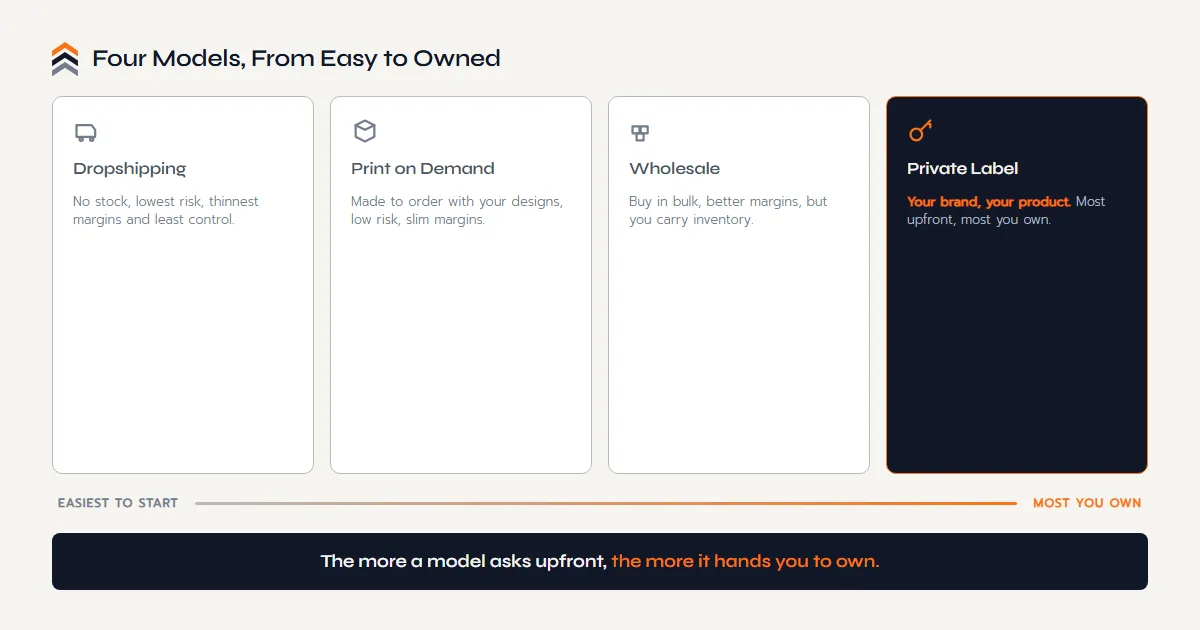
- Dropshipping. A supplier ships to your customer; you never hold stock. Lowest upfront cost and lowest risk, but also the thinnest margins and the least control over quality and shipping. Easy to start, hard to build a brand on.
- Print on demand. Products made to order with your designs. Low risk, no inventory, and a real chance to build a brand on your creative, though margins are slim and production is out of your hands.
- Wholesale and reselling. Buy stock in bulk and resell it. Better margins than dropshipping, but you carry inventory and you are often one of many selling the same thing.
- Private label and own brand. You put your brand on a product you control, even if a partner manufactures it. The most upfront work and the most ownership. This is the model most likely to become an asset, and it maps closely to the path many Amazon private-label sellers already walk.
There is no single right answer, only the right trade for your goal. But notice the pattern: the models that ask more upfront tend to hand you more to own. If the aim is a business worth something in three years, weigh ownership as heavily as ease.
Step 3: Choose Where You Sell
This is the decision most founders make by default, and it is the one that quietly determines your ceiling. You have three broad options: sell on a marketplace like Amazon or Etsy, sell on your own website, or do both. Each hands you something and keeps something.
A marketplace gives you immediate access to millions of buyers, which is genuinely valuable when you are starting with no audience. What it keeps is the relationship: the customer, their data, the pricing power, and the brand all belong to the platform, not to you. Your own website flips that, you get the customer, the margin, and the brand, but you have to bring the traffic yourself. Neither is a trap and neither is a silver bullet; the mistake is treating the marketplace as the whole business. The honest comparison, laid out fully, is in selling on Amazon versus your own website.
Sell where the buyers already are. But build the place that is yours from the very start.
Our view, from doing this for a living, is that the strongest starting position is both, in order: use a marketplace for reach while you build the website you own beside it. That way the marketplace funds the business and the site becomes the asset. Leaving the owned site for "later" is the most expensive delay in ecommerce, because you spend years building a customer base that stays with the platform.
Building Toward a Brand You Own?
The Push Roadmap is a free 12 page PDF that maps the move from renting sales to owning a brand, with the Ownership Scorecard to show where you stand.
Sent straight to your inbox.
Step 4: Build the Store
With the product, model, and channel decided, you build the storefront. This is where an ecommerce business becomes real: the pages, the product listings, the cart, the checkout, and the payment setup. We will not repeat the full walkthrough here, because it has its own guide in how to start an online store, but two decisions from this step matter at the business level.
First, the platform. The tool you build on decides how much you own and how far you can grow, and the options for a small business are laid out in ecommerce platforms for small business. Second, the principle: build on software you own rather than rent wherever you reasonably can, so the store is an asset with your name on the files, not a subscription you never stop paying. Get those two right and the rest of the build is execution.
Step 5: Build the Brand, Then Launch
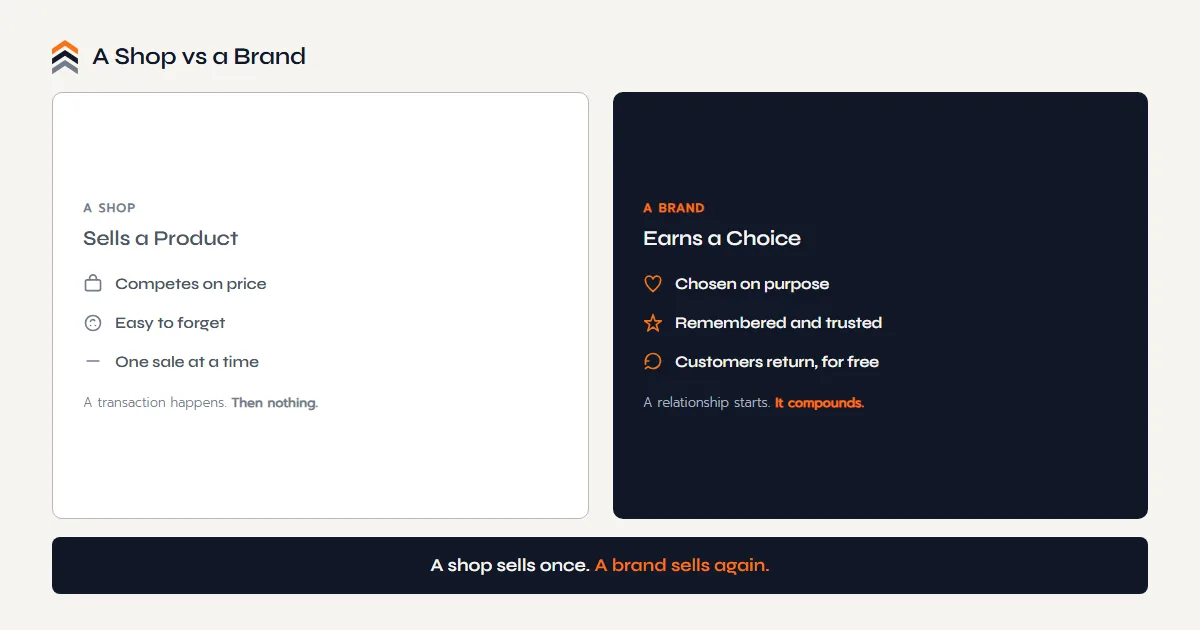
A store that sells a product is a shop. A store people remember, return to, and recommend is a brand, and the difference is worth more than any single sale. This is the step that turns a transaction into a business: a clear identity, a reason to choose you beyond price, and a way to reach past customers directly instead of paying to find them again.
Practically, that means capturing an email list from day one so you own a line to your customers, telling a story that makes the brand specific, and earning demand from search and content over time so buyers find you without an ad meter running. Those are the assets that compound, and they are the same ones covered across our work on brand strategy and owning your customer data. Then you launch, not as a finish line, but as the start of the part that actually builds equity.
Questions Founders Ask
How Much Does It Cost to Start an Ecommerce Business?
Less than most people fear, more than the no-money promises suggest. Your real costs are inventory or sourcing, a domain and hosting or a platform fee, and the store build itself. You can start lean and reinvest, but treat the website as an asset worth building well. As of 2026, verify current platform and supplier pricing.
Is an Ecommerce Business Profitable?
It can be, but profit comes from margin and repeat customers, not just sales. The businesses that last own their customer relationship and sell to the same people again, instead of paying for every new buyer. If you only ever rent traffic from a marketplace or ads, margin stays thin no matter the revenue.
Do I Need an LLC to Start an Ecommerce Business?
Not to make your first sale, but most founders form one before scaling for liability protection and cleaner finances. Rules and tax treatment vary by country and state and they change, so as of 2026, treat this as a prompt to confirm with an accountant or attorney in your jurisdiction rather than settled advice.
What Is the Easiest Ecommerce Business to Start?
The easiest to launch is reselling or dropshipping, because you hold no stock. The easiest to build into something you own is a branded product line you control, even a small one. Easy to start and easy to keep are different tests, and the second one is what decides whether you have a business or a side hustle.
Should I Sell on Amazon or on My Own Website?
Ideally both, in the right order. A marketplace like Amazon gives you fast access to buyers, which is real. Your own website gives you the customer, the margin, and the brand, which a marketplace never hands over. The strongest position is selling on Amazon while building the site you own beside it.
Can You Start an Ecommerce Business With No Money?
Almost none is possible with a model like print on demand or dropshipping, where you pay a supplier only after a sale. But "no money" usually means trading cash for time and thin margins. A small budget aimed at a proper store and a product you control tends to build something worth more, faster.
The Conclusion
Starting an ecommerce business has never been more accessible, and that is exactly why the tools are not the point. The five decisions, what you sell, your model, where you sell, how you build, and how you brand it, all bend toward one question: at the end of the day, what do you actually own? Get the sales anywhere you can. Build the asset deliberately.
If you are coming to this from Amazon, you are further along than most; you already have the hardest part, a product with proven demand. The move left is to give those sales somewhere to compound, on ground that is yours.
Your sales can live on Amazon. Your brand should not.
The Next Move
You Have the Plan.
Now Build the Part You Own.
Ready to Build
A free call, no pitch script. Tell us about your product and your plans, and get a straight answer on the owned site that would fit them.
Book a Free CallStill Weighing It
The Push Roadmap is a free PDF with the Ownership Scorecard. See the whole move from renting sales to owning a brand, mapped in order.